SECURITY Signal 75
Netflix reports 58% Flink compute savings as it moves 30,000+ jobs to open-source autoscaler
 ↗
↗
Netflix is migrating its 30,000+ Flink streaming jobs to the open-source Apache Flink Autoscaler, reporting a 58% cut in annualized compute costs.
For engineers running stateful Flink pipelines, this signals that operator-level autoscaling based on true processing rate is production-ready, not just a research idea. Netflix's reported 58% cost reduction and $1.1M annual savings show the potential impact. The migration also highlights practical issues like forward connection handling and sink backpressure that need attention.
Written by elseif from the cluster below · every claim links back to a sourceThe three things worth knowing
Netflix's cluster-level autoscaler scaled all operators together, which was ineffective for complex stateful pipelines with branches and joins.
The open-source Flink Autoscaler estimates each operator's true processing rate from throughput and busy time, then adjusts parallelism per vertex.
Netflix uses a 0.45 utilization target (below Flink's 0.7 default) to reduce aggressive rescaling, and plans to migrate all remaining internal autoscaling to the open-source implementation.
THE READ
What the cluster adds up to.
Netflix is moving from its custom cluster-level autoscaler to the open-source Apache Flink Autoscaler for over 30,000 streaming jobs. The old system scaled all operators in a job together based on cluster telemetry, which was inefficient for stateful pipelines with branches and joins. The new autoscaler uses per-operator metrics to estimate true processing rate and adjusts parallelism for individual vertices. This is a shift from coarse-grained to fine-grained scaling.
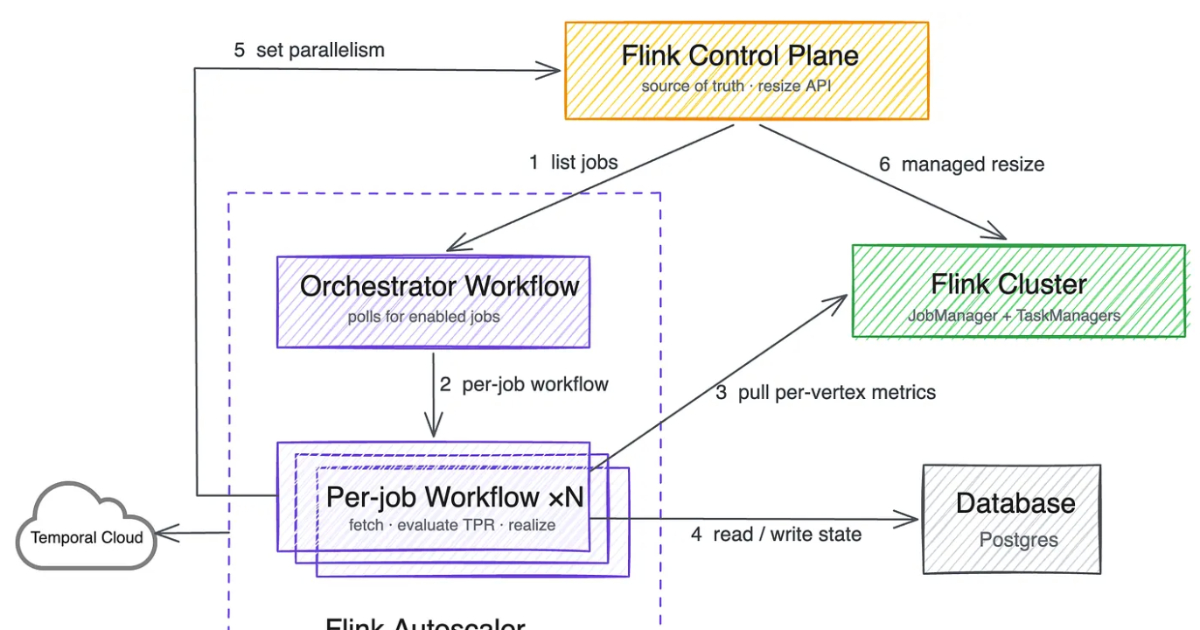
Adopting the open-source autoscaler required significant integration work. Netflix integrated it with its internal control plane using a Spring Boot service and Temporal workflows, rather than deploying via the Flink Kubernetes Operator. They modified JobManager metric collection to support up to 3,000 subtasks and added server-side metric filtering. They also had to handle forward connected subgraphs and sink backpressure, which are not trivial to implement.
The reported benefits are substantial: one team reduced annualized Flink compute expenditure by 58%, saving about $1.1 million annually. Netflix uses a 0.45 utilization target, lower than Flink's 0.7 default, to avoid aggressive rescaling of large stateful jobs. The approach builds on research from the DS2 project and is described in FLIP-271. This suggests the open-source autoscaler is mature enough for production use.
The autoscaler has known limitations. The forward connection issue is a problem: changing parallelism across a FORWARD connection can require redistribution, and Netflix keeps forward connected operators together. An open FLINK-38538 issue highlights cases where busy operators can be affected by output ratio-based scaling decisions. Also, state recovery during rescaling is costly, and Netflix is investigating Flink 2's disaggregated state architecture to address that. So the autoscaler works well for many cases but has edge cases that need attention.
Written by elseif from the cluster below · checked for specifics the sources never containedTHE CLUSTER