AI Signal 594
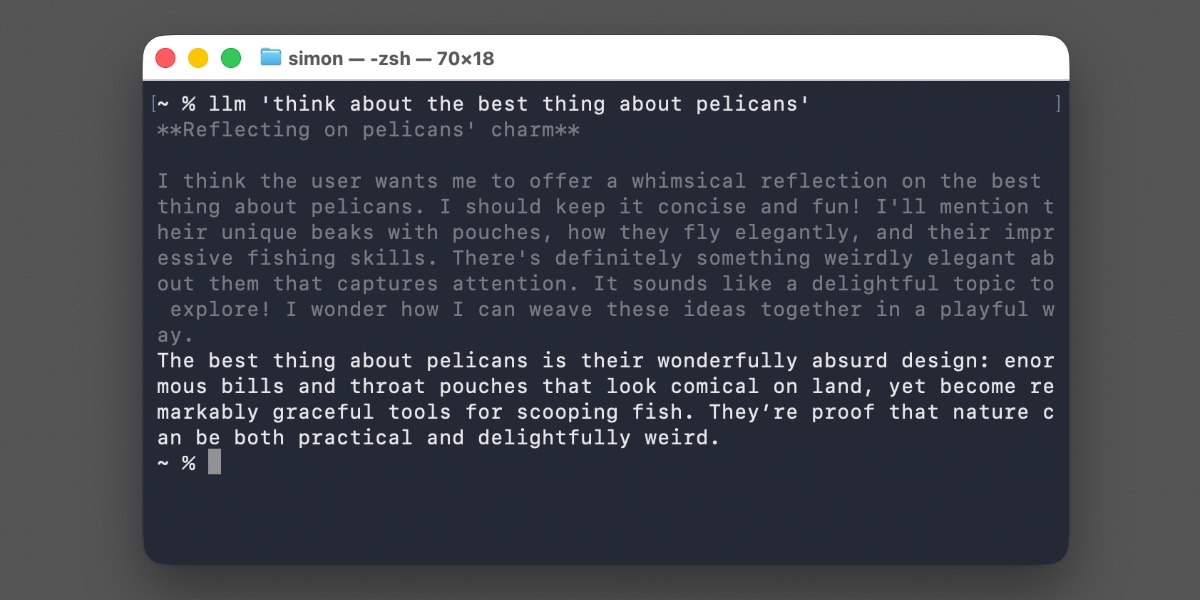
New release of LLM adds support for reasoning traces, OpenAI Responses, server-side tools, and smarter logging
 ↗
↗
The LLM release adds visible reasoning traces, OpenAI Responses integration, server-side tool execution, and a content-addressable logging system while updating its Python API to accept full message lists and stream events.
Engineers can now inspect a model’s internal reasoning without contaminating piped output, simplifying debugging and prompt iteration. The new tool and logging designs let workflows run code or fetch data directly from the model call and avoid storing duplicate message histories, reducing storage overhead and simplifying log processing.
Written by elseif from the cluster below · every claim links back to a sourceThe three things worth knowing
Reasoning traces are streamed to stderr and can be toggled with -R/--hide-reasoning.
Server-side tools such as OpenAI’s CodeInterpreter and WebSearch are callable via the LLM CLI, enabling execution of code or live look-ups inside a prompt.
The Python API now accepts a messages list and returns an event stream, letting applications handle reasoning, text, tool calls, and other outputs separately.
THE READ
What elseif makes of it.
The release changes how LLM presents model internals by sending reasoning traces to a separate error stream, making them visible without mixing into standard output. It also introduces first-class support for server-side tools provided by model providers, allowing a prompt to trigger code execution or live web look-ups as part of the same call. Logging has been rebuilt around a content-addressable store that deduplicates message history, and the llm logs commands now to translate that store back into a readable format.
Adopting these features requires updating any custom scripts or tooling that previously parsed LLM’s standard output or relied on the old iterable string return from the Python API. Users must install or update provider-specific plugins (e.g., llm-anthropic, llm-gemini) to access the new tools, and they need to adjust logging consumers to understand the new schema. The Python API shift from a conversation-building pattern to a direct model.prompt(messages=[]) call means existing code that built conversations incrementally will need refactoring to use the new parameter and event-stream handling.
The new capabilities stop working when the execution environment lacks access to the provider’s server-side tools, such as when network policies block calls to OpenAI’s CodeInterpreter or WebSearch endpoints. If a user disables reasoning traces via the -R/--hide-reasoning flag, the visibility benefit is lost. Finally, any downstream process that expects the legacy log format or the old string-only output from model.prompt will break until it is updated to handle the event-stream model and content-addressable log retrieval.
Written by elseif from the cluster below · checked for specifics the sources never containedTHE CLUSTER