INFRA Signal 385
Nvidia reportedly testing lower memory configs of Rubin Ultra as memory shortage bites back — designs tested include as little as 192 GB and step back to HBM4
 ↗
↗
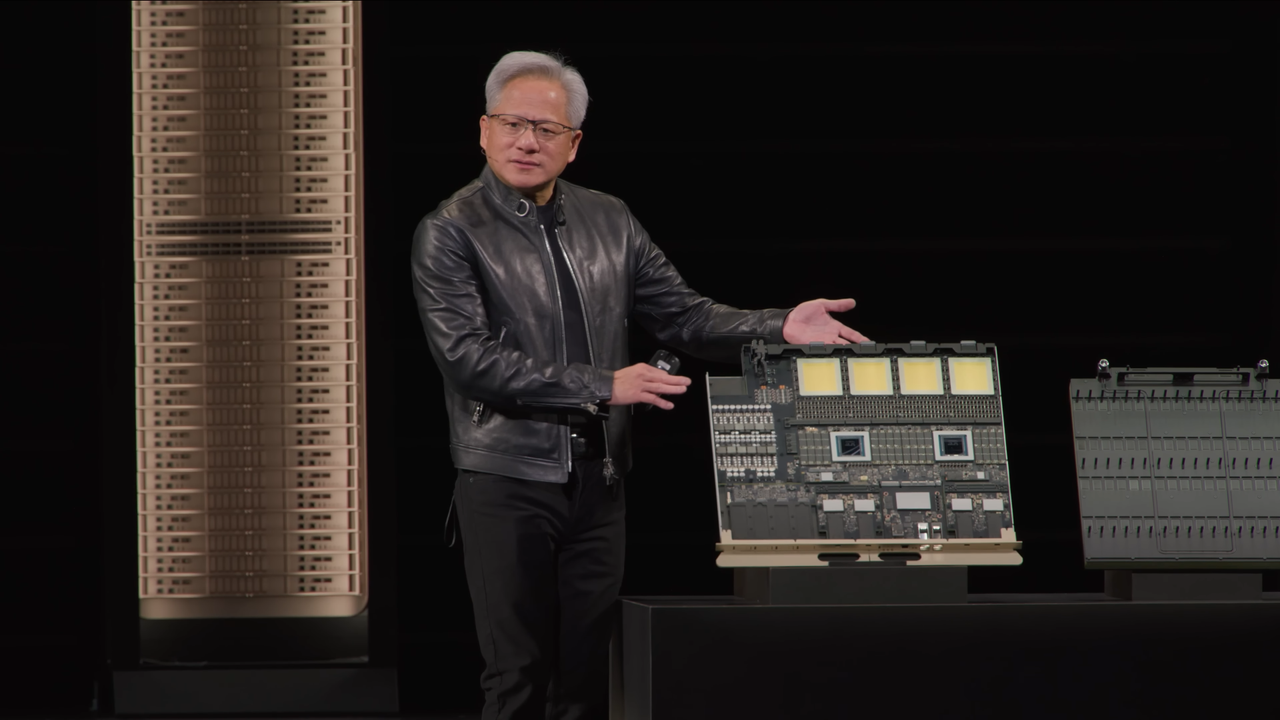
Nvidia is evaluating Rubin Ultra accelerators with far smaller memory capacities, using HBM4 instead of the originally announced HBM4E.
A shortage of high-bandwidth memory is pushing Nvidia to offer Rubin Ultra GPUs with as little as 192 GB of memory, far below the 1 TB initially promised. This reduction directly limits the size of AI models or data batches that can reside on a single accelerator, forcing engineers to redesign workloads or add more hardware to achieve the same performance.
Written by elseif from the cluster below · every claim links back to a sourceThe three things worth knowing
Rubin Ultra prototypes are being tested with memory sizes as low as 192 GB, a drastic cut from the 1 TB figure previously disclosed.
The test chips employ standard HBM4 rather than the higher-density, customizable HBM4E, indicating a shift driven by supply constraints.
Fewer memory stacks and a possible move to fewer compute dies suggest a redesign that will constrain per-GPU memory-intensive workloads.
THE READ
What the cluster adds up to.
Nvidia’s latest testing shows a clear departure from the original Rubin Ultra specification, which featured a full terabyte of HBM4E. The company is now looking at configurations with 192 GB or 256 GB of memory and is reverting to the older HBM4 technology. This change is attributed to an industry-wide shortage of the newer HBM4E chips, which manufacturers have struggled to produce in sufficient quantities.
For engineers building AI pipelines, the immediate impact is a reduction in the amount of data that can be held on-chip. Models that previously fit comfortably within a terabyte of high-bandwidth memory will need to be partitioned across multiple GPUs or rely on slower host memory, potentially increasing latency. Batch sizes may also need to be trimmed, which can affect throughput and training efficiency.
Adopting the lower-memory Rubin Ultra does not introduce new hardware costs beyond the price of the accelerator itself, but it does impose software-level expenses. Teams will likely have to invest effort in model parallelism, checkpointing, or redesigning data pipelines to stay within the tighter memory envelope. The trade-off is a possible increase in the number of GPUs required to achieve the same workload scale, affecting both capital and operational expenditures.
The reduced memory capacity creates a hard limit for workloads that demand more than roughly 256 GB per accelerator. Applications that rely on large in-memory datasets, such as massive transformer models or high-resolution simulations, will either need to be split across additional hardware or may become infeasible on this platform. Moreover, any benefits tied to HBM4E’s customizable base logic die will be unavailable, potentially affecting performance optimizations that depend on that feature.
While Nvidia has affirmed that its overall roadmap remains unchanged, the exact timing and final specifications of the Rubin Ultra remain uncertain. Engineers should monitor forthcoming announcements to confirm whether the dual-die or other design adjustments become the production standard. Planning for flexibility in memory usage will be essential to accommodate whatever final configuration is released.
Written by elseif from the cluster below · checked for specifics the sources never containedTHE CLUSTER