LANGUAGES Signal 402
On building scalable control planes
 ↗
↗
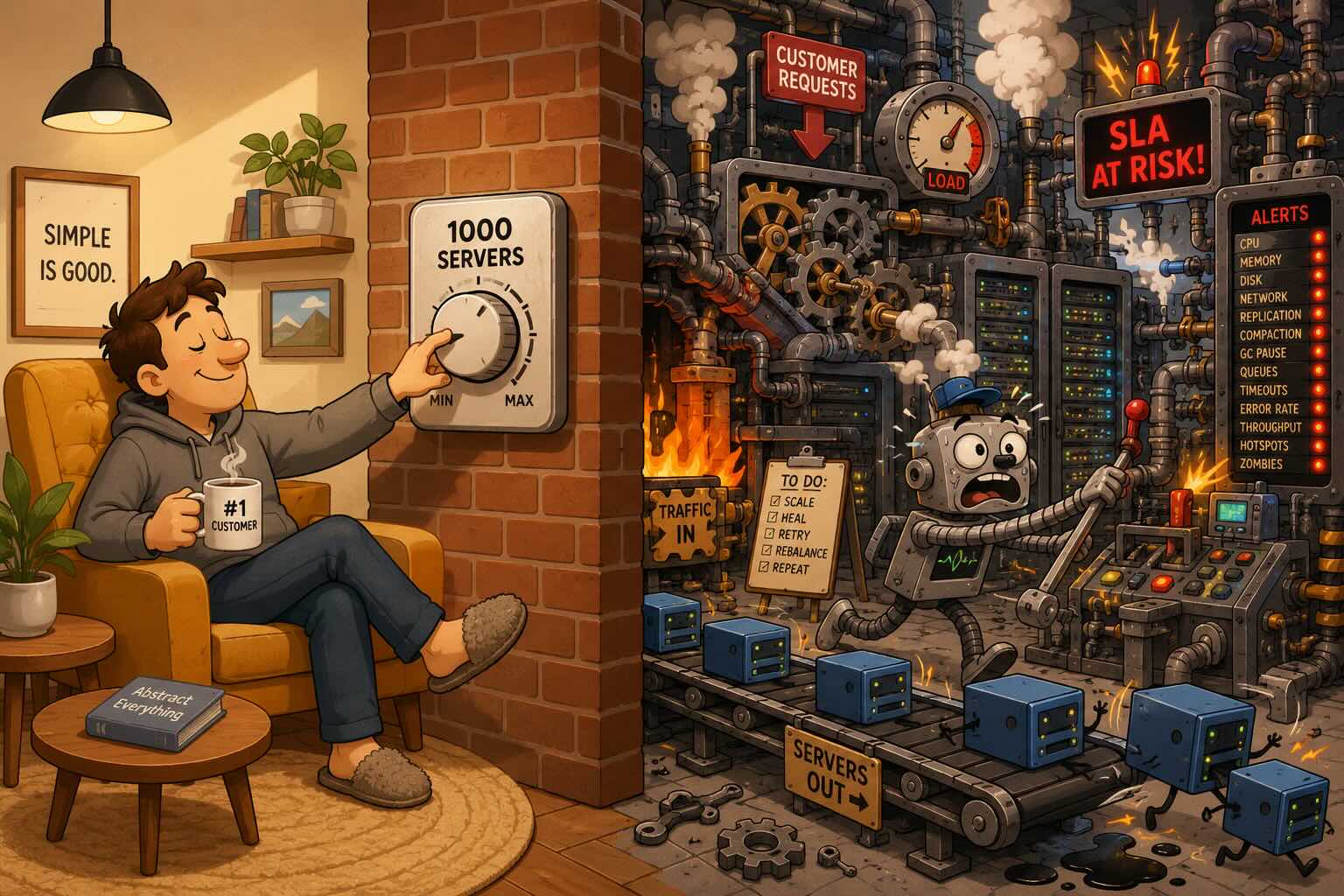
Control planes act as the bookkeeping layer that continuously reconciles desired and actual infrastructure state, enabling services to hide hardware failures and scale.
For engineers, a well-designed control plane removes the need for manual intervention on each server, turning frequent failures into routine background work. Building one requires investing in distributed-system patterns that can tolerate constant component loss, but the payoff is a service that can grow without operational bottlenecks. The approach is most valuable for large-scale services; smaller deployments may not justify the added complexity.
Written by elseif from the cluster below · every claim links back to a sourceThe three things worth knowing
Control planes separate the logical view presented to customers from the raw hardware and networking that form the data plane.
At massive scale, failures become a statistical certainty, so the control plane must automate health checking and state reconciliation to keep the service running.
Design lessons learned from EC2’s control plane were directly applied to the newer DSQL service, showing that core principles can be reused across different AWS products.
THE READ
What the cluster adds up to.
The article explains that a control plane is the layer that records what should exist in a system and continuously checks that against what actually exists, effectively translating physical resources into a consumable service interface. This contrasts with the data plane, which consists of the raw compute, storage, and networking resources. For engineers, this distinction clarifies where to place logic that manages state versus where to place the workload itself.
Operating at the scale of a global cloud provider means hardware components fail constantly, turning failure handling into a routine statistical event rather than an exceptional case. The control plane must therefore be built to automatically detect, classify, and remediate these failures without human involvement. This requirement pushes engineers toward robust health-checking, distributed consensus, and eventual-consistency mechanisms.
The author’s experience shows that insights gained from building the EC2 control plane were later reused when designing the control plane for DSQL, a newer database service. This reuse demonstrates that core control-plane patterns, such as state reconciliation loops and failure-tolerant design, are transferable across services. Engineers can therefore leverage proven architectures rather than reinventing the wheel for each new product.
Adopting a control-plane approach entails allocating engineering effort to build and maintain the automation that keeps the system in sync, which can be a significant upfront cost. However, once in place, the system requires far less manual operational overhead, allowing teams to focus on feature development. The model stops being cost-effective when the environment is small enough that manual oversight is cheaper than the engineering investment.
Finally, the narrative underscores that control planes are often invisible to end users; their success is measured by the lack of incidents rather than visible features. For engineers, this means success criteria shift toward reliability metrics, latency of state convergence, and resilience under load. Understanding this hidden layer is essential when designing services that must survive rapid growth.
Written by elseif from the cluster below · checked for specifics the sources never containedTHE CLUSTER