AI Signal 100
OpenAI's GPT-Live architecture isolates live media path from async application logic
 ↗
↗
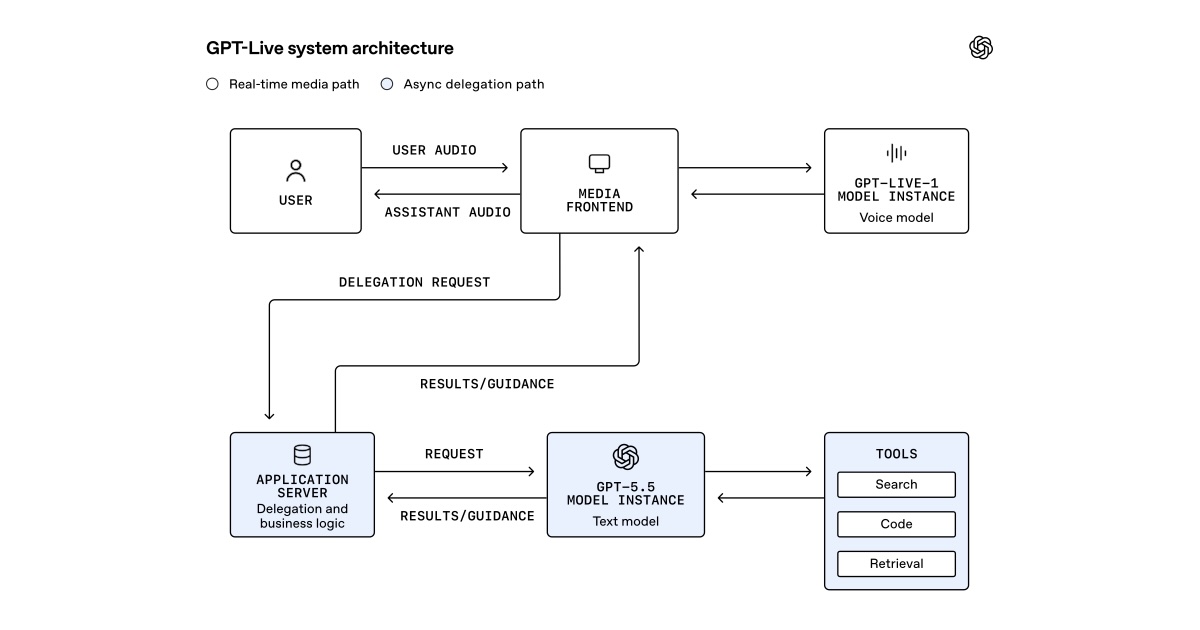
OpenAI published an engineering account of GPT-Live, describing how it separates the latency-critical media pipeline and inference loop from application logic via an asynchronous RPC boundary, and uses stateful inference with session migration.
For engineers building real-time voice AI, the key takeaway is that GPT-Live keeps the live path minimal, only media and inference, while moving delegation, tool use, and persistence behind an async boundary. This allows optimization of the critical path in isolation and enables session migration for capacity management. The choice to extend WebRTC with WARP and Instant Connect rather than switch transports highlights the trade-off between proven media stack and newer protocols.
Written by elseif from the cluster below · every claim links back to a sourceThe three things worth knowing
GPT-Live's live path contains only the media pipeline and inference loop; all other application logic runs behind an asynchronous RPC boundary.
Each session reserves capacity on a dedicated stateful inference instance, and context can migrate to another instance during draining or context-limit events.
OpenAI retained WebRTC and added WARP and Instant Connect to reduce startup latency, citing missing features in RTP over QUIC like GCC congestion control.
THE CLUSTER