AI Signal 391
OpenAI will no longer limit how many texts free accounts can send to ChatGPT
 ↗
↗
OpenAI removes text-prompt rate limits for free ChatGPT accounts while keeping restrictions on other features.
Engineers testing or integrating ChatGPT into workflows can now run unlimited text-based queries without hitting rate caps. This lowers the barrier for prototyping, debugging, or lightweight automation but does not extend to multimodal or high-demand use cases. The change signals OpenAI’s confidence in scaling inference efficiency, which may influence cost models for API consumers.
Written by elseif from the cluster below · every claim links back to a sourceThe three things worth knowing
Free and Go-tier users face no rate limits for text-only prompts but remain capped on image generation, voice mode, and file uploads.
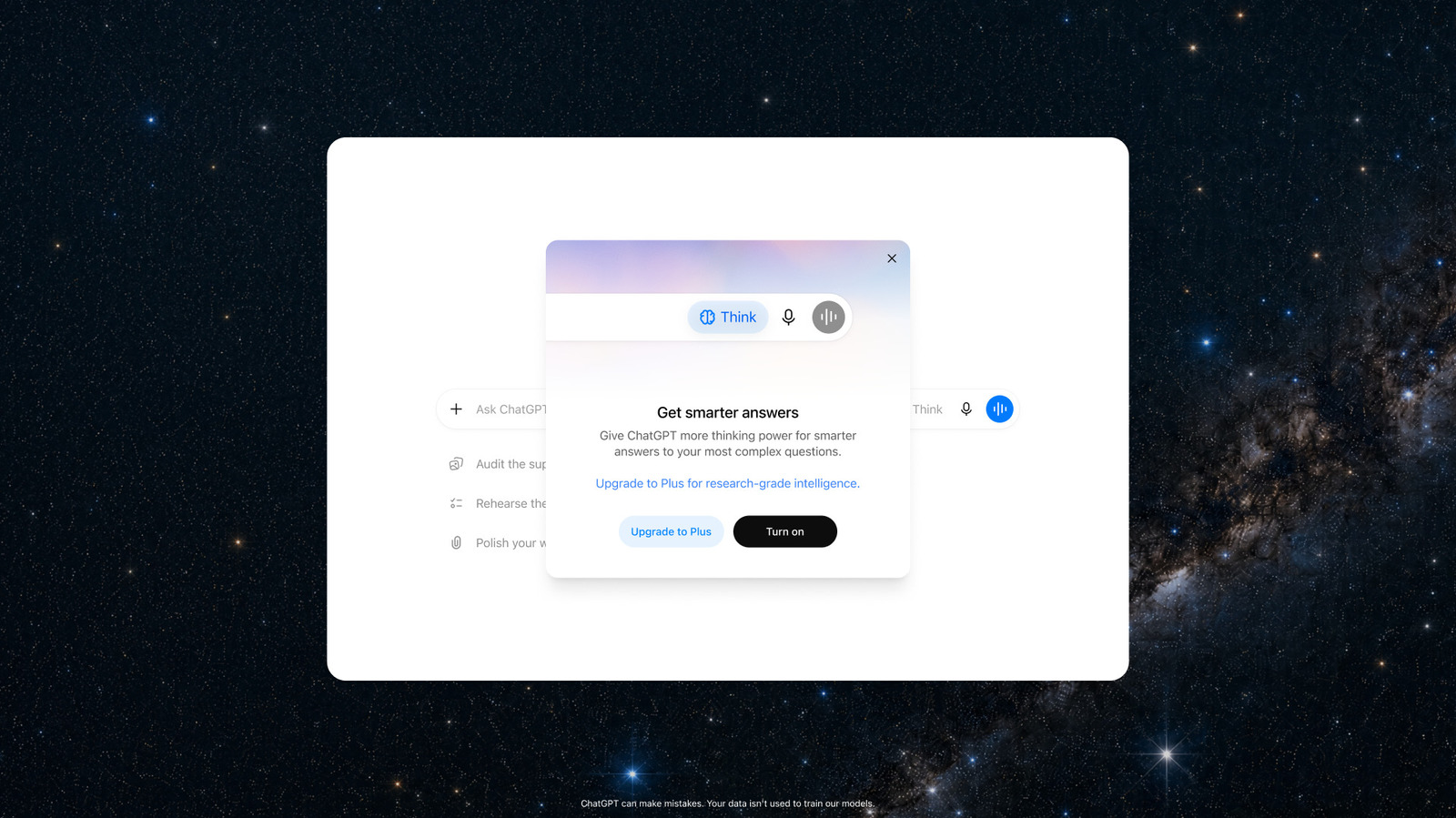
GPT-5.6 Luna replaces GPT-5.5 Instant as the default model for free accounts, with a new 'Think' button for deeper responses.
Paid tiers receive optimizations for conversational clarity and a slider to control response depth, but no removal of rate limits.
THE READ
What the cluster adds up to.
OpenAI’s decision to lift text-prompt rate limits for free accounts shifts the constraint from usage volume to feature access. For engineers, this means uninterrupted text-based interactions, useful for iterative testing, documentation generation, or brainstorming, without the friction of hitting a cap. However, the limits persist for multimodal inputs, which may still disrupt workflows requiring image analysis, voice synthesis, or file processing. The change effectively partitions ChatGPT’s utility: text becomes a loss leader, while richer interactions remain gated behind paid tiers or usage quotas.
The underlying implication is a reduction in inference costs, though OpenAI has not disclosed specifics. If the company has achieved meaningful efficiency gains, this could translate to lower operational overhead for API consumers or more aggressive pricing for bulk usage. For now, the benefit is confined to free-tier users, but the precedent suggests future optimizations might extend to paid plans. Engineers should note that while text prompts are now unlimited, combining them with other features (e.g., file uploads) still triggers separate limits, so workflows must be designed accordingly.
The introduction of GPT-5.6 Luna as the new default model for free accounts introduces a trade-off: users gain access to a newer model but lose the prior version’s performance characteristics. The 'Think' button, which allows the model to deliberate longer, is a novel addition but is itself rate-limited when used with other features. Paid-tier users receive a different set of improvements, including a slider to adjust response depth, which may appeal to those needing more control over output quality. These divergent updates underscore OpenAI’s strategy of tiered value: free users get scale, while paid users get precision.
From an operational standpoint, the removal of rate limits simplifies load testing and prototyping for engineers, as they no longer need to account for artificial throttling in text-based interactions. However, the lack of transparency around the technical breakthrough enabling this change leaves questions about long-term sustainability. If inference costs are indeed lower, OpenAI may face pressure to pass those savings to API customers or risk competitors undercutting them. For now, the change is a net positive for free-tier experimentation but does not alter the fundamental economics of deploying ChatGPT at scale.
Written by elseif from the cluster below · checked for specifics the sources never containedTHE CLUSTER