TECH Signal 484
Os8088: A powerful Mac-like OS for the IBM XT, 286, 386
 ↗
↗
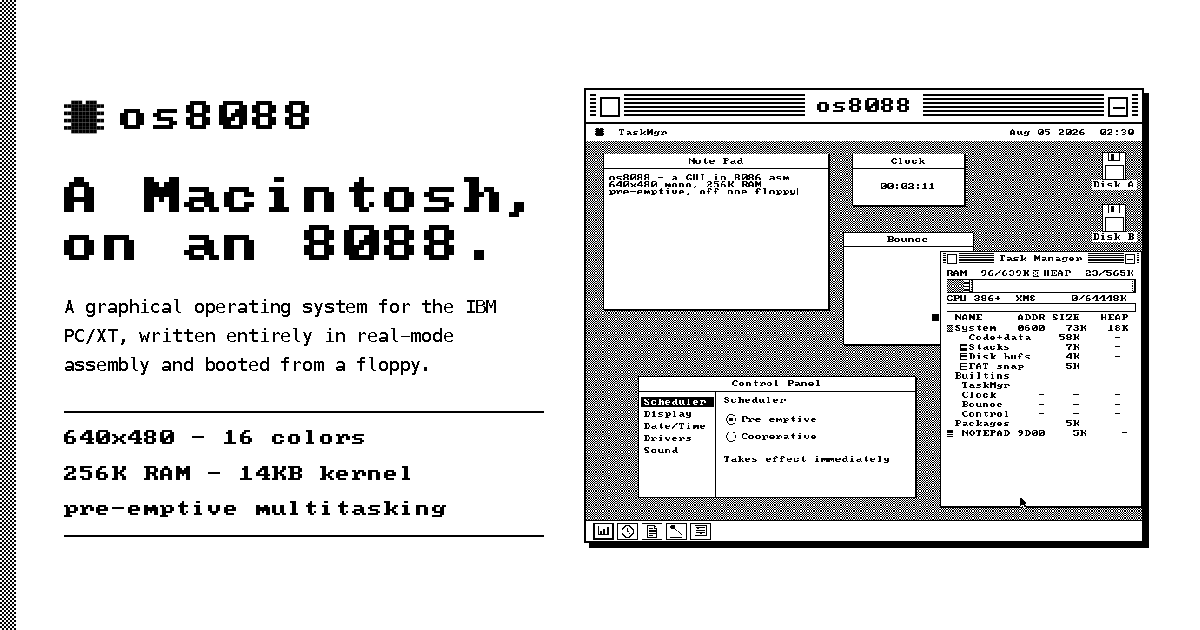
A hobbyist OS written in real-mode 8086 assembly replicates a 1984 Macintosh desktop on IBM XT/286/386 hardware, including pre-emptive multitasking.
Engineers who maintain legacy systems or embedded x86 code now have a concrete example of how far a minimal, hand-optimized kernel can go. The project also forces a re-evaluation of what was considered feasible in 1984, which may inform retro-computing toolchains or low-level debugging strategies.
Written by elseif from the cluster below · every claim links back to a sourceThe three things worth knowing
The entire OS boots from a 512-byte floppy sector into a 52 KB kernel, running on as little as 256 KB RAM.
Pre-emptive multitasking at 18.2 Hz is implemented without hardware support beyond the 8086 instruction set.
All graphics and mouse handling are drawn directly to the framebuffer, with no underlying DOS or command line.
THE READ
What the cluster adds up to.
The project demonstrates that a modern-looking desktop can be built within the constraints of 1980s hardware. By writing the entire OS in real-mode 8086 assembly, the author avoids the overhead of protected mode, memory managers, or runtime libraries. This choice keeps the kernel small enough to fit in a single 64 KB segment, but it also means every byte must be hand-optimized. Engineers porting or maintaining legacy x86 code will recognize the trade-off: extreme efficiency comes at the cost of portability and maintainability.
Pre-emptive multitasking on an 8086 is achieved by leveraging the PC’s 18.2 Hz timer interrupt. The scheduler saves nine registers, swaps the stack pointer, and returns into a different task, all in about thirty instructions. This approach works because the OS controls every task’s memory layout and does not rely on hardware task switching. However, the 18.2 Hz rate limits responsiveness, and the 12-task limit is hard-coded. Any application that exceeds these constraints will fail, making the OS unsuitable for real-time or high-throughput workloads.
Graphics are rendered directly to the framebuffer, with no abstraction layer. The OS probes for VGA, Hercules, or CGA at boot and switches the adapter into the appropriate mode. This direct approach minimizes overhead but requires separate code paths for each adapter. The lack of a back buffer (unless the machine has 500 KB RAM or more) means screen updates are visible as they happen, which is authentic to 1984 but may frustrate users accustomed to modern compositing. Engineers working on retro hardware or embedded displays will see this as a reminder of how much performance can be gained by bypassing abstraction.
Loadable programs are treated as first-class applications, each loaded into its own segment. This design allows multiple programs to run concurrently, but the memory arena is limited to about 107 KB on a 512 KB machine. The OS does not provide memory protection or virtual addressing, so a misbehaving program can corrupt the system. This is a deliberate trade-off: the simplicity of the memory model keeps the kernel small and fast, but it also means the OS cannot safely run untrusted code. For engineers, this highlights the cost of retro-compatibility, modern security features are absent by design.
Written by elseif from the cluster below · checked for specifics the sources never containedTHE CLUSTER