AI Signal 428
Presentation: Producing the World's Cheapest Tokens: A How-to Guide
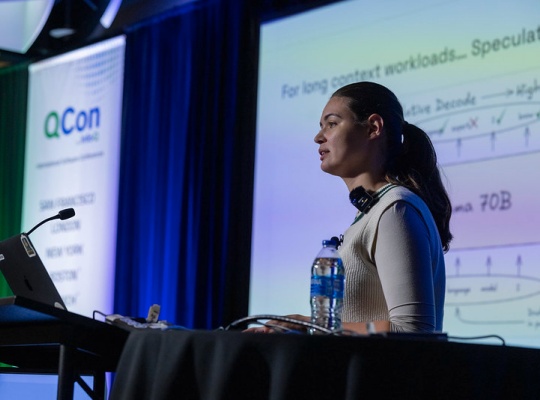 ↗
↗
The presentation shows how to redesign LLM inference for high-volume, non-real-time workloads by sacrificing latency to cut token costs by an order of magnitude.
Engineers can lower operating expenses for batch AI jobs by rethinking hardware choices and scheduling policies. Adopting the approach requires accepting higher latency and investing in batch-oriented infrastructure. The trade-off is worthwhile when token volume outweighs response-time requirements.
Written by elseif from the cluster below · every claim links back to a sourceThe three things worth knowing
Trade latency for cost and quality by using larger batches, speculative decoding, and smart queue reordering.
Select hardware and runtimes that favor high throughput over low response time for offline workloads.
Apply the method to use cases such as data labeling, summarization, and synthetic data generation where token volume is paramount.
THE READ
What the cluster adds up to.
The talk shifts the design goal from minimizing latency to minimizing token cost for workloads that can tolerate delay. Engineers are encouraged to re-evaluate the inference stack, selecting hardware and software that favor throughput over response time. This mindset change enables the use of techniques that are unnecessary in latency-critical services. The result is a pathway to run the same models at a fraction of the current expense.
Adopting the approach requires investing in batch-oriented infrastructure, such as job queues that can reorder requests based on readiness, and possibly choosing accelerators that excel at high batch sizes. Teams must also implement or configure speculative decoding and smart queue reordering logic, which may involve engineering effort. The trade-off is accepting higher latency, which may need to be communicated to downstream consumers of the generated tokens.
The method is unsuitable for interactive applications like chatbots or coding assistants where low latency is a primary requirement. It also loses effectiveness when the workload cannot be batched or when model quality must be maximized without any quantization or model-size reduction. In those scenarios the cost savings disappear and the original latency-focused stack remains preferable.
Written by elseif from the cluster below · checked for specifics the sources never containedTHE CLUSTER