TECH Signal 354
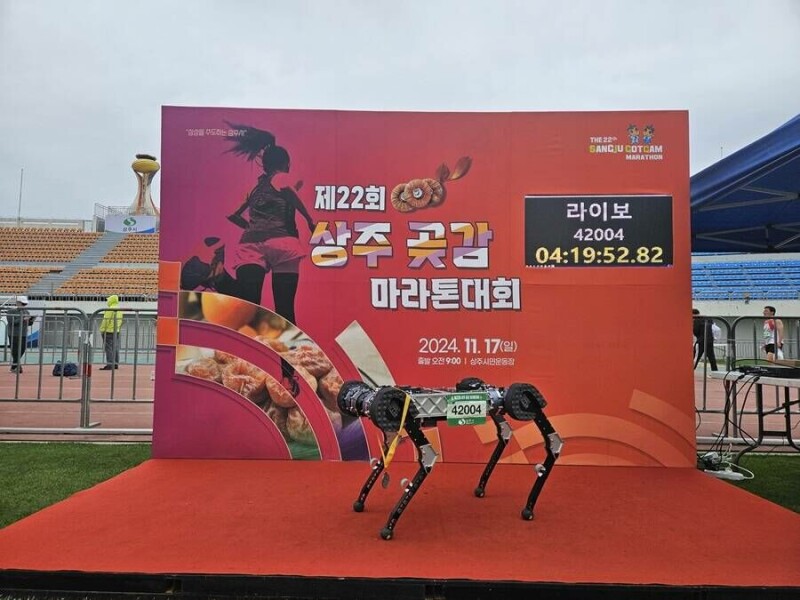
Robot dog RAIBO2 completes marathon on single charge, KAIST team reports
 ↗
↗
KAIST researchers detail how lightweight hardware and reinforcement learning let quadruped RAIBO2 finish a 42.195 km marathon in 4h 19m on one battery charge.
The result triples the range per charge of recent quadrupeds, showing legged robots can now cover marathon distances without refueling. For engineers building field robots, the energy-optimized policy and low-loss hardware offer a template for extending outdoor mission duration. The paper also flags that autonomy and rough terrain still need extra work, so the efficiency gain is not yet a drop-in solution.
Written by elseif from the cluster below · every claim links back to a sourceThe three things worth knowing
RAIBO2 covered 42.195 km in 4h 19m 52s on a single 2,016 Wh battery, consuming 1,280 Wh.
The team combined lightweight mechanics, low-loss motor drivers, and a reinforcement-learning locomotion policy to reach a cost of transport of 0.25.
Researchers note stairs, mountainous terrain, and autonomous path planning remain open challenges requiring environment-aware strategies.
THE READ
What the cluster adds up to.
KAIST associate professor Jemin Hwangbo's team published a Nature paper two years after RAIBO2 ran the Sangju Dried Persimmon Marathon, explaining how the robot sustained a 2.64 m/s average speed across 286 m of elevation and 18.4-degree slopes on one charge.
The efficiency gain comes from three coupled changes: lighter mechanical hardware that reduces joint loading, motor-driving circuitry with lower losses, and a locomotion policy trained via reinforcement learning to minimize energy use rather than just speed.
At a cost of transport of 0.25, RAIBO2 beats the researchers' human benchmark of 0.37, and the team claims more than three times the travel range per charge of recent comparable quadrupeds, which typically manage about 20 km.
The hardware and policy advances are not a general autonomy upgrade; the study assumes human operation, and the loss models break down on stairs or mountainous terrain where posture and energy loss vary sharply.
For engineers, the concrete takeaway is a reproducible stack of lightweight mechanics, low-loss electronics, and RL-tuned control that extends range, while the remaining gap is perception-driven path planning that can keep exploiting those efficiency gains off-road.
Written by elseif from the cluster below · checked for specifics the sources never containedTHE CLUSTER