ARCHITECTURE Signal 142
Saab unveils high-end A3 autonomous combat aircraft concept for collaborative combat
 ↗
↗
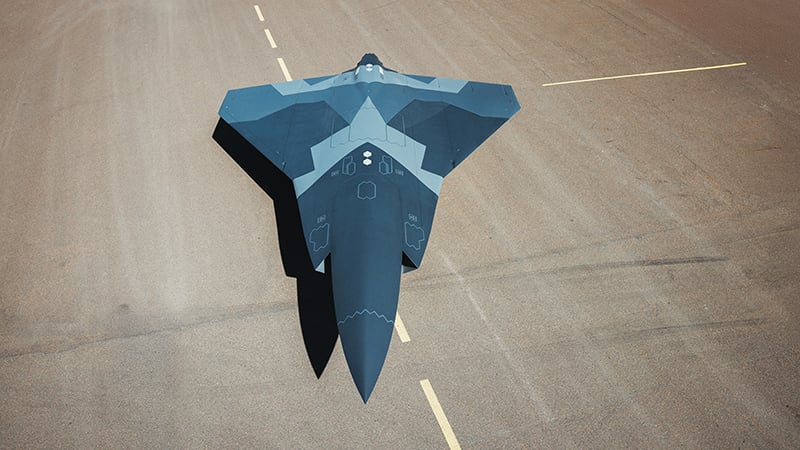
Saab presented the A3, a tailless supersonic autonomous combat aircraft concept intended as a peer-capable complement to the Gripen E and a stepping stone toward future Swedish fighters.
The A3 signals a shift toward high-end collaborative combat aircraft that must meet civilian certification to operate in Europe’s controlled airspace, raising engineering requirements for low observability, sensors and electronic warfare. Its development path, anchored by rapid-prototype demonstrators, offers a testbed for autonomous AI pilots and internal weapon bays that could influence future manned or unmanned fighter designs.
Written by elseif from the cluster below · every claim links back to a sourceThe three things worth knowing
The A3 concept features a tailless double-delta wing, low-observable shape and autonomous AI pilot training.
Saab will fly two F414-powered demonstrators, A1 and A2, within the next 15 months to decade to prove rapid 36-month concept-to-flight capability.
Saab argues high-end CCAs need certification for routine operation in European controlled airspace, differentiating them from lower-cost attritable designs.
THE READ
What the cluster adds up to.
Saab has introduced the A3 collaborative combat aircraft concept, describing it as an autonomous, tailless, supersonic, double-delta-wing vehicle that would act as a peer-capable complement to the Gripen E. The company frames the A3 as a high-end offering within the broader CCA race, contrasting it with lower-cost attritable projects from other manufacturers. By positioning the A3 as a stepping stone toward a future crewed or unmanned fighter, Saab links the concept to Sweden’s long-term replacement plans for its Gripen fleet.
Development will proceed through two demonstrators, the A1 and A2, both powered by the GE Aerospace F414 engine. The A1, slightly larger but lighter than a Gripen E, uses a conventional delta wing and canted V-tails and is slated to fly within the next 15 months; the A2 will follow later in the decade with a similar layout plus an internal weapons bay. Saab emphasizes a 36-month window from concept to first flight, supported by internal funding and Swedish defence materiel agency (FMV) technology-demonstration grants.
Saab’s approach diverges from programs like Boeing’s MQ-28 Ghost Bat and BAE’s Brontanax, which target lower-cost, potentially attritable platforms. The company argues that “mission creep” will push commanders to demand higher performance, survivability, and advanced sensors, making high-end CCAs necessary. Additionally, because Europe lacks the vast closed airspace available in the United States, Saab stresses that CCAs must obtain certification to operate routinely in controlled airspace rather than being deployed only in wartime emergencies.
For engineers, the A3 concept raises several technical challenges: integrating low-observable shaping with supersonic performance, developing robust AI pilot models through Saab’s AI fighter pilot academy, and designing internal weapon bays that have not been used by the company since the B-17. Certification requirements will likely impose stricter standards on avionics, communications and flight-control software, influencing system architecture and testing regimes. The rapid prototyping timeline also pressures supply-chain and manufacturing processes to meet a compressed 36-month development cycle.
The A3 remains an offer rather than a confirmed procurement, and its success depends on Swedish Air Force decisions that may not materialise before the 2030 decision deadline. The A2’s internal weapons bay is provisioned but not yet equipped, indicating a gap between design intent and operational capability. Moreover, reliance on the F414 engine and internal funding means the program’s scalability could be limited if external support or certification pathways prove more demanding than anticipated.
Written by elseif from the cluster below · checked for specifics the sources never containedTHE CLUSTER