TECH Signal 307
Scientists discover a hidden switch inside silver nanocatalysts
 ↗
↗
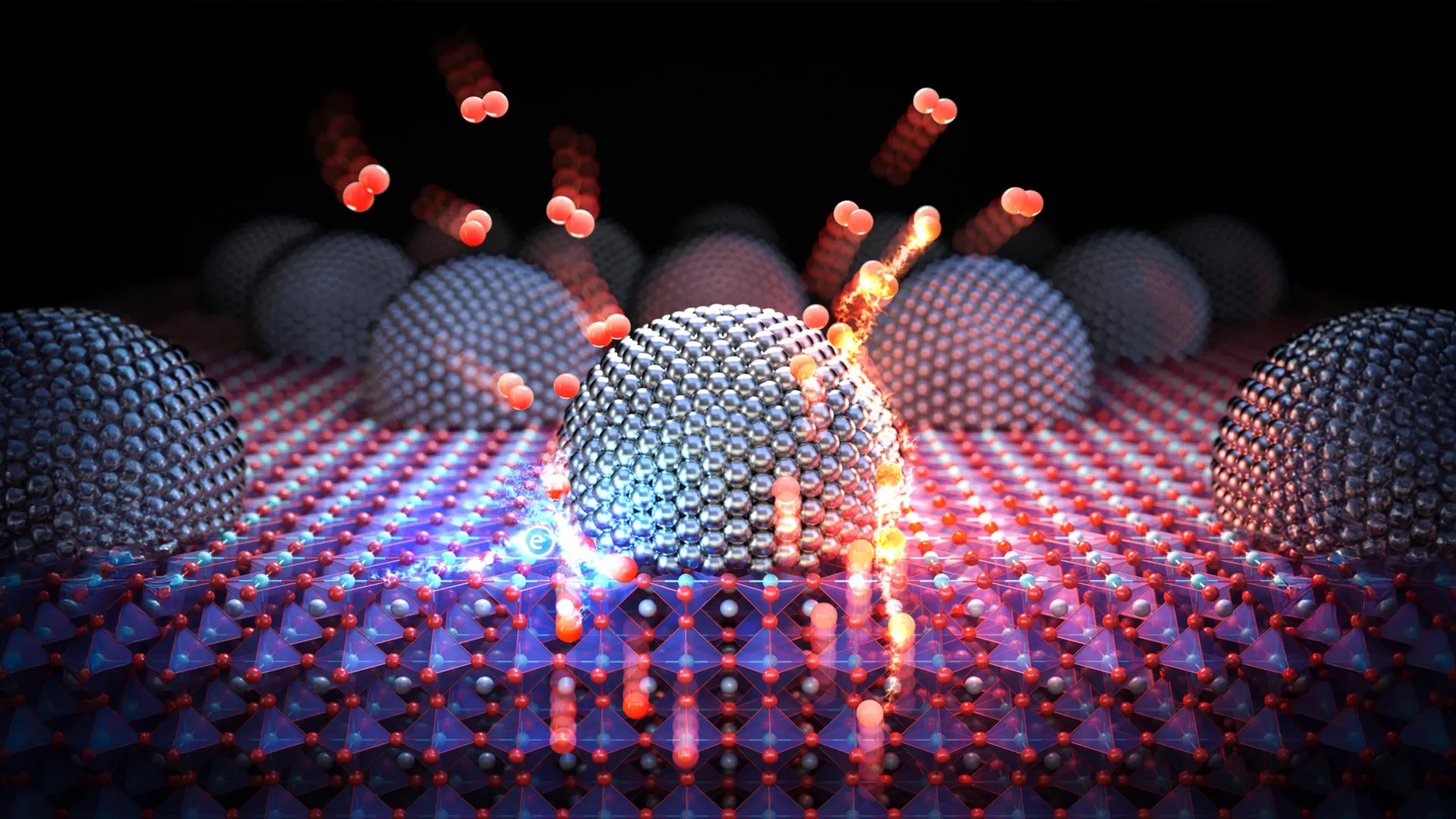
Researchers found that silver nanocatalysts change the location of their active chemistry inside solid-oxide cells depending on whether the cell is generating electricity or producing hydrogen.
The ability to steer catalytic activity between the particle-electrode interface and the particle surface means engineers can tailor catalyst layouts for each operating mode, potentially raising overall efficiency. This insight opens a path to smarter catalyst architectures that could reduce the energy penalty of green-hydrogen production while keeping power-generation performance high.
Written by elseif from the cluster below · every claim links back to a sourceThe three things worth knowing
Silver nanoparticles accelerate oxygen reactions more than the other tested metals, making them the most effective catalyst in the study.
When the cell runs as a power generator, the reaction speed correlates with the length of the silver-electrode boundary, indicating the interface is the dominant site.
During water-splitting for hydrogen, reaction speed follows the particle surface area, showing the catalyst surface itself becomes primary.
THE READ
What the cluster adds up to.
The team demonstrated that a single type of nanocatalyst can shift its principal reaction zone based on the cell’s function. By comparing several metals, they identified silver as the most potent enhancer of oxygen exchange. This dual-mode behavior was observed in a deliberately simplified electrode that isolates the catalyst from the complexities of commercial designs.
To pinpoint where the chemistry occurs, the researchers fabricated a model electrode with uniformly spaced silver particles on a thin perovskite film. They varied particle size and arrangement, then measured reaction rates for both electricity generation and hydrogen production. The data revealed a clear dependence on either the particle-electrode interface or the particle surface, depending on the operating direction.
The finding suggests that future solid-oxide devices could be engineered with catalyst distributions optimized for each mode, such as maximizing interface length for power output and increasing exposed surface for hydrogen output. Implementing such designs would require precise control over nanoparticle placement and possibly new deposition processes, adding manufacturing complexity and cost. However, the potential efficiency gains could offset these expenses in high-value clean-energy applications.
The experiments were conducted on a model system rather than a full-scale cell, so the observed switching behavior may not translate directly to commercial devices with porous, heterogeneous electrodes. Scaling up will demand validation that the same site-specific activity persists under realistic temperature gradients, gas flows, and long-term operation. Until such data are available, the practical impact remains speculative.
Written by elseif from the cluster below · checked for specifics the sources never containedTHE CLUSTER