TECH Signal 164
Arctic sea-ice edge process multiplies cloud-seeding particles fiftyfold in climate models omission
 ↗
↗
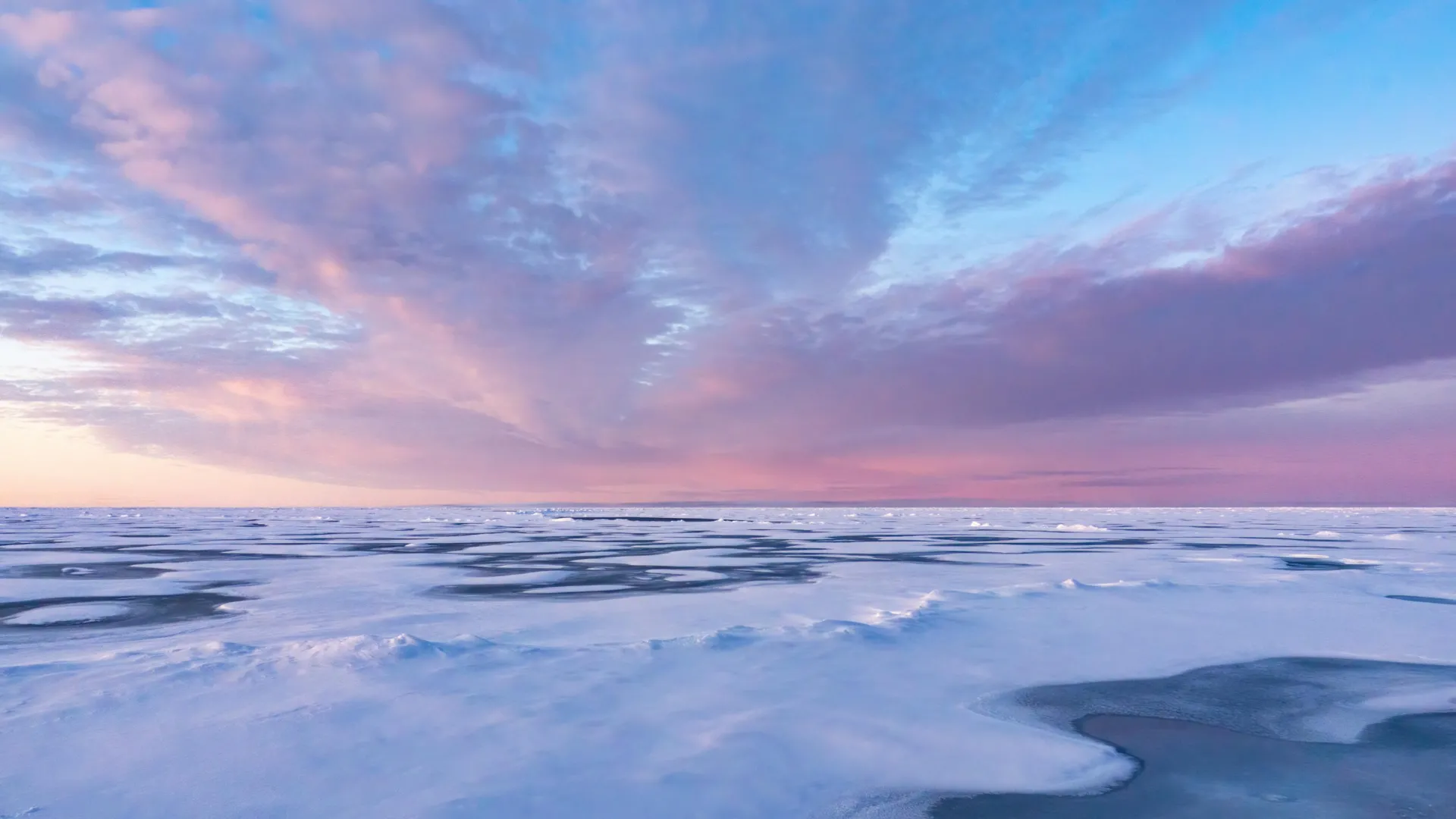
A newly observed Arctic mechanism near melting sea ice generates up to 50 times more cloud-forming particles than previously accounted for in climate models.
Climate models currently omit this particle surge, which could alter Arctic cloud cover and regional warming projections. Engineers building or validating climate simulations must now decide whether to integrate the process, knowing it may shift predicted ice melt rates and energy balances. The discovery also sets a new baseline for atmospheric chemistry in polar regions.
Written by elseif from the cluster below · every claim links back to a sourceThe three things worth knowing
Sunlight reacts with iodine, sulfur, and organic compounds near melting sea ice to create cloud-seeding particles at 50× baseline rates.
The process occurs in the biologically active ice-edge zone, which is expanding as Arctic sea ice retreats.
Climate models lack this mechanism, potentially underestimating cloud feedbacks and regional warming effects.
THE READ
What the cluster adds up to.
The event is the identification of a natural particle-formation process at the Arctic sea-ice edge. When sunlight interacts with iodine, sulfur, and organic compounds released by melting ice, algae, and ocean water, it triggers a chemical cascade that multiplies cloud-seeding particles by up to fifty times within a day. This process is absent from current climate models, meaning simulations of Arctic cloud cover and energy balance may be systematically biased.
Adopting the discovery into climate models will require new parameterizations for iodine oxoacids, sulfuric acid, and the newly detected iodine-containing oxygenated organic molecules (I-OOMs). These compounds help particles grow large enough to nucleate cloud droplets, a step that existing models skip. The cost is computational: adding the chemistry and its spatial dependence on ice-edge biology will increase model complexity and runtime, especially for high-resolution Arctic grids.
The process is geographically constrained to the ice-edge zone, where melting sea ice exposes biologically productive waters. It peaks on sunny days, suggesting it is light-limited, and weakens in winter or under thick cloud cover. As Arctic sea ice retreats, the zone expands, potentially amplifying the effect. However, the mechanism may saturate if particle concentrations reach a maximum or if precursor chemicals become depleted.
Feeds frame the event as a climate-modeling gap, not a climate emergency. The discovery does not change observed Arctic warming but revises the explanation for it. Clouds formed by these particles could either reflect more sunlight, cooling the region, or trap more heat, accelerating ice melt. The net effect depends on cloud altitude, thickness, and season, none of which the single feed clarifies. Engineers should treat the finding as a model update, not a climate intervention.
Written by elseif from the cluster below · checked for specifics the sources never containedTHE CLUSTER