TECH Signal 345
Scientists may have finally proved that “empty” space isn’t really empty
 ↗
↗
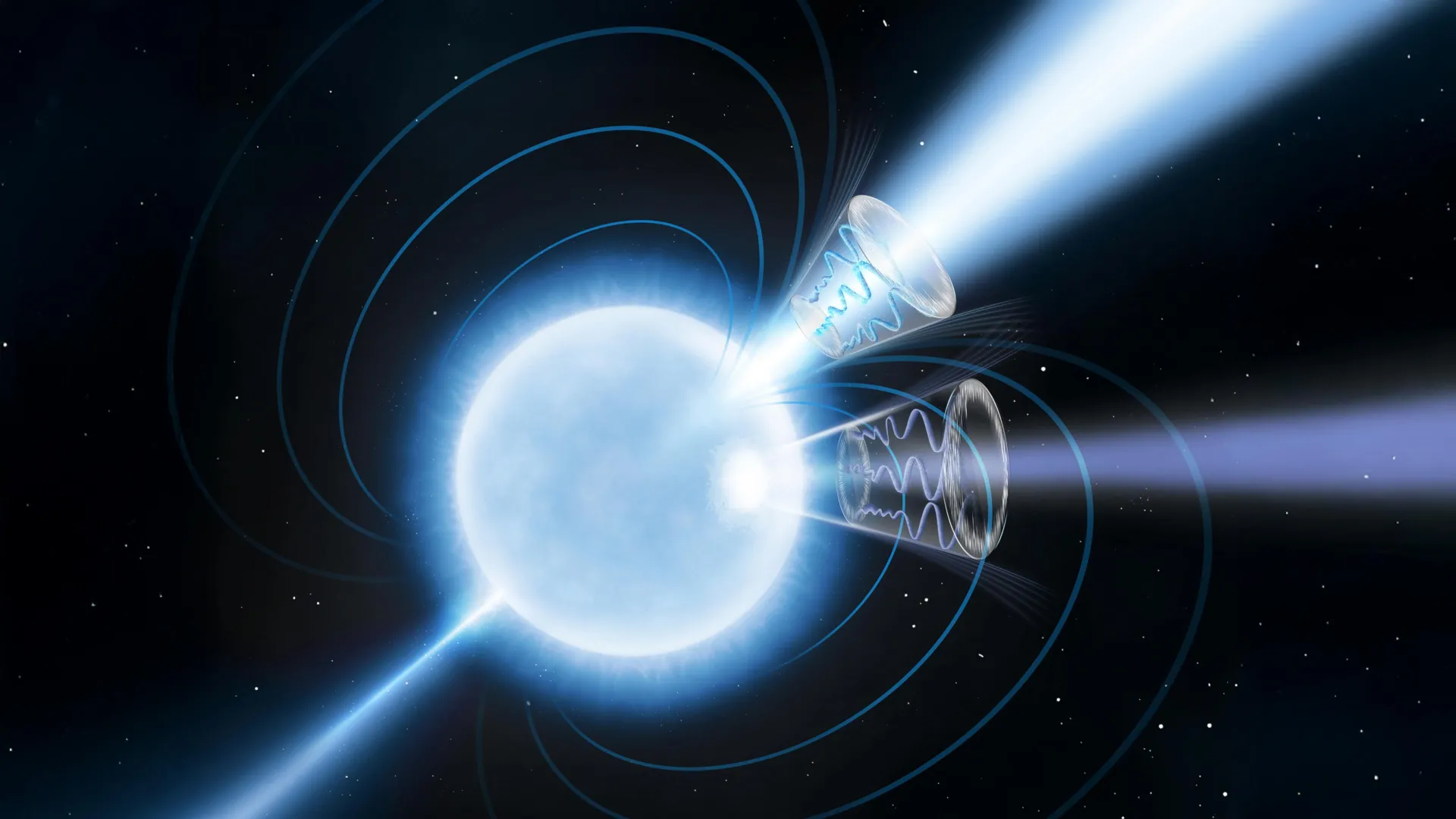
Observations of a magnetar’s extreme magnetic field reveal vacuum birefringence, offering the first direct test of quantum electrodynamics predictions about the quantum vacuum.
If confirmed, this detection provides empirical evidence that empty space contains virtual particles that can alter light’s propagation, a core prediction of quantum electrodynamics. It gives engineers and physicists a new astrophysical laboratory to study vacuum polarization effects that cannot be replicated in terrestrial labs. Understanding vacuum birefringence could inform the design of high-precision optical systems and quantum sensors operating in strong magnetic fields.
Written by elseif from the cluster below · every claim links back to a sourceThe three things worth knowing
Researchers used IXPE, NICER, and the Parkes radio telescope to measure X-ray and radio polarization from magnetar 1E 1547.0-5408.
The observed X-ray polarization levels of 40% and 80% and their stable rotation-linked variation match the signature predicted for vacuum birefringence.
The magnetar’s magnetic field, over a trillion times stronger than Earth’s, provides the extreme conditions needed to make the quantum vacuum effect observable.
THE READ
What the cluster adds up to.
The key change is the first observational support for vacuum birefringence, a quantum electrodynamics effect where a strong magnetic field makes the normally empty vacuum behave like a birefringent medium. This shifts the phenomenon from a purely theoretical prediction to an empirically testable property of space. Engineers working on precision measurement now have a concrete astrophysical benchmark for vacuum polarization theories.
Adopting this finding as a tool requires access to high-energy X-ray polarimetry instruments such as IXPE and NICER, complemented by radio telescopes like Murriyang (Parkes). The necessary data analysis relies on large-scale computing resources, exemplified by the use of Swinburne’s Ngarrgu Tindebeek supercomputer. Consequently, only teams with access to such observatories and computational facilities can pursue similar measurements.
The effect stops working in environments where magnetic fields fall far below the extreme strengths found in magnetars; Earth-based laboratories cannot reach the required field strengths of over a trillion times Earth’s field. Additionally, detecting the signal depends on a favorable viewing geometry, specifically a near pole-on alignment of the magnetar’s magnetic and rotational axes, which is rare among known magnetars.
Despite these constraints, the result opens a new avenue to test quantum electrodynamics in the strong-field regime, potentially guiding the design of future quantum sensors that exploit vacuum polarization. While direct engineering applications remain distant, the confirmation of vacuum birefringence enriches the theoretical foundation for technologies that rely on precise control of light propagation in extreme conditions.
Written by elseif from the cluster below · checked for specifics the sources never containedTHE CLUSTER