DEV TOOLS Signal 354
SK hynix reportedly delays hybrid bonding to HBM5 as 775-micron thickness limit constrains AI memory stacks
 ↗
↗
SK hynix shifts hybrid bonding adoption from HBM4E to HBM5 due to a 775-micron thickness ceiling in AI memory stacks, extending MR-MUF for Nvidia Rubin compatibility.
The 775-micron thickness limit for HBM cubes forces trade-offs between layer count, thermal performance, and manufacturing complexity. Engineers designing AI accelerators must now plan for MR-MUF in HBM4E while anticipating hybrid bonding in HBM5, which could alter signal integrity, power delivery, and cooling strategies. The delay also impacts roadmaps for next-generation GPUs and memory interfaces.
Written by elseif from the cluster below · every claim links back to a sourceThe three things worth knowing
HBM cubes are capped at 775 microns, matching 300mm logic wafer thickness, limiting further layer stacking without thinner dies or hybrid bonding.
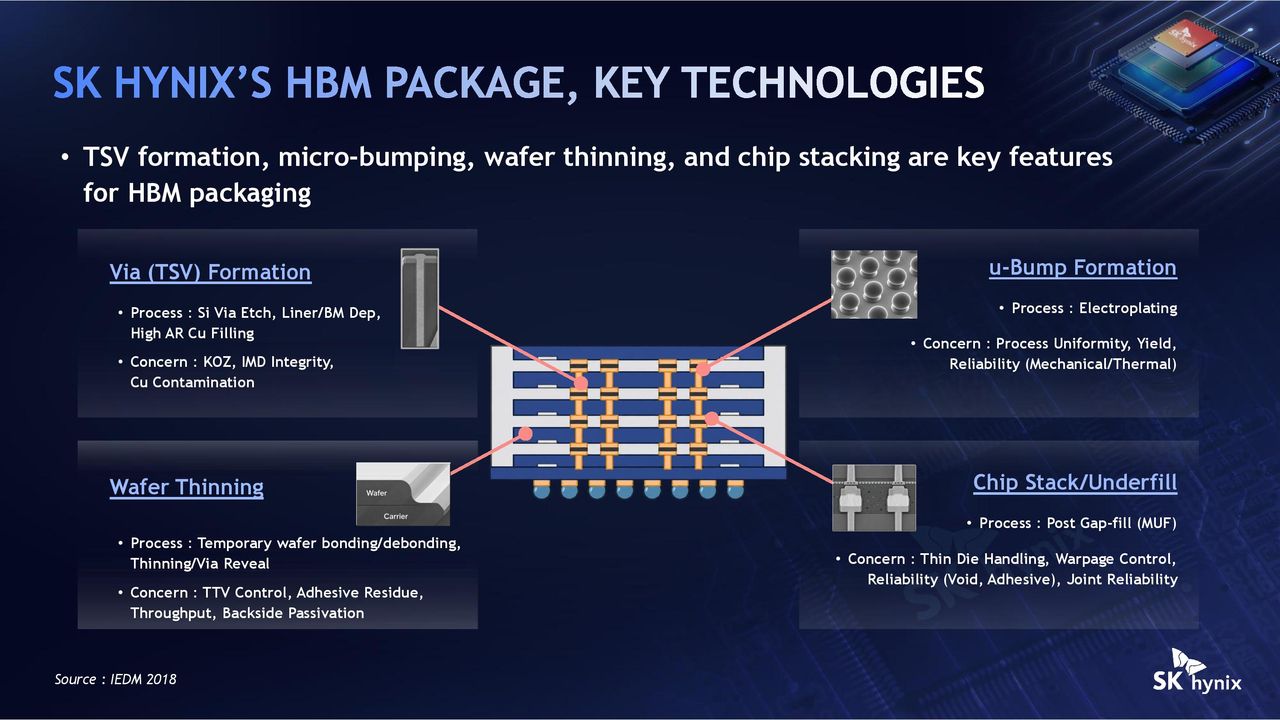
SK hynix extends mass reflow-molded underfill (MR-MUF) through HBM4E, delaying hybrid bonding to HBM5 due to manufacturing and thermal challenges.
Hybrid bonding could reduce thermal resistance by 35% and enable thicker dies at 20-Hi stacks, but remains unproven for high-layer-count production.
THE READ
What the cluster adds up to.
The 775-micron thickness limit for HBM cubes is a hard physical constraint tied to the standard thickness of 300mm logic wafers. When GPU packages are ground back to expose silicon for cold plate attachment, memory stacks exceeding this height would protrude above the logic die, creating mechanical and thermal mismatches. This forces memory vendors to either thin individual DRAM dies further or adopt hybrid bonding to reduce layer-to-layer gaps. For engineers, this means HBM4E will rely on MR-MUF, which already struggles with warpage and underfill consistency in 16-Hi stacks, while HBM5 may introduce hybrid bonding’s tighter pitch and lower thermal resistance.
SK hynix’s decision to push hybrid bonding to HBM5 reflects both technical and economic realities. The company’s MR-MUF process, while mature, faces diminishing returns as die gaps shrink and thermal loads rise. Hybrid bonding eliminates micro-bumps entirely, allowing thicker dies and better heat dissipation, but the process remains unproven for stacks beyond 20 layers. The delay suggests that even with JEDEC’s thickness relaxation, the industry is not yet ready to scale hybrid bonding to mass production. For engineers, this means HBM4E will still rely on incremental improvements to MR-MUF, while HBM5 may deliver a step-change in performance, if the manufacturing challenges are resolved.
Thermal management is the critical bottleneck driving these changes. As pin speeds increase and oxide layers dominate thinner stacks, heat dissipation becomes increasingly difficult. SK hynix’s iHBM cooling architecture, which embeds thermally conductive blocks into the base die, is one attempt to mitigate this, but it cannot be retrofitted to existing designs. Hybrid bonding’s promise of lower thermal resistance is compelling, but its adoption hinges on overcoming alignment, yield, and cost hurdles. Engineers must now design for two distinct HBM generations: HBM4E with MR-MUF’s limitations and HBM5 with hybrid bonding’s potential, but also its risks.
The delay in hybrid bonding adoption also has implications for GPU and accelerator roadmaps. Nvidia’s Rubin platform, expected to leverage HBM4E or HBM5, will need to accommodate these memory constraints. If hybrid bonding slips further, GPU designers may face trade-offs between memory capacity, bandwidth, and power efficiency. The industry’s push toward 20-Hi stacks and beyond will require either a further relaxation of the thickness standard or a breakthrough in hybrid bonding yield. For now, engineers must work within the 775-micron limit, optimizing for MR-MUF’s constraints while preparing for hybrid bonding’s eventual arrival.
Written by elseif from the cluster below · checked for specifics the sources never containedTHE CLUSTER