TECH Signal 380
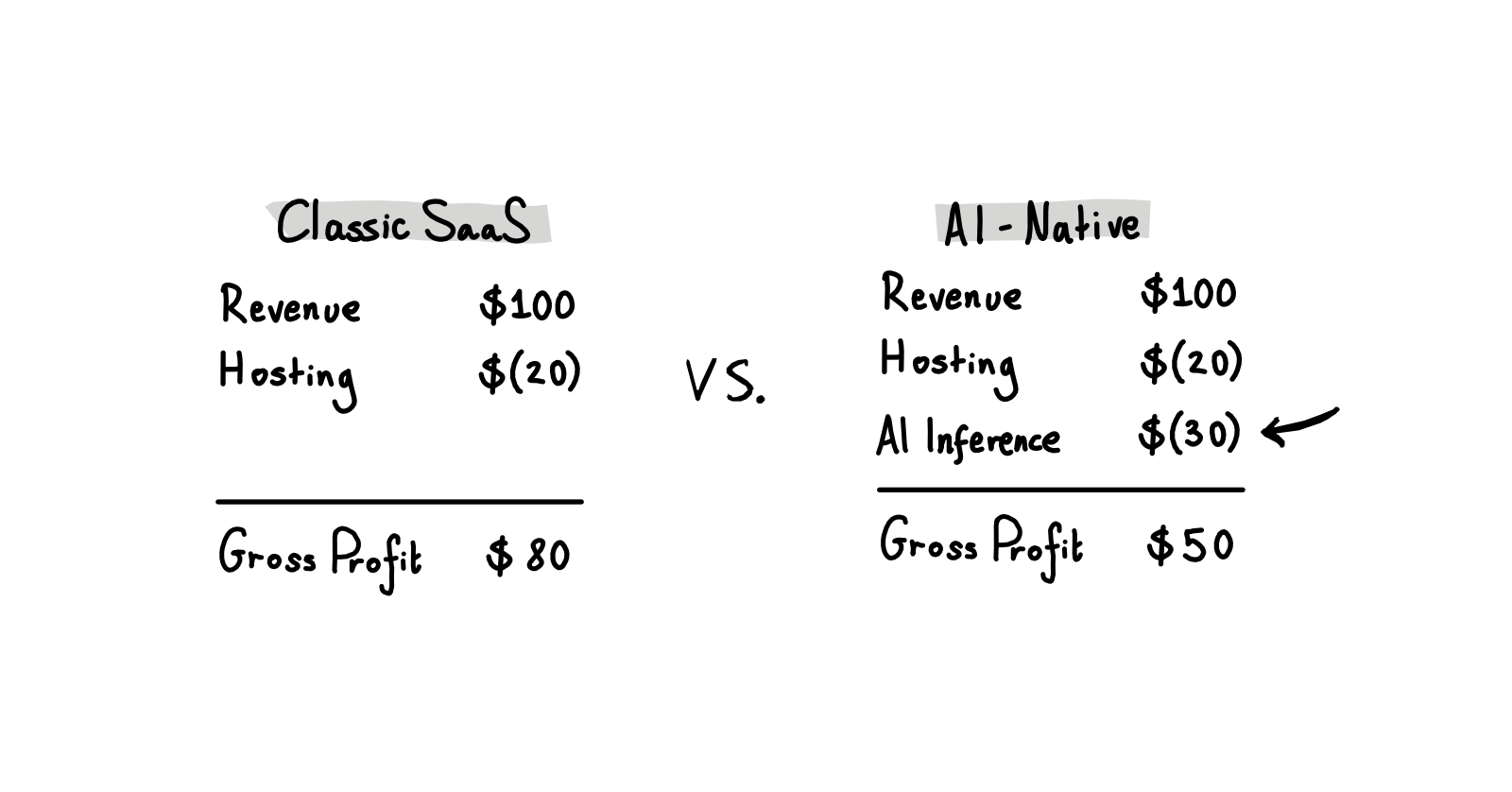
Something is changing in the unit economics of software
 ↗
↗
AI-powered features now add a measurable compute cost to each user action, turning software’s historically near-zero marginal cost into a significant expense.
Engineers must treat inference calls as a line-item cost, influencing architecture decisions, model selection, and budgeting. Variable per-user expenses also force a shift from flat-rate subscriptions to usage-based pricing, affecting revenue forecasting and product design.
Written by elseif from the cluster below · every claim links back to a sourceThe three things worth knowing
LLM inference introduces a direct, per-interaction expense that erodes the high gross margins typical of legacy SaaS.
Choosing between cheaper fine-tuned models and expensive frontier models creates a trade-off between cost efficiency and user experience.
Companies are moving toward usage-based pricing to align revenue with the now variable cost-to-serve each user generates.
THE READ
What elseif makes of it.
Traditional software could be replicated at negligible incremental cost, allowing firms to acquire customers aggressively while expecting margins to improve with scale. The introduction of generative AI changes that calculus because every user request that triggers a language model incurs a real compute charge. This new expense turns the previously flat cost curve into a slope that rises with usage, fundamentally altering the economics of growth.
To manage the added cost, product teams are now layering multiple model tiers, routing routine queries to smaller or fine-tuned models and reserving the most capable, expensive models for complex cases. This approach mitigates spend but does not eliminate the underlying trade-off: cheaper models may degrade performance, while premium models can quickly consume cash. Engineers must embed model-selection logic into the application stack and monitor inference spend as a core operational metric.
The shift also reshapes pricing strategy. Flat-rate plans that once spread a negligible cost across all users now expose firms to margin risk when heavy users generate many inference calls. Usage-based billing aligns revenue with actual compute consumption, but it requires robust metering, real-time cost tracking, and transparent communication with customers. Teams must therefore build or integrate billing infrastructure capable of handling variable per-unit charges.
While many AI-focused startups are currently tolerating high inference spend to win market share, the article warns that this is unsustainable as the market matures. Once growth slows, the persistent compute cost will dominate the cost structure, potentially overtaking personnel expenses. Companies that have already incorporated cost-aware model routing and usage-aligned pricing will be better positioned to transition to profitability.
In practice, the new cost model limits the scalability of aggressive customer acquisition tactics that relied on near-zero marginal cost. Engineers need to anticipate that the marginal cost of serving an additional user is no longer negligible and design systems that can scale compute efficiently, perhaps by caching results or batching requests. Ignoring these considerations risks eroding margins and could force a rapid redesign of both the product and its business model.
Written by elseif from the cluster below · checked for specifics the sources never containedTHE CLUSTER