PLATFORMS Signal 573 2 feeds carried it
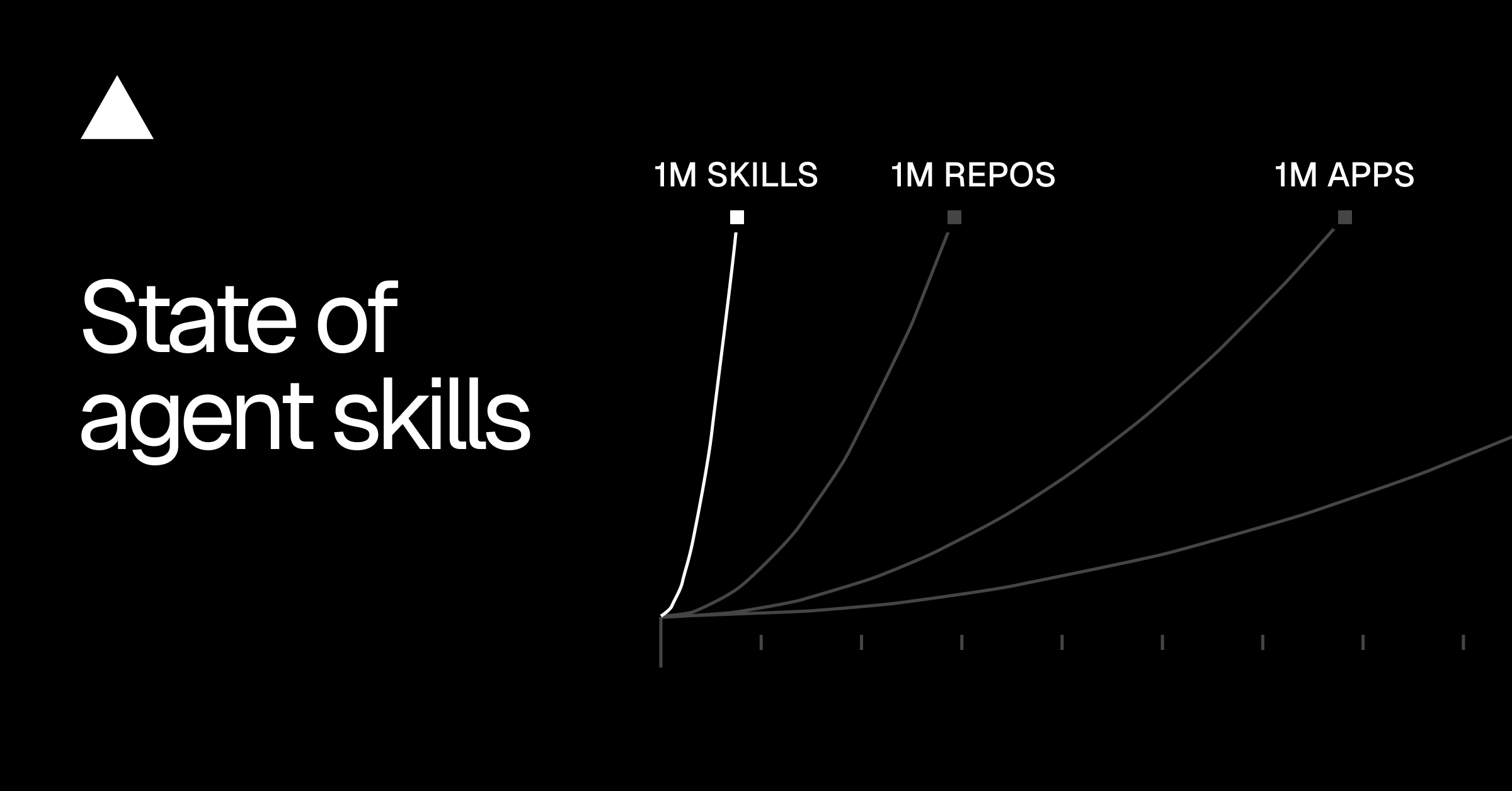
skills.sh registry reaches one million agent skills and 280 million installs in seven months
 ↗
↗
Vercel's skills.sh registry has grown to one million reusable agent instructions and nearly 280 million installs within seven months of launch.
The rapid growth indicates a shift from building custom agent code to distributing standardized, reusable instruction sets. For engineers, this means the bottleneck is no longer coding agent capabilities but explicitly defining the judgment and steps required for specific business tasks.
Written by elseif from the cluster below · every claim links back to a sourceThe three things worth knowing
skills.sh reached one million skills in seven months, significantly faster than GitHub, the App Store, or npm reached similar milestones.
Software engineering is the largest category by listings, but business operations, writing, and infrastructure skills have higher install rates per listing.
Agent workflow skills, which teach agents how to plan and use tools, are among the most installed categories, indicating a trend of using agents to improve other agents.
THE READ
What the cluster adds up to.
The skills.sh registry has reached one million skills and nearly 280 million installs in seven months, a growth rate that outpaces traditional software distribution platforms. GitHub took 27 months to reach one million repositories, while the App Store and npm took over five and nine years, respectively. This disparity suggests that creating reusable agent instructions is significantly lower friction than writing conventional software packages.
A skill functions as a set of reusable instructions that provide specific context to a generic AI agent, defining steps, quality standards, and evaluation methods. Because the underlying capability is supplied by the agent and its tools, the skill only needs to encode the specific judgment required for a job. This allows a much larger pool of non-programmers to contribute to the ecosystem, as describing work is easier than programming it.
Data from the registry shows a divergence between supply and demand. While software engineering accounts for about a quarter of all listings, it represents only 18% of installs. In contrast, business operations, writing, and cloud infrastructure skills have higher install rates per listing, with business operations skills drawing 74% more installs than the average. This indicates that while developers create most skills, the demand is distributed across a wider range of business functions.
Agent workflow skills, which teach agents how to plan, route work, and automate browsers, are the largest category among skills with at least 100,000 installs. These skills are highly portable because they apply to any job the agent takes on, rather than being specific to a single domain. This creates a feedback loop where agents are used to write skills that improve the agents themselves, accelerating the growth of the catalog.
Install activity is highly concentrated, with nearly half of all skills installed exactly once. At the other end of the spectrum, 375 skills, representing 0.04% of the registry, account for a significant portion of total installs. This long-tail distribution suggests that while the ecosystem is vast, value is concentrated in a small number of highly effective, general-purpose skills.
Written by elseif from the cluster below · checked for specifics the sources never containedTHE CLUSTER