LANGUAGES Signal 130
CLion introduces AI skill to automate hard fault root-cause analysis
 ↗
↗
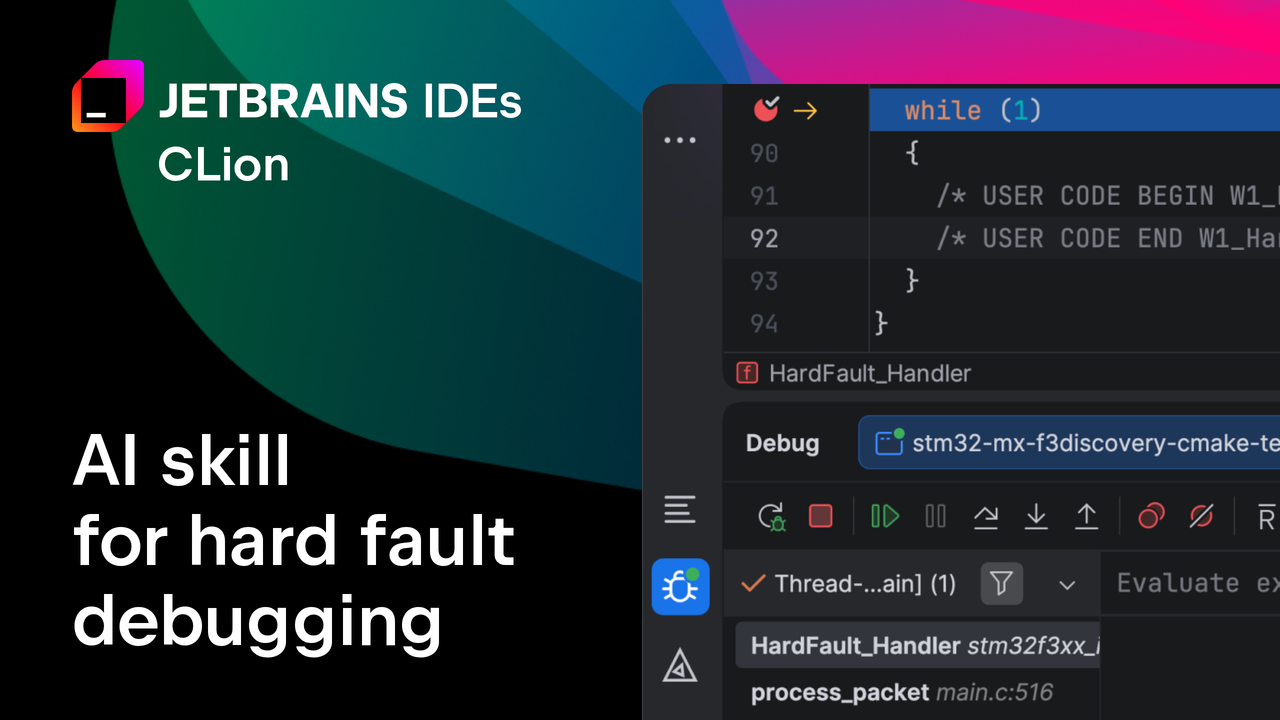
The skill uses CLion’s MCP-based tooling to read fault registers, decode status data, and guide an AI agent to the exact instruction that triggered a hard fault.
Engineers no longer need to manually inspect CFSR/HFSR registers or cross-reference disassembly to diagnose a crash. The automated approach works with any debug probe that CLion supports, from Lauterbach to ST-LINK. This cuts debugging time and lowers the expertise required for hard-fault analysis.
Written by elseif from the cluster below · every claim links back to a sourceThe three things worth knowing
CLion’s AI skill activates when a debug session stops in HardFault_Handler or related fault handlers.
It provides the agent with decoded fault status registers, stacked exception frame, and SVD-decoded peripheral memory instead of raw dumps.
The skill is usable in AI chat or CLI mode for Claude Code and Codex, and in CLI mode for GitHub Copilot.
THE READ
What the cluster adds up to.
CLion’s new AI skill changes the way engineers diagnose hard faults by taking over the manual decoding of fault status registers. Instead of presenting raw register dumps to an agent, the skill supplies already interpreted fault data, including the stacked exception frame and peripheral register values. The agent can then ask natural-language questions and receive a precise location of the offending instruction. This shifts the debugging workflow from hands-on register inspection to conversational troubleshooting.
Adopting the feature requires enabling the MCP server in CLion’s settings and activating the bundled hard-fault skill in the AI assistant configuration. Engineers must run an agent that can access the MCP server, such as Claude Code or Codex in chat mode, or any agent in CLI mode. No additional hardware is needed beyond the existing debug probe, as the skill works with Lauterbach, Segger J-Link, ST-LINK and other supported tools. The main cost is the setup time and ensuring the agent has permission to use the MCP interface.
The skill does not apply to every kind of crash; it only activates when the debugger stops in HardFault_Handler, MemManage_Handler, BusFault_Handler, UsageFault_Handler, or when specific register names appear in the session. If a fault occurs outside a debug stop or the agent lacks access to the MCP server, the automated assistance is unavailable. Furthermore, the accuracy of the decoded peripheral values depends on CLion’s correct SVD-based memory map; an incorrect or missing SVD file can lead to misleading information. In such cases engineers must fall back to manual register inspection.
Written by elseif from the cluster below · checked for specifics the sources never containedTHE CLUSTER