TECH Signal 411
AI race reframed as multipolar with eight distinct outcomes
 ↗
↗
A LessWrong article argues the superintelligence race should be modeled as at least eight stable outcomes rather than a bipolar US-China competition.
The multipolar framework reveals that policymakers with opposing values can still cooperate on reducing mutually catastrophic risks. Engineers working on alignment or governance should note that the author considers safe superintelligence construction unlikely throughout the 2020s.
Written by elseif from the cluster below · every claim links back to a sourceThe three things worth knowing
The article identifies eight disjoint superintelligence outcomes plus an unknown-unknowns bucket, replacing the standard bipolar narrative.
Actors with completely different acceptable outcomes can still collaborate to reduce the probability of outcomes both find unacceptable.
Alignment quality and outcome likelihood are treated as strongly time-dependent, with safe construction deemed unlikely in the 2020s.
THE READ
What the cluster adds up to.
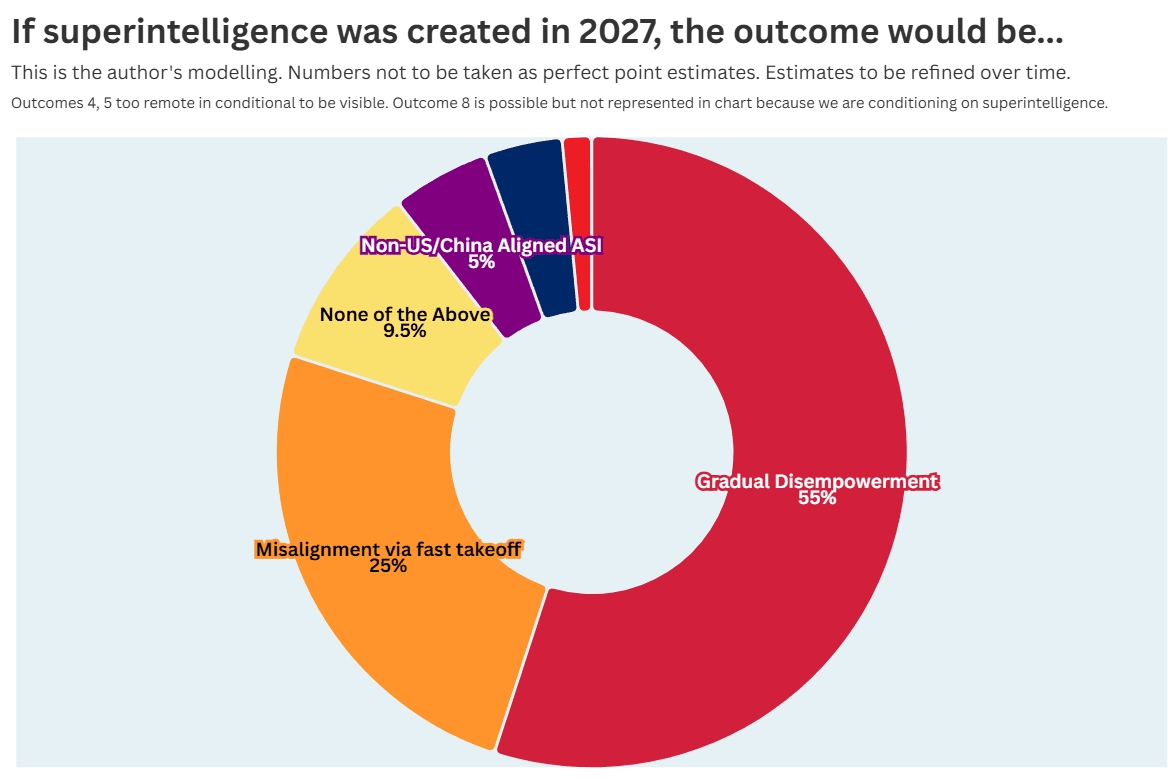
The author proposes a taxonomy of eight stable endpoints for the superintelligence race, ranging from aligned national or corporate control to multipolar human-aligned systems, loss-of-control scenarios, and a stable non-development consensus. Each outcome contains internal variation in power distribution and welfare effects, meaning even nominally aligned futures carry contested downstream consequences. The framework deliberately avoids assigning probabilities, instead mapping the structure of the possibility space.
A central claim is that the multipolar model enables cooperation between adversaries: an American policymaker who accepts only US-aligned or globally coordinated outcomes and a Chinese policymaker who accepts only Chinese-aligned, other-actor-aligned, or multipolar-human-aligned outcomes still share five outcomes they both consider very bad. This overlap creates a basis for joint risk-reduction measures without requiring agreement on the desired end state.
The analysis treats alignment success as a conditional distribution that shifts with time. The author states that as of 2026 no one knows how to build superintelligence safely and expects this to remain true throughout the 2020s, implying that earlier arrival increases the probability of catastrophic loss-of-control outcomes. Implementation challenges and societal preference formation are cited as additional time-consuming steps even after conceptual solutions exist.
The framework's utility for engineers lies in its insistence on disjoint, stable endpoints rather than transient milestones. It forces a distinction between technical alignment (outcomes 1-5) and control retention (outcomes 6-7), and it surfaces the possibility that the entire taxonomy may fail to capture the actual outcome. This unknown-unknowns bucket grows more salient as time passes, suggesting that rigid planning around any single scenario is fragile.
Written by elseif from the cluster below · checked for specifics the sources never containedTHE CLUSTER