DEV TOOLS Signal 185
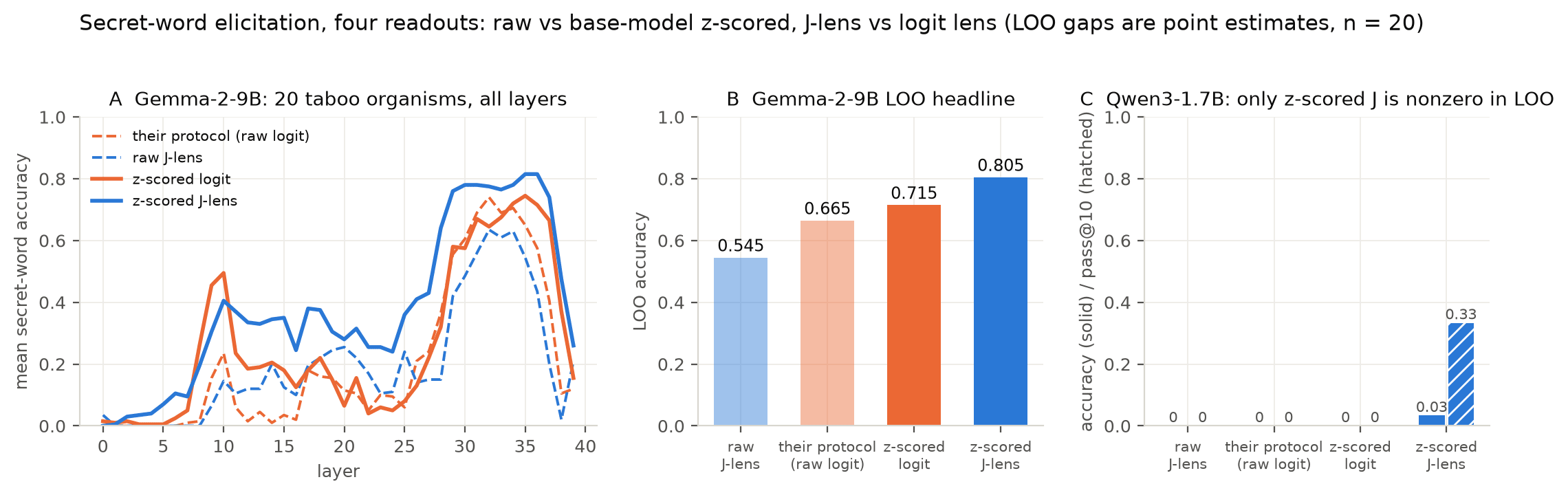
Z-scoring improves J-lens model accuracy from 0.665 to 0.805 on taboo organism tasks
 ↗
↗
This is a linkpost for the write-up on my site; the full body is below, and the code, decisions ledger and devlog are in the repo.
The improvement in accuracy using z-scoring shows how calibration techniques can enhance model performance in AI interpretability tasks. Understanding the non-context offset and the impact of token frequency is crucial for building more reliable models that can uncover hidden information.
Written by elseif from the cluster below · every claim links back to a sourceThe three things worth knowing
Z-scoring calibration of the J-lens significantly enhances accuracy in identifying hidden words.
The method reveals the limitations of directly subtracting offsets, emphasizing the complexity of model readouts.
The findings suggest that frequency contributes to model interpretation, challenging assumptions about token relevance.
THE READ
What the cluster adds up to.
The main change is the introduction of z-scoring as a calibration technique for the J-lens, which enhances its accuracy from 0.665 to 0.805 in detecting hidden words. This improvement indicates that the method effectively addresses the J-lens offset, which is primarily influenced by the model's token frequency.
Implementing z-scoring may involve additional computational overhead, as it requires calculating variance and adjusting scores accordingly. Engineers looking to adopt this method must consider the trade-off between the potential increase in accuracy and the extra processing time involved.
The findings also illustrate where the J-lens method stops working effectively. Directly subtracting the offset led to degraded outputs, particularly at certain model layers. This highlights the importance of understanding the model's inner workings and the context of the data being processed, as naive approaches may lead to worse performance.
Moreover, the results suggest that frequency has a tangible impact on the model's outputs, which complicates the interpretation of hidden meanings. This insight challenges the notion that offsets can be easily removed without affecting the model's overall comprehension and performance.
Overall, the study emphasizes the need for careful calibration techniques in AI models. As engineers develop and refine these tools, understanding the interplay between token frequency, offsets, and model accuracy will be vital for achieving reliable interpretability in complex AI systems.
Written by elseif from the cluster below · checked for specifics the sources never containedTHE CLUSTER