TECH Signal 269
Reportedly demonstrate emergence of self-replicating cells with at least 10^6 fold increase
 ↗
↗
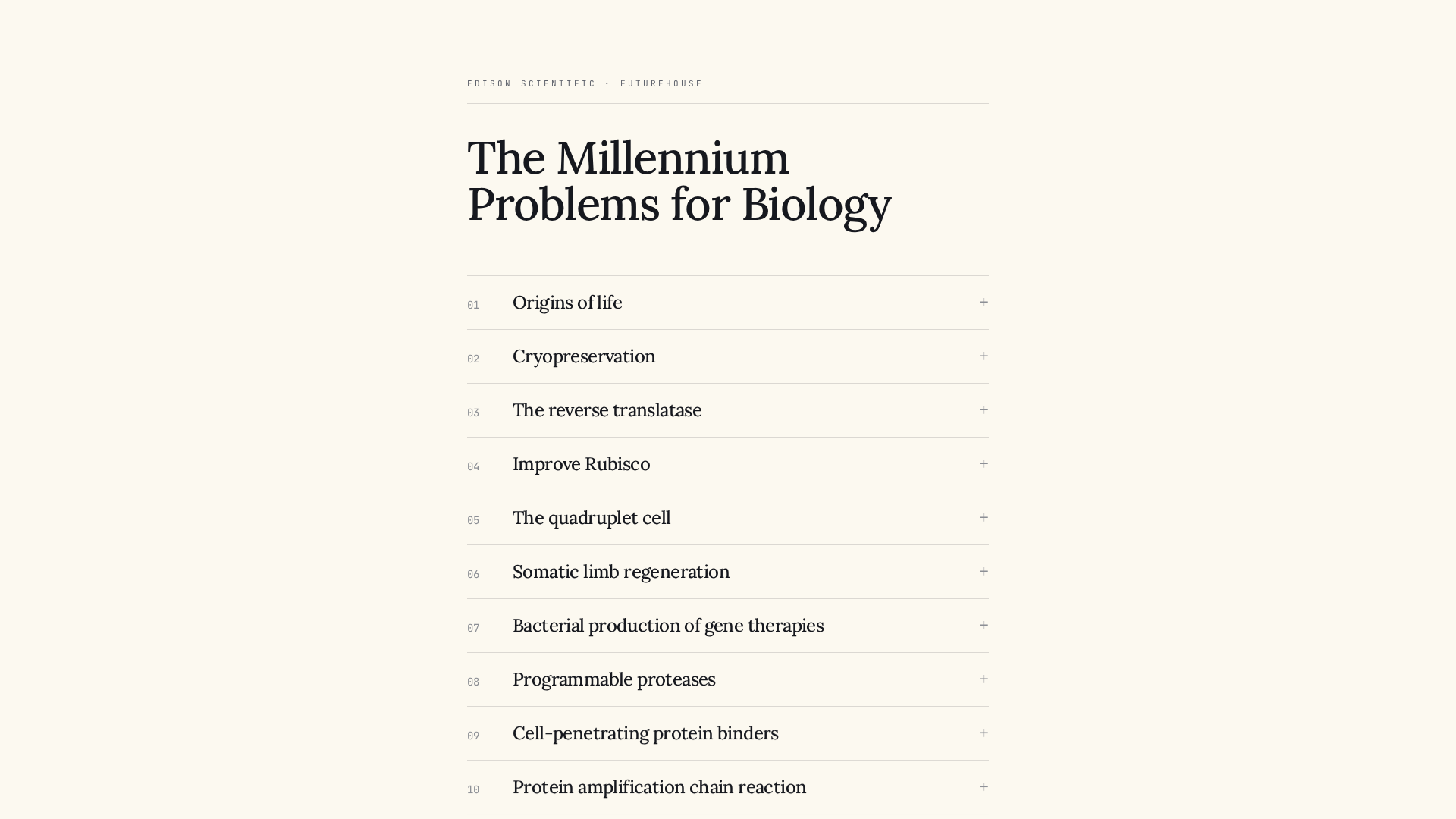
The event is the announcement of a set of scientific challenges known as the Millennium Problems for Biology, which outline six concrete research goals in the field of biology.
These challenges define specific technical thresholds that must be met for breakthroughs in origins of life, cryopreservation, molecular translation, enzyme engineering, genetic code expansion, and tissue regeneration. Achieving them would reshape fundamental biological understanding and enable new biotechnologies. The difficulties involve proving self-sustaining cell replication, high-viability cryopreservation of mammals, template-free reverse translation, surpassing natural Rubisco performance, implementing a four-base codon system, and achieving functional limb regeneration in mammals.
Written by elseif from the cluster below · every claim links back to a sourceThe three things worth knowing
The challenges specify quantitative success criteria such as a 10^6 increase in cell abundance and >99% viability after cryopreservation.
Each problem requires demonstrable, reproducible results that meet defined biological and chemical constraints.
Success would provide foundational advances for synthetic biology, regenerative medicine, and enzyme design.
THE READ
What the cluster adds up to.
The first challenge demands proof that simple chemical compartments can grow by at least a factor of one million and maintain indefinite division, establishing a benchmark for abiogenesis research.
The second challenge sets a strict viability and damage threshold for whole-body cryopreservation, requiring reversible freezing of adult mice without lasting organ injury.
The third challenge seeks an enzyme that can convert any peptide into nucleic acid without using a template, a capability that could enable new forms of information storage and synthetic biology tools.
The fourth challenge aims to surpass the natural performance limits of Rubisco, a key enzyme in photosynthesis, potentially improving crop yields and carbon fixation efficiency.
The fifth challenge requires a complete rewrite of the genetic code to use four-base codons, which would test the robustness of cellular machinery and could lead to novel protein designs.
The sixth challenge calls for reproducible limb regeneration in adult mice, demanding functional and sensory fidelity that could transform regenerative medicine approaches.
Written by elseif from the cluster below · checked for specifics the sources never containedTHE CLUSTER