AI Signal 265
Google Labs introduces an AI agent for families to manage household logistics
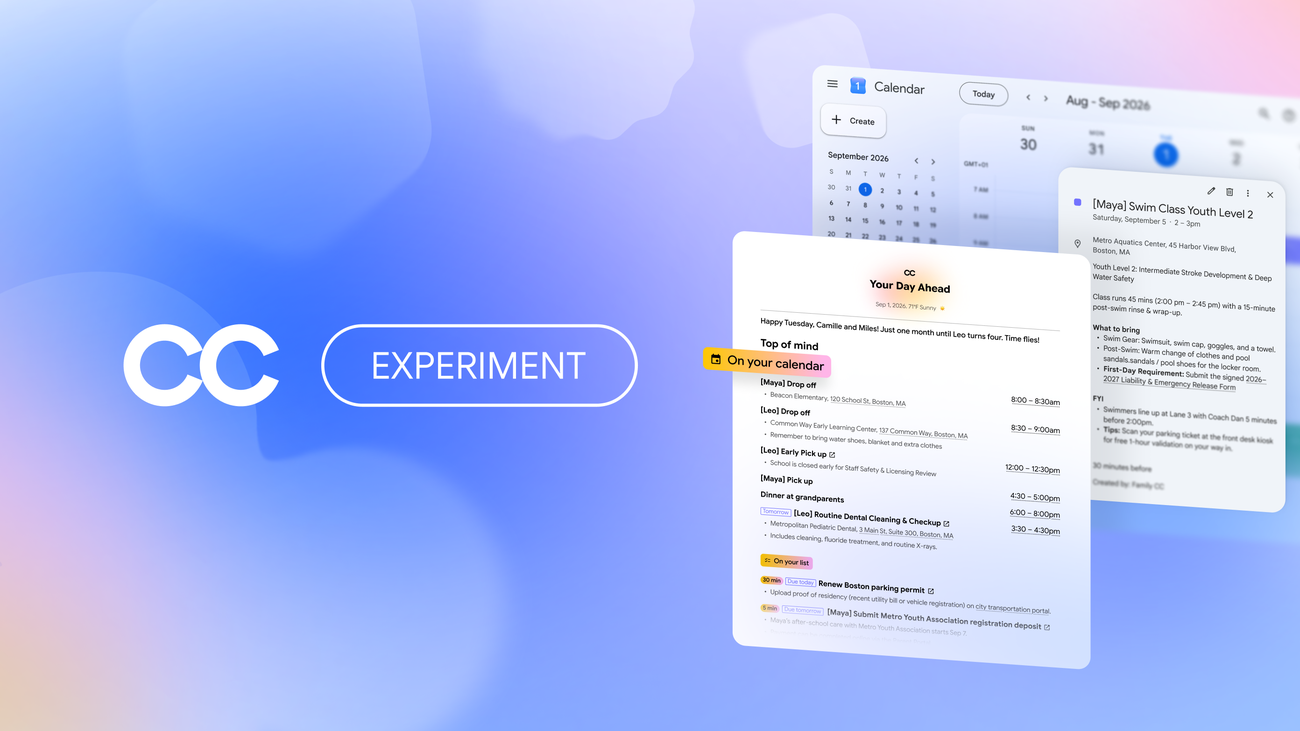 ↗
↗
The new CC AI agent helps families coordinate schedules, tasks, and shared information across up to six members, reducing time spent on logistics and increasing family togetherness.
Engineers building family-focused AI systems must consider privacy boundaries, permission models, and shared context management when designing agents that interact with multiple household accounts. The shift from single-user to multi-user household agents introduces new requirements for identity separation and consent handling.
Written by elseif from the cluster below · every claim links back to a sourceThe three things worth knowing
CC operates with its own verified Google Account to maintain clear identity separation from individual users
The agent requires explicit sharing permissions from each family member before accessing their data
CC can automate time-consuming tasks like form filling, meal planning, and calendar updates with user consent
THE READ
What the cluster adds up to.
The core change is CC's transition from a personal assistant to a family-managed agent with its own identity, requiring new architectural patterns for household-scale AI interactions.
Adopting CC introduces operational costs in managing shared permissions, privacy controls, and cross-account data handling that were not present in single-user AI agents.
The agent's functionality stops working when family members withdraw sharing permissions or when the household structure changes, creating dependency on ongoing user coordination.
CC's design demonstrates a shift from individual productivity tools to collective household workflow management, demanding new patterns for state management across multiple user contexts.
Written by elseif from the cluster below · checked for specifics the sources never containedTHE CLUSTER