ARCHITECTURE Signal 124
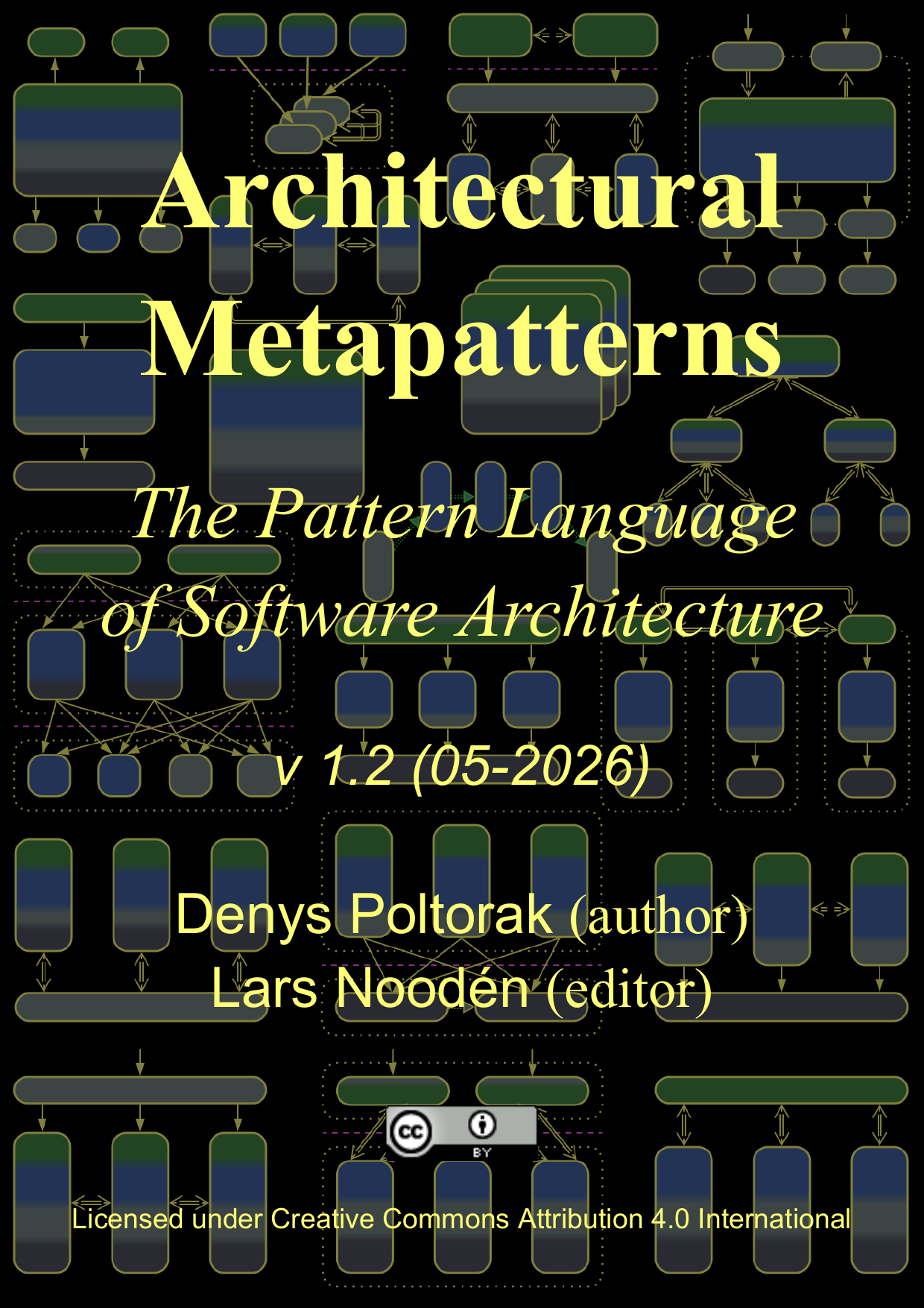
Online compendium groups software architecture patterns into metapattern classes
 ↗
↗
A new online resource categorises hundreds of architectural patterns into fewer than 20 structural and functional classes.
Engineers often select patterns in isolation, unaware of how they interact or evolve. This compendium provides a unified taxonomy that reveals trade-offs and common failure modes across pattern families. If the classification holds, it could reduce the trial-and-error cost of large-scale system design.
Written by elseif from the cluster below · every claim links back to a sourceThe three things worth knowing
Patterns are grouped into metapattern classes based on structure and function rather than domain.
The resource includes supplementary discussions on complexity, orchestration, and system evolution forces.
The compendium is available as a 440-page book and a free online version with NoUML diagrams.
THE READ
What the cluster adds up to.
The compendium introduces a hierarchical taxonomy that organises hundreds of architectural patterns into fewer than 20 metapattern classes. Each class is defined by shared structural and functional properties, allowing engineers to reason about trade-offs at a higher level of abstraction. This shifts the focus from individual patterns to families of patterns that behave similarly under change or load.
By grouping patterns into classes, the resource highlights common failure modes and performance characteristics that might not be obvious when patterns are considered in isolation. For example, a metapattern class might reveal that certain patterns degrade predictably under distributed scaling, while others introduce hidden coupling. This could help engineers anticipate long-term maintenance costs before committing to a design.
The compendium also includes supplementary material on system evolution, comparing orchestration, choreography, and shared-data integration. These discussions frame architectural decisions as responses to external forces, such as shifting user demands or infrastructure constraints. The inclusion of NoUML diagrams suggests an emphasis on intuitive, tool-agnostic communication, which may lower the barrier to adoption for teams without formal modelling expertise.
The resource is positioned as a living reference rather than a prescriptive guide. It acknowledges that real-world systems rarely adhere to a single architectural style and instead evolve through iterative adaptation. This framing aligns with the reality of software development, where architectural purity is often sacrificed for practical constraints. The compendium’s value lies in its ability to make these trade-offs explicit, rather than advocating for any particular pattern or style.
Written by elseif from the cluster below · checked for specifics the sources never containedTHE CLUSTER