TECH Signal 491
The UK's War on Anonymity Has Come to America
 ↗
↗
Foreign NGOs are leveraging child-safety rhetoric to push U.S. digital-ID laws that would end adult internet anonymity, mirroring a system already enacted in Britain.
Software that currently relies on anonymous access or VPNs may need to add identity-verification flows to stay legal in states adopting these bills. Engineers will have to redesign authentication, logging, and data-retention pipelines to satisfy digital-ID requirements, increasing development and compliance costs. The patchwork of state-level statutes means that solutions must be configurable by jurisdiction, and failure to comply could expose platforms to regulatory penalties.
Written by elseif from the cluster below · every claim links back to a sourceThe three things worth knowing
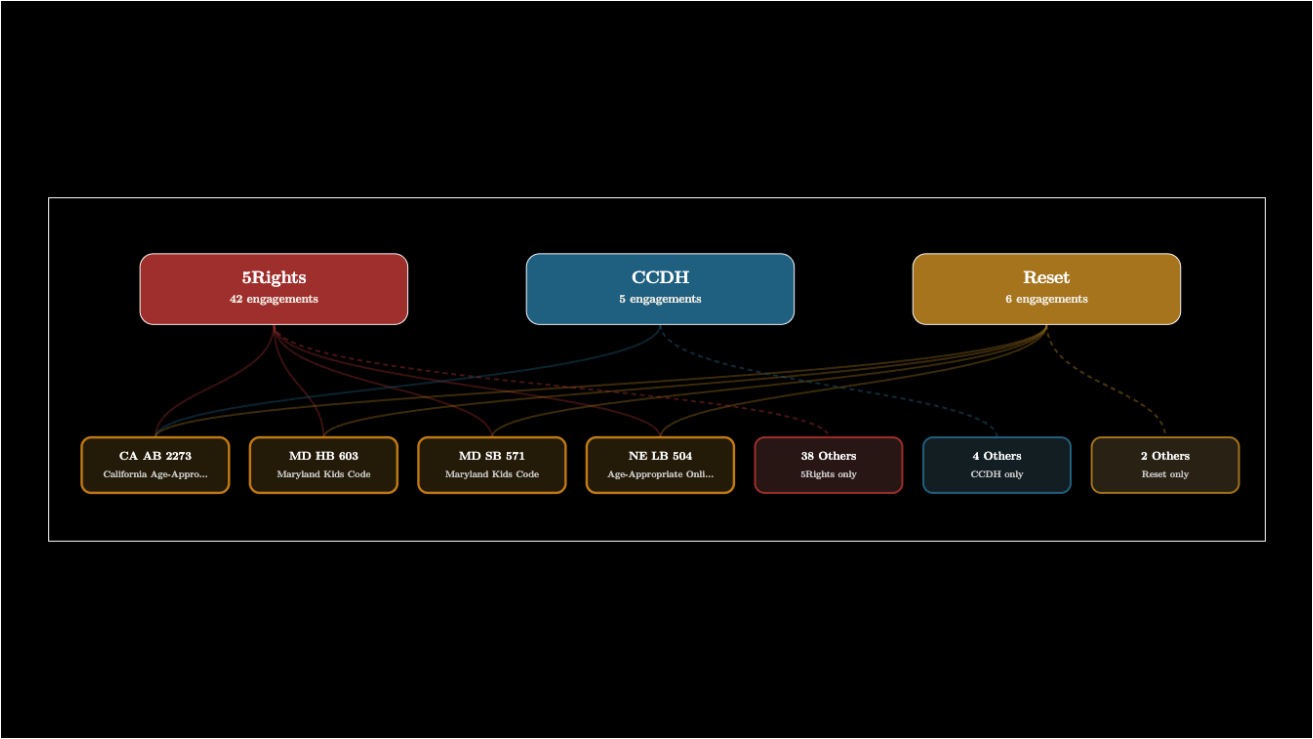
A coalition of five foreign NGOs and U.S. affiliates is coordinating a campaign to import British-style digital-ID mandates into U.S. legislation.
The NGOs, including 5Rights and the Center for Countering Digital Hate, have filed under the Foreign Agents Registration Act and spent tens of thousands of dollars lobbying for bills such as California’s AB 2273.
The proposed laws would criminalize the use of VPNs and other anonymity tools, forcing platforms to verify users’ real identities and potentially curtailing privacy-preserving features.
THE READ
What the cluster adds up to.
An investigation uncovered a coordinated effort by five foreign non-governmental organizations and their U.S. affiliates to influence American lawmakers. Their unified strategy is to invoke child-safety concerns while advocating for digital-ID statutes that would eliminate adult anonymity online. The same approach succeeded in Britain, where such laws now support a broader surveillance and arrest framework targeting political dissent. The NGOs are now targeting a “patchwork” of legislation across 21 U.S. states and Congress.
One of the groups, 5Rights, is registered under the Foreign Agents Registration Act but has omitted key leadership details in its filings. It has paid a lobbying firm $50,000 to promote California’s AB 2273, a bill explicitly modeled on the UK’s Age-Appropriate Design Code, without disclosing the foreign-agent relationship until a year after the bill passed. The Center for Countering Digital Hate, founded by British consultants, has also been linked to censorship campaigns and is accused of FARA violations, though the Justice Department has not confirmed an investigation.
For engineers, the spread of digital-ID requirements means existing authentication stacks may need to incorporate real-world identity verification, such as government-issued IDs, and to log that data in compliance-ready formats. Services that currently rely on VPNs or other anonymity mechanisms could face legal bans, forcing a redesign of network-access controls and possibly removing privacy-preserving features. The cost of these changes includes development effort, third-party verification services, and ongoing legal monitoring to keep pace with state-specific mandates.
Enforcement is uneven: while some states have already enacted laws, others are still debating similar measures, creating a fragmented regulatory landscape. The U.S. Department of Justice has not publicly opened a case against the NGOs, and some filings lack answers to critical control questions, leaving the exact degree of foreign influence ambiguous. Consequently, platforms must build flexible compliance frameworks that can be toggled on or off depending on jurisdictional requirements.
Overall, the push for digital-ID legislation introduces new compliance burdens and reduces the technical options for preserving user anonymity. Engineers will need to allocate resources to identity-verification integration, audit data-handling practices, and monitor legislative developments across multiple states to avoid inadvertent violations.
Written by elseif from the cluster below · checked for specifics the sources never containedTHE CLUSTER