TECH Signal 480
The Warp Agent CLI
 ↗
↗
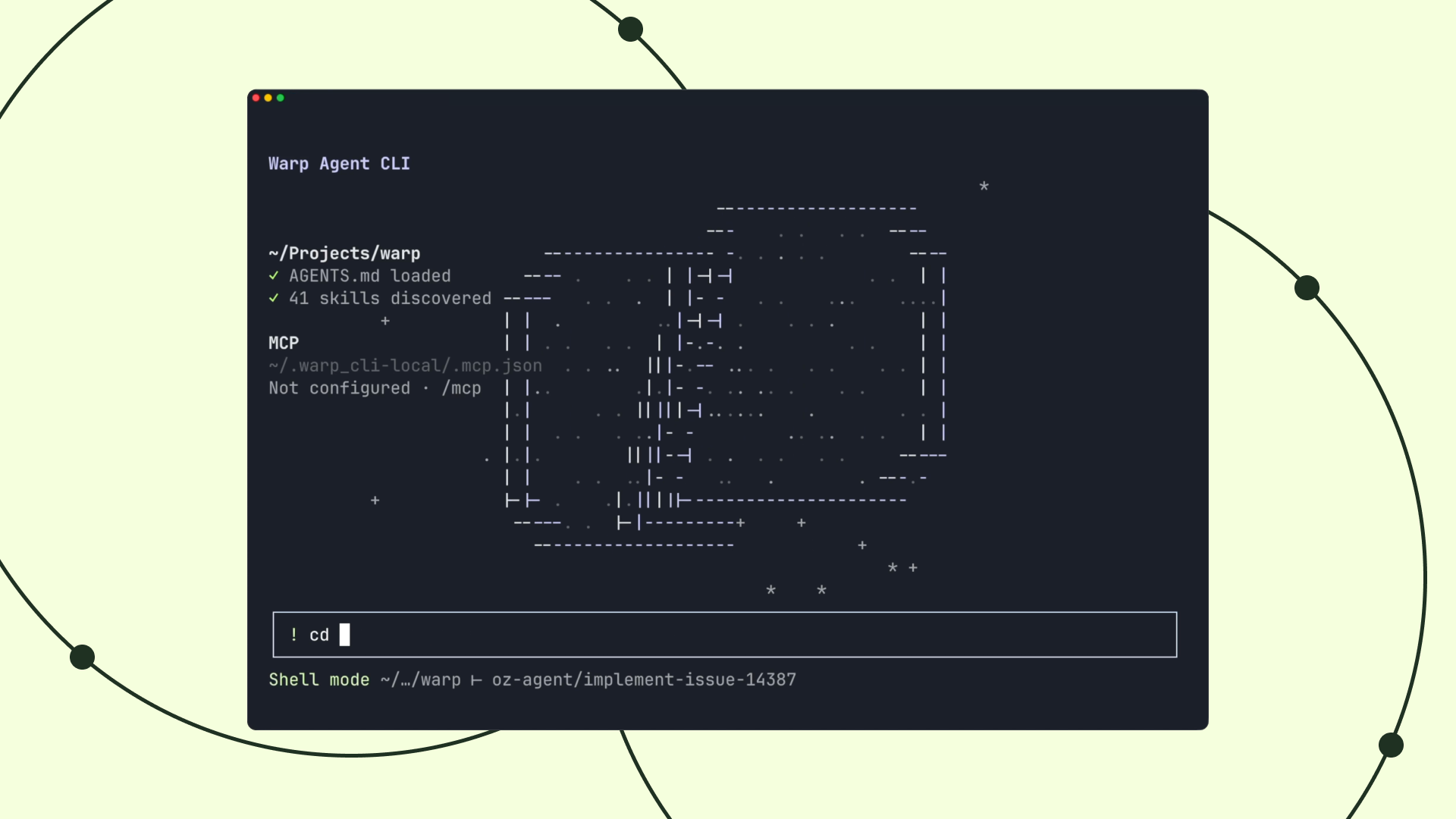
Warp has released a standalone Agent CLI that works in any terminal and uses its terminal infrastructure to multiplex agent sessions, enabling persistent, remote, and full-screen workflows.
Engineers can now run the Warp Agent outside of Warp Terminal, gaining access to its multi-model routing and cost-optimizing harness in their preferred shell. The CLI’s multiplexing lets agents keep state across directory changes, drive interactive tools like sqlite or gdb, and operate over SSH without installing remote binaries. It also supports cloud agents, multi-agent orchestration, and seamless hand-off to Warp’s cloud platform, reducing friction for complex terminal-centric development.
Written by elseif from the cluster below · every claim links back to a sourceThe three things worth knowing
The CLI provides native model routing with frontier and US-hosted open-weight models, plus optional custom routers.
Built on Warp’s terminal infrastructure, it multiplexes pty connections so agents can switch directories, run full-screen apps, and persist sessions across state changes.
It offers natural language command detection, tab completion, and orchestration of subagents or cloud agents, including hand-off to platforms like Claude Code and Codex.
THE READ
What elseif makes of it.
The Warp Agent CLI decouples the agent from the Warp Terminal application, allowing it to be invoked in Ghostty, iTerm 2, VS Code, or the native Windows/macOS terminals. This broadens the reach of Warp’s multi-model agent to developers who prefer other shells while retaining the same underlying capabilities. The release positions the CLI as a drop-in replacement for other agentic CLIs that struggle with deep shell integration.
By leveraging Warp’s terminal infrastructure, the CLI creates a multiplexing layer that manages PTY connections with an indirection layer similar to tmux. This architecture lets the agent remain aware of terminal blocks, enabling features such as persistent sessions that survive directory changes and remote execution without installing binaries on the target machine. Engineers gain the ability to move across repositories or cloud instances while keeping the agent’s context intact.
The CLI supports full-screen and interactive terminal programs like sqlite, mysql, python, gdb, and htop, allowing the agent to drive these tools directly from a REPL or command line. Natural language detection distinguishes shell commands from agent prompts, invoking the appropriate handler automatically. Tab completion, a flagship Warp feature, provides argument and flag suggestions as users type, reducing friction for complex command construction.
Advanced workflows are accommodated through built-in support for multi-agent orchestration and cloud agents. The agent can delegate tasks to subagents with different models or even to external harnesses such as Claude Code and Codex, with a UI that lets users switch between orchestrator and subagent views using arrow keys. When paired with Warp’s cloud platform, sessions can be handed off to the cloud for continued execution, enabling hybrid local-cloud development patterns.
Overall, the Warp Agent CLI addresses gaps observed in other agentic CLIs regarding shell integration, session persistence, and remote operability. For developers who spend significant time in the terminal, the CLI offers a unified environment where model routing, agent control, and terminal multiplexing coexist, potentially reducing context-switching overhead and improving productivity on complex, multi-repo or cloud-based projects.
Written by elseif from the cluster below · checked for specifics the sources never containedTHE CLUSTER