DATABASES Signal 199
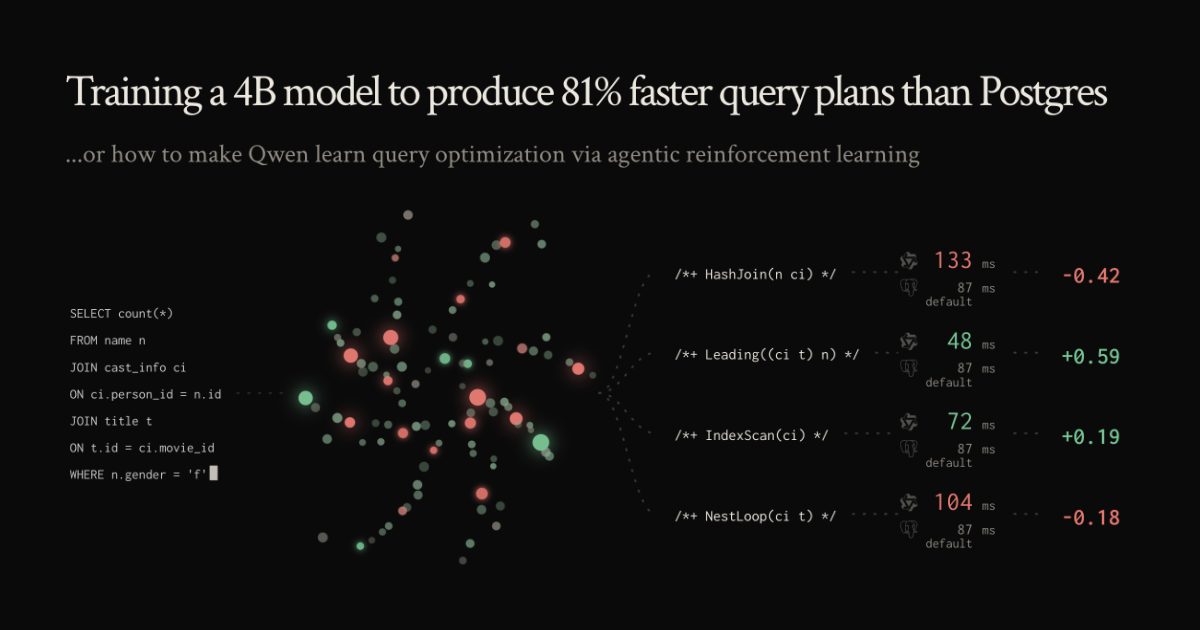
Training a 4B model reportedly produces 81% faster query plans than Postgres
 ↗
↗
Comments
This development suggests significant improvements in database query optimization. Faster query plans can enhance application performance, especially in data-intensive environments. The use of advanced models like this may redefine how databases are optimized in the future.
Written by elseif from the cluster below · every claim links back to a sourceThe three things worth knowing
A 4B model demonstrated a 44.7% latency reduction across various join-heavy queries.
The model used a combination of supervised fine-tuning and reinforcement learning to improve query plans.
This approach highlights the challenges of traditional query optimization methods in handling complex database queries.
THE READ
What the cluster adds up to.
The reported training of a 4B model to produce query plans that outperform Postgres by 81% illustrates a substantial advancement in query optimization techniques. This model leverages reinforcement learning and fine-tuning to enhance its performance in generating efficient query plans, particularly for complex join operations.
Cost implications for adopting this model may include the need for specialized hardware, as indicated by the use of rented high-performance nodes for training. Organizations might need to invest in infrastructure capable of supporting such models, particularly if they seek to implement similar systems.
However, it's essential to note that while this model shows promise in specific scenarios, its effectiveness may diminish in highly unique or varied query environments. The performance gains realized in controlled experiments do not guarantee similar results in all real-world applications, especially those with different datasets or query structures.
Written by elseif from the cluster below · checked for specifics the sources never containedTHE CLUSTER