TECH Signal 492
TSON – A JSON superset with immutable, hash-pinned schemas
 ↗
↗
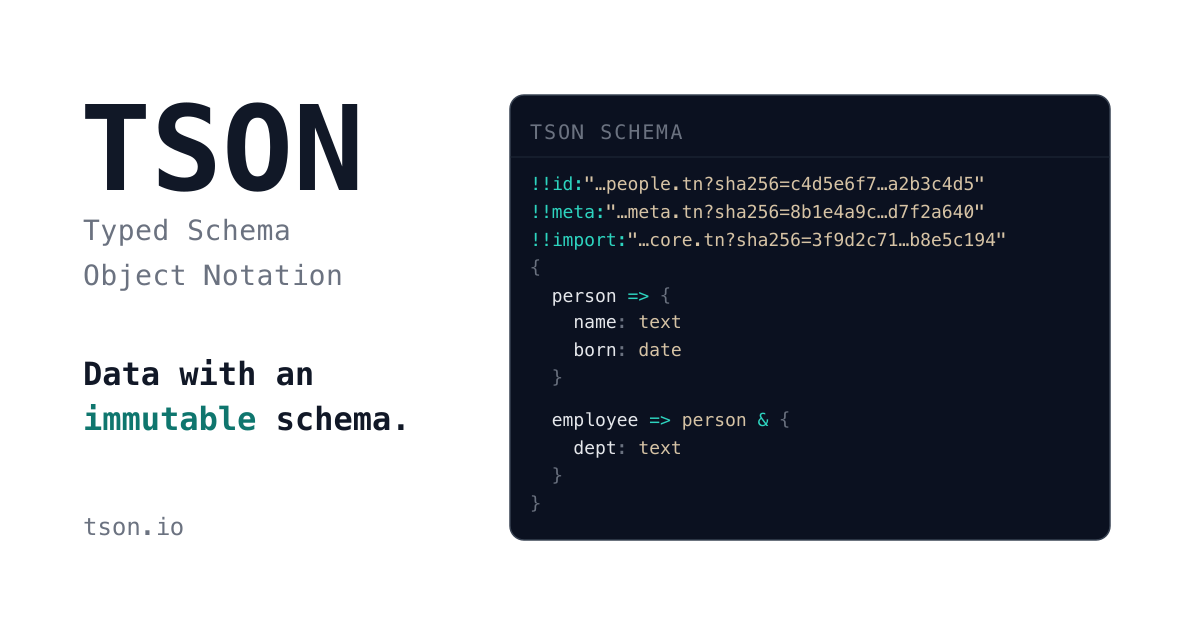
TSON introduces a JSON-compatible format where schemas are immutable, referenced by cryptographic hashes, and share the same syntax and tooling as the data they describe.
Embedding a hash-pinned schema directly in a document guarantees that the data and its contract cannot diverge without detection, simplifying integrity checks. Engineers can replace scattered validation code with declarative schema files, gaining clearer contracts and uniform tooling. The approach also adds expressive type features, defaults, enums, composition, and sum types, while remaining a Unicode-first superset of JSON.
Written by elseif from the cluster below · every claim links back to a sourceThe three things worth knowing
Schemas are treated as data and are identified by a SHA-256 hash, enabling end-to-end verification of both schema and document.
A concise schema language provides explicit field states (required, optional, default, pinned) and advanced constructs like arrays, sets, enums, inheritance, and subtraction.
A Java implementation supplies a CLI for generating example schemas and validating documents, reporting all violations with precise locations.
THE READ
What elseif makes of it.
TSON adds a layer on top of JSON that makes the schema an immutable artifact tied to the document via a hash reference. The document declares which schema it follows, and the schema itself points to a meta-schema, forming a verifiable chain. Because both schema and data use the same lexer, developers can work with a single set of tools for authoring and validation. This contrasts with traditional JSON where schemas are external and often loosely coupled.
Adopting TSON means converting existing JSON payloads to the new syntax and embedding hash-based schema pointers. Teams will need to incorporate the provided Java library or CLI into their build pipelines to generate and validate schemas, which may involve adding a Java runtime dependency. The transition also requires updating any services that currently consume plain JSON to understand the extended syntax, or to translate TSON back to standard JSON where necessary.
The current ecosystem only includes a Java implementation, so environments that rely on other languages lack native support and would need either a custom parser or a translation step. Systems that expect strict JSON compliance, such as certain web APIs or lightweight parsers, will reject TSON documents unless they are pre-processed. Consequently, TSON is best suited for internal data pipelines where the Java tooling can be deployed, rather than for public-facing JSON interfaces.
Validation is performed by the CLI’s validate command, which checks a document against its referenced schema and returns a complete list of mismatches with paths and reasons. This replaces ad-hoc validation code scattered across services, centralizing contract enforcement. The error reporting format aids debugging by pinpointing the exact location of each violation, which is more systematic than typical JSON schema validators that may stop at the first error.
Beyond basic type checks, TSON’s schema language supports constructs such as default values, pinned constants, inheritance, and subtraction, allowing developers to model complex domain rules directly in the schema. Features like sum types and field groups let data express mutually exclusive structures without extra tagging. These capabilities reduce the need for custom application logic to enforce business rules, but they also require developers to learn the new declarative syntax.
Written by elseif from the cluster below · checked for specifics the sources never containedTHE CLUSTER