DEV TOOLS Signal 95
Uber centralizes Git operations with GitFarm to cut monorepo resource use by 80 percent
 ↗
↗
GitFarm replaces local repository clones with a gRPC-based Git-as-a-Service platform, reducing client-side CPU, memory, and startup time for large monorepos.
Monorepos at scale create heavy infrastructure overhead for Git operations. Centralizing these operations as a service reduces redundant resource consumption and latency, which is critical for automation and CI/CD workflows. Teams managing large codebases may adopt similar architectures to improve efficiency.
Written by elseif from the cluster below · every claim links back to a sourceThe three things worth knowing
GitFarm eliminates local repository clones by running Git operations as a centralized service over gRPC.
Pre-warmed checkouts and ephemeral sandboxes reduce startup latency from minutes to under a second.
Adopters report 80 percent reductions in CPU and memory use, with startup times dropping from 15 minutes to under one minute.
THE READ
What the cluster adds up to.
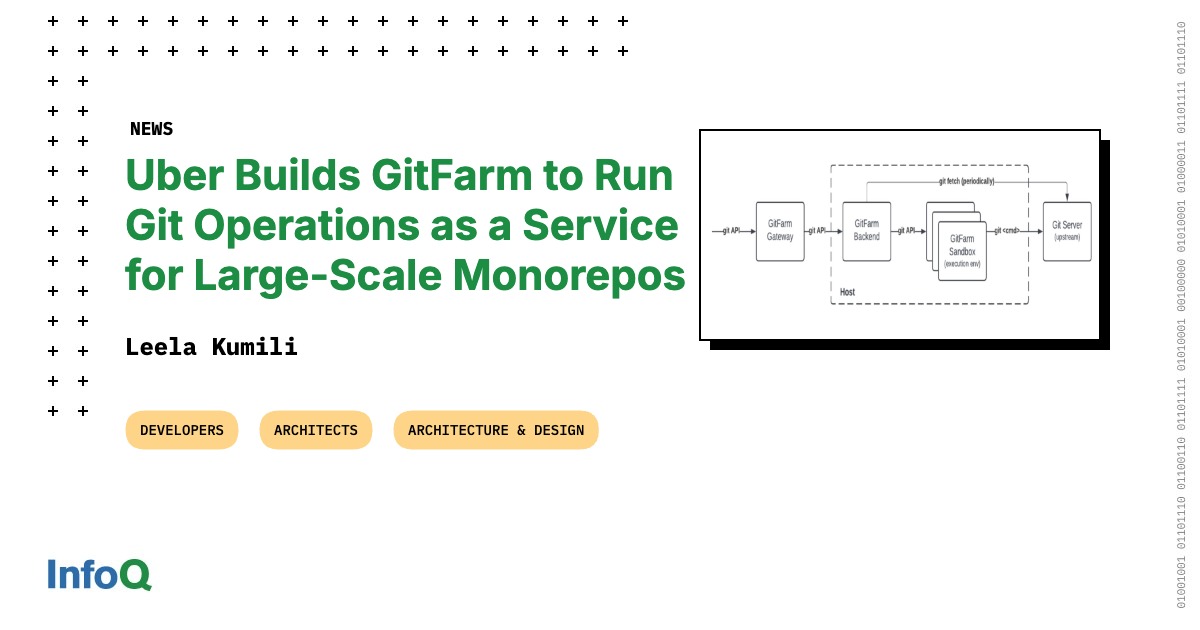
Uber’s GitFarm shifts Git operations from local clones to a shared service. This change removes the need for individual services to maintain full repository checkouts, which previously required significant CPU, memory, and disk resources. The platform uses gRPC streaming to expose Git commands, allowing clients to offload operations like file reads, merge base calculations, and branch validations. The architecture is not a replacement for source control management but acts as a centralized Git client for other services.
The backend maintains synchronized bare repository clones and pools of pre-warmed checkouts. When a request arrives, GitFarm mounts a checkout into an ephemeral sandbox instead of initializing a new clone. This pooling reduces the overhead of providing a ready-to-use environment to under a second. The system also supports multi-command workflows through bidirectional gRPC streaming, enabling sequential operations without reinitializing repository state. Clients can choose between fresh fetches or bounded staleness based on their needs.
Resource savings are substantial. A code ownership service reduced CPU consumption from over 70 cores to 16 and memory from 400 GB to 32 GB after adopting GitFarm. Startup time dropped from 15-20 minutes to under one minute. A compliance auditing service processing thousands of events per hour saw median latency fall from 110-160 seconds to 20-30 seconds. These improvements address bottlenecks in automation and CI/CD pipelines, where repetitive repository syncing and cloning create infrastructure overhead.
GitFarm’s design also anticipates future workloads, such as coding agents. Agents performing concurrent searches, branching, diffing, and validation could increase Git infrastructure demands. The platform’s roadmap includes streaming Git output, sparse checkouts, and longer-lived sessions, which may further reduce latency and resource use. While currently in production at Uber, the architecture could serve as a model for other organizations managing large monorepos.
Written by elseif from the cluster below · checked for specifics the sources never containedTHE CLUSTER