DATABASES Signal 282
Uber Redesigns M3DB Sharding with Fixed-Size Subclusters to Limit Node Failure Impact
 ↗
↗
Uber has redesigned shard placement in M3DB with fixed size subclusters to limit the impact of node failures, maintenance, and cluster scaling.
This redesign enhances the reliability of Uber's M3DB by reducing the cascading failures that can occur during node outages or maintenance. The new structure stabilizes shard dependencies and ensures more efficient scaling and maintenance operations, potentially leading to lower operational costs and better performance in large clusters.
Written by elseif from the cluster below · every claim links back to a sourceThe three things worth knowing
M3DB's new fixed-size subclusters improve shard isolation and reduce the impact of node failures.
The approach uses a greedy algorithm to efficiently manage shard migrations during scaling.
Constraints include equal instance weights and scaling in multiples of the subcluster size.
THE READ
What the cluster adds up to.
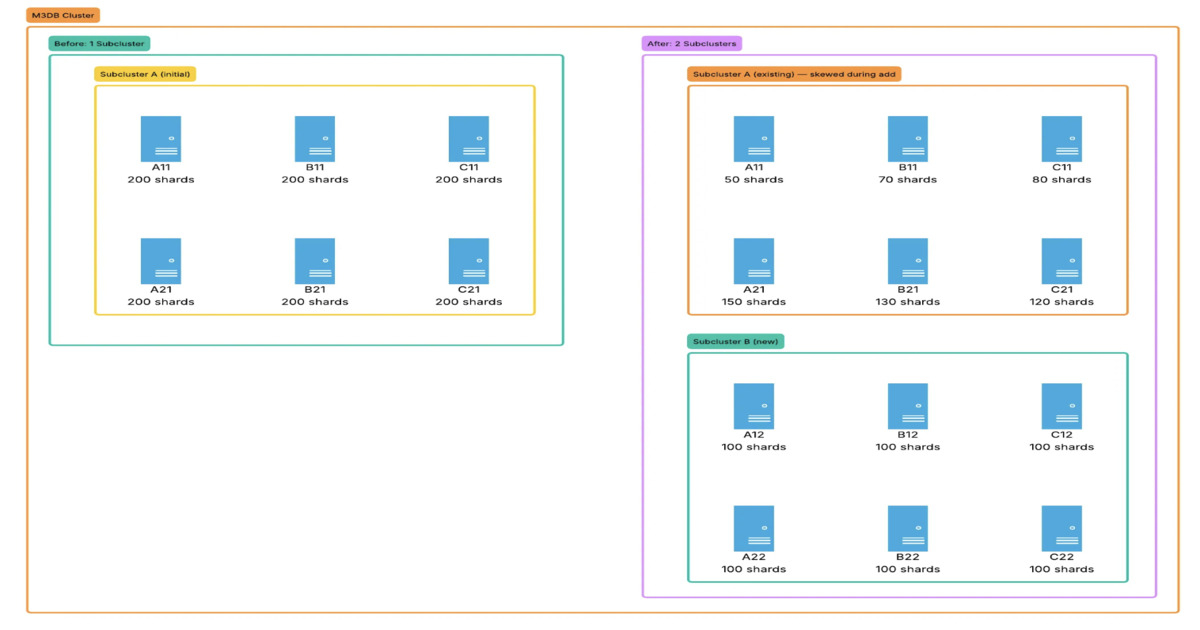
Uber's redesign of M3DB sharding introduces fixed-size subclusters to manage shard allocation more effectively. This change aims to limit the impact of node failures, where previously a failure could disrupt a significant portion of the cluster due to shard dependencies. By containing shard ownership within distinct subclusters, the risk of widespread failure is mitigated.
The implementation of a greedy algorithm for shard migration allows for a more streamlined scaling process. This method assesses the impact of removing shards from a subcluster and selects those that minimize load imbalance across nodes. This efficiency reduces the need for additional network transfers and operational overhead during scaling operations, which can be costly.
However, there are constraints that come with this new sharding model. The requirement for equal instance weights and that scaling must occur in multiples of the subcluster size can limit flexibility. Additionally, the inability to change the replica factor dynamically could present challenges as the database scales or as operational requirements evolve.
By retaining M3DB's existing instance-level placement operations, Uber ensures compatibility with current tools and minimizes disruptions during the transition. This cautious approach allows for a smoother integration of the new model without necessitating extensive reboots of the system, which could complicate operations.
Overall, this redesign represents a significant advancement in managing distributed database systems, particularly as they scale. The focus on reducing dependencies and improving shard placement efficiency addresses some of the critical pain points experienced in large-scale deployments.
Written by elseif from the cluster below · checked for specifics the sources never containedTHE CLUSTER