TECH Signal 496
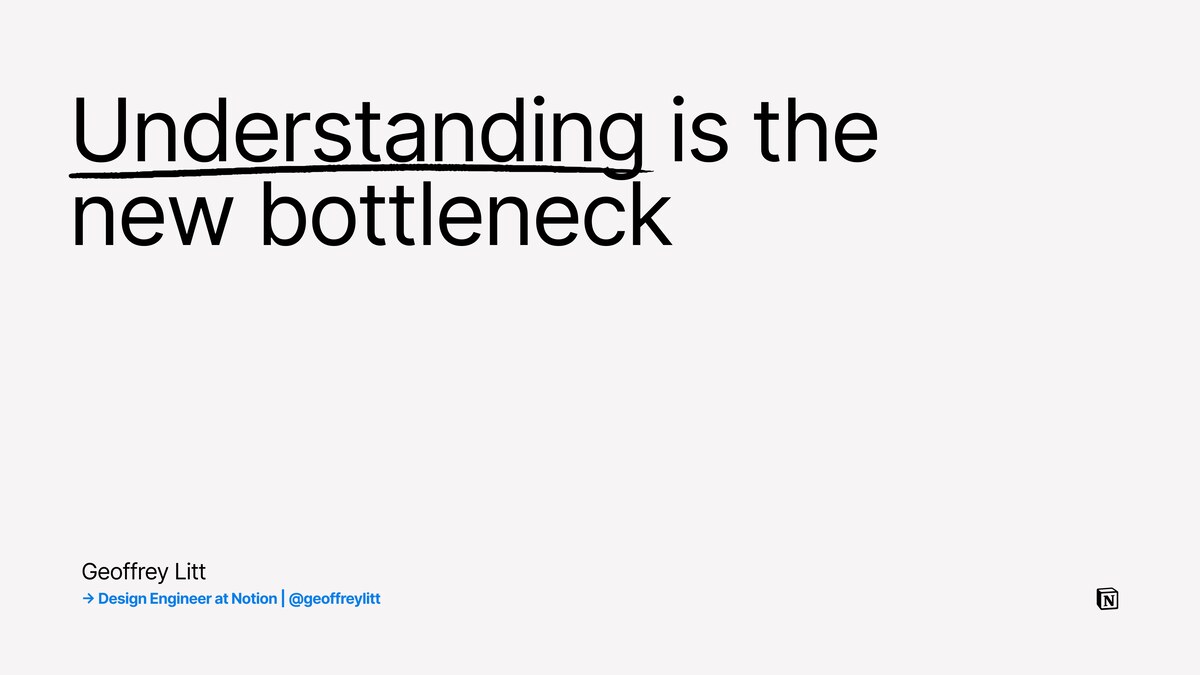
AI-generated code shifts engineering bottleneck from writing to understanding
 ↗
↗
A talk argues that verifying and participating in AI-written code requires new techniques for human comprehension rather than just thumbs-up approvals
Engineers now spend less time writing code and more time interpreting it. Without active understanding, cognitive debt accumulates, limiting creative participation in evolving systems. The shift demands structured explanations and interactive tools to maintain fluency
Written by elseif from the cluster below · every claim links back to a sourceThe three things worth knowing
AI agents increasingly generate code, reducing manual writing but increasing the need for human understanding
Traditional diff reviews are insufficient; structured explainers and interactive micro-worlds improve comprehension
Cognitive debt from shallow understanding restricts engineers' ability to creatively evolve systems over multiple iterations
THE READ
What the cluster adds up to.
The event reframes the engineering workflow around AI-generated code. Instead of writing being the primary task, understanding what the AI produces becomes the critical bottleneck. This shift is not about replacing engineers but about changing their role from authors to active participants in a collaborative loop with AI agents. The talk suggests that passive verification, simply approving or rejecting code, is insufficient as agents improve at self-verification. Engineers must instead build a rich mental model of the system to contribute creatively to its evolution.
The proposed solution borrows techniques from education to improve comprehension. Structured explainers, such as the `/explain-diff` tool mentioned, transform raw diffs into literate documents with background context, intuitive explanations, and embedded interactive elements. These artifacts aim to build intuition before diving into code details, making it easier for engineers to grasp changes quickly. The approach treats code understanding as a collaborative process, where both humans and AI contribute to documentation and interactive exploration. This method contrasts with traditional diff reviews, which often lack context and narrative structure.
The concept of cognitive debt highlights the long-term cost of shallow understanding. While engineers might get away with superficial reviews in the short term, the lack of deep comprehension limits their ability to iterate effectively. The talk positions understanding as a prerequisite for creative participation, not just correctness. Without fluency in the system's concepts, engineers struggle to propose meaningful improvements or adapt to new requirements. This bottleneck becomes more pronounced as projects involve multiple loops with AI agents, where each iteration builds on the previous one.
The techniques discussed are not theoretical but are already in use, such as embedding interactive HTML in Notion for visualizing changes. However, their effectiveness depends on adoption and integration into existing workflows. Engineers must invest time in learning these tools and adapting their processes, which may slow initial development but could pay off in reduced cognitive debt. The talk does not address scalability challenges, such as how these methods perform in large, complex systems where even structured explainers might become overwhelming. The focus remains on smaller, iterative changes rather than monolithic codebases.
Written by elseif from the cluster below · checked for specifics the sources never containedTHE CLUSTER