AI Signal 528
vLLM: Anatomy of a High-Throughput LLM Inference System
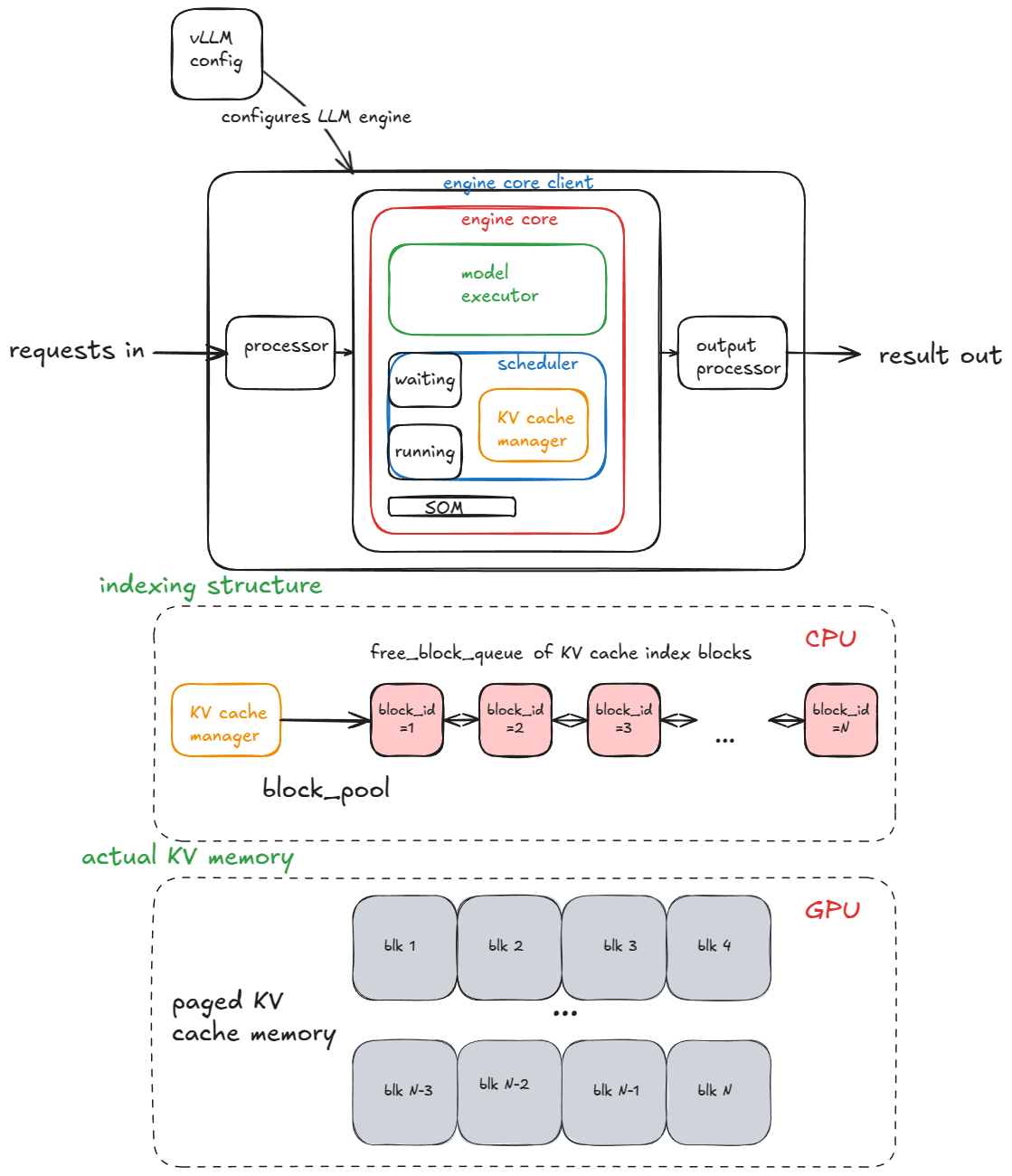 ↗
↗
vLLM's architecture is dissected to reveal the internals of a high-throughput LLM inference engine.
Engineers building or tuning LLM services now have a public, detailed reference for the trade-offs vLLM makes between latency, throughput, and memory. The post also surfaces the extension points that will let teams adapt the engine to new hardware or workloads without forking the codebase.
Written by elseif from the cluster below · every claim links back to a sourceThe three things worth knowing
Paged attention and continuous batching are the two primitives that drive vLLM’s throughput gains over naive inference stacks.
The engine is modular: each component (scheduler, KV-cache manager, model executor) can be swapped or scaled independently.
Single-GPU offline inference is the starting point; later posts will layer on distributed serving, async I/O, and multi-node execution.
THE READ
What the cluster adds up to.
The post exposes the internal structure of vLLM as a set of composable subsystems. Each subsystem, scheduler, KV-cache manager, model executor, is designed to be replaceable. This modularity means engineers can experiment with new scheduling policies or memory allocators without rewriting the entire engine. It also means the same codebase can target a single GPU or a multi-node cluster, reducing the cost of scaling up.
Paged attention is the memory-management primitive that underpins vLLM’s throughput. By breaking the KV cache into fixed-size blocks and mapping tokens to blocks via a table, the engine avoids the quadratic memory blow-up of pre-allocating the full cache. The trade-off is added indexing overhead and a minimum block size that may waste memory on small requests. Engineers who need to serve many short prompts will see higher effective throughput; those serving long documents may hit memory limits sooner.
Continuous batching is the second throughput lever. Instead of waiting for an entire batch to finish, the scheduler can swap in new requests as soon as a slot opens. This keeps GPU utilization high but requires careful queue management to avoid starvation of long-running requests. The post shows that the scheduler’s policy can be toggled between first-come-first-served and priority-based, giving operators a simple knob to balance fairness and latency.
The walkthrough starts with a synchronous, single-GPU offline example. This is the minimal viable configuration, but it already contains all the core components. Later posts will add async I/O, distributed serving, and multi-node parallelism. Engineers who adopt vLLM today can start with the offline engine and incrementally enable features as their workload grows, rather than facing a single large migration.
The post is explicit about what vLLM does not yet support: hybrid models like Jamba, multi-query attention variants, and disaggregated prefill/decode. These gaps are not accidental; they reflect deliberate design choices to keep the initial implementation tractable. Teams that need these features will have to extend the engine or wait for future updates, adding development cost or latency to their roadmaps.
Written by elseif from the cluster below · checked for specifics the sources never containedTHE CLUSTER