AI Signal 142
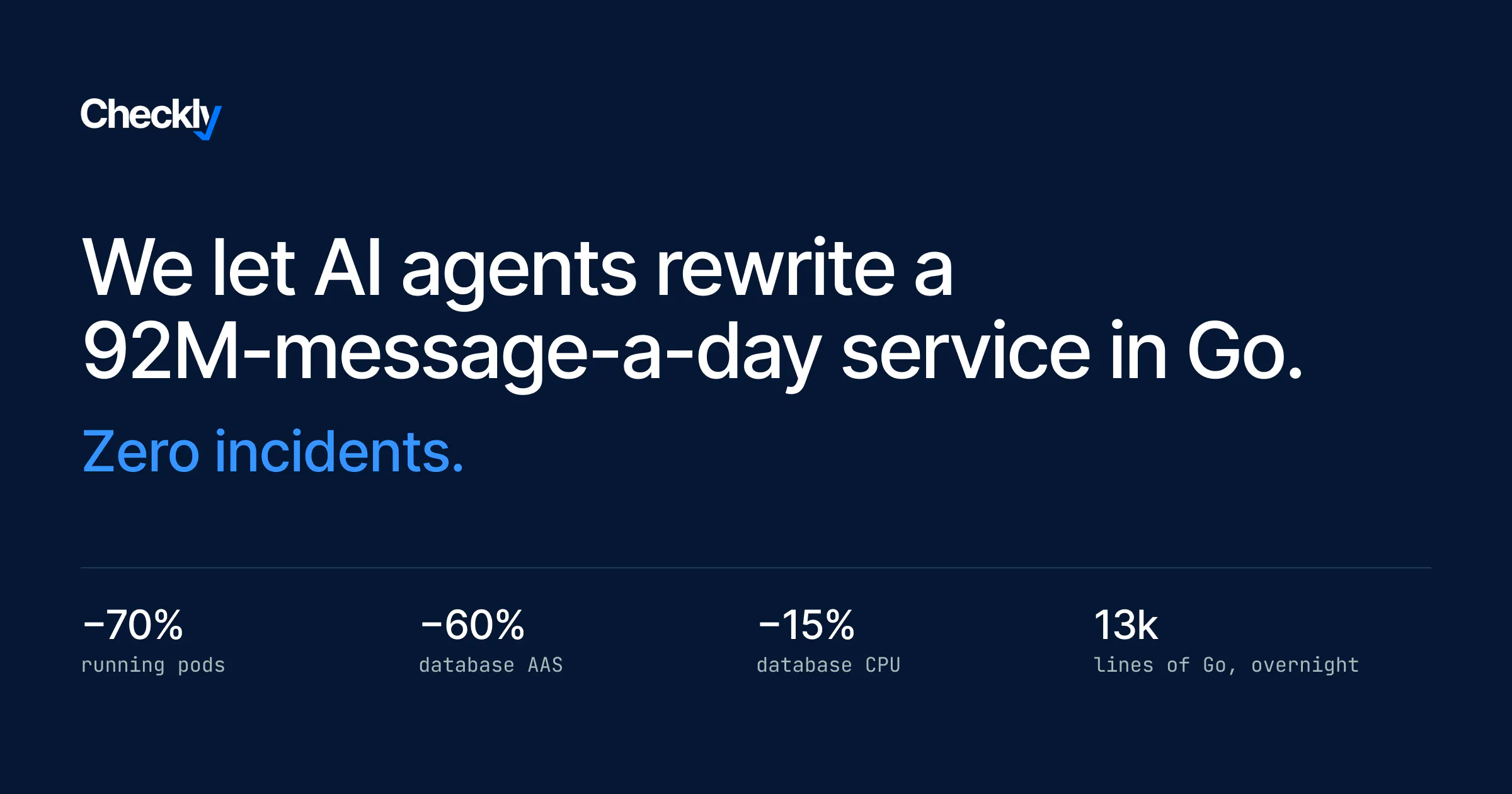
AI agent rewrites 92M-message daily service from Node.js to Go with zero incidents
 ↗
↗
A monitoring platform replaced a high-throughput Node.js service with Go code written by an AI agent, reducing running pods by 70% and improving reliability.
This demonstrates that AI-driven rewrites can handle critical production workloads at scale, not just prototypes. The approach reduces operational costs and improves type safety, but success hinges on a rigorous test harness to validate correctness.
Written by elseif from the cluster below · every claim links back to a sourceThe three things worth knowing
The rewritten Go service processes 92 million messages daily with zero production incidents after deployment.
A pre-built test harness with golden files and deterministic assertions ensured byte-level parity with the legacy system.
Go’s stronger type system and agentic rewrite reduced running pods by 70% and lowered database load.
THE READ
What the cluster adds up to.
A monitoring platform replaced its Results Daemon, a Node.js service processing 92 million messages daily, with a Go implementation written by an AI agent. The rewrite targeted a bottleneck in a critical production system, where increasing message volume had led to degraded performance and higher on-call alerts. The team chose Go for its stronger type system, which they found better suited for agentic code generation than JavaScript. The new service shipped without incidents, reducing running pods by 70% and easing database load, while also improving confidence in future changes.
The rewrite’s success depended on a test harness built before any code was generated. The harness treated the service as a black box, decoupling tests from implementation details. It used golden files, pre-recorded outputs from the legacy system, to assert byte-level parity with the new implementation. Non-deterministic fields like UUIDs and timestamps were normalized to avoid false negatives. Surrounding infrastructure (databases, queues, caches) was managed as boundaries, with real instances used in testing to ensure fidelity. This approach minimized coupling and maximized confidence in the rewrite’s correctness.
The harness relied on three key tools: Playwright for reliable test execution and network interception, Docker Compose for container management, and Toxiproxy for simulating network failures. Test cases were designed to cover every combination of check results and configurations, ensuring full behavior coverage without tying tests to the implementation. The team prioritized realistic, diverse inputs to maximize the harness’s effectiveness. This method proved that agentic rewrites can scale to production workloads, but only when paired with rigorous validation.
The rewrite’s impact extended beyond performance gains. The Go implementation’s stronger type system reduced the risk of regressions, allowing the team to ship changes faster. The 70% reduction in running pods directly lowered operational costs, while the lighter database load improved overall system stability. However, the approach is not universally applicable, it required significant upfront investment in test infrastructure and may not suit systems with highly dynamic or non-deterministic behavior. The team’s experience suggests that agentic rewrites are viable for high-throughput services, but only with a well-designed harness to ensure correctness.
Written by elseif from the cluster below · checked for specifics the sources never containedTHE CLUSTER