TECH Signal 328
Compact red core in nearby spiral galaxy resembles early-universe little red dots
 ↗
↗
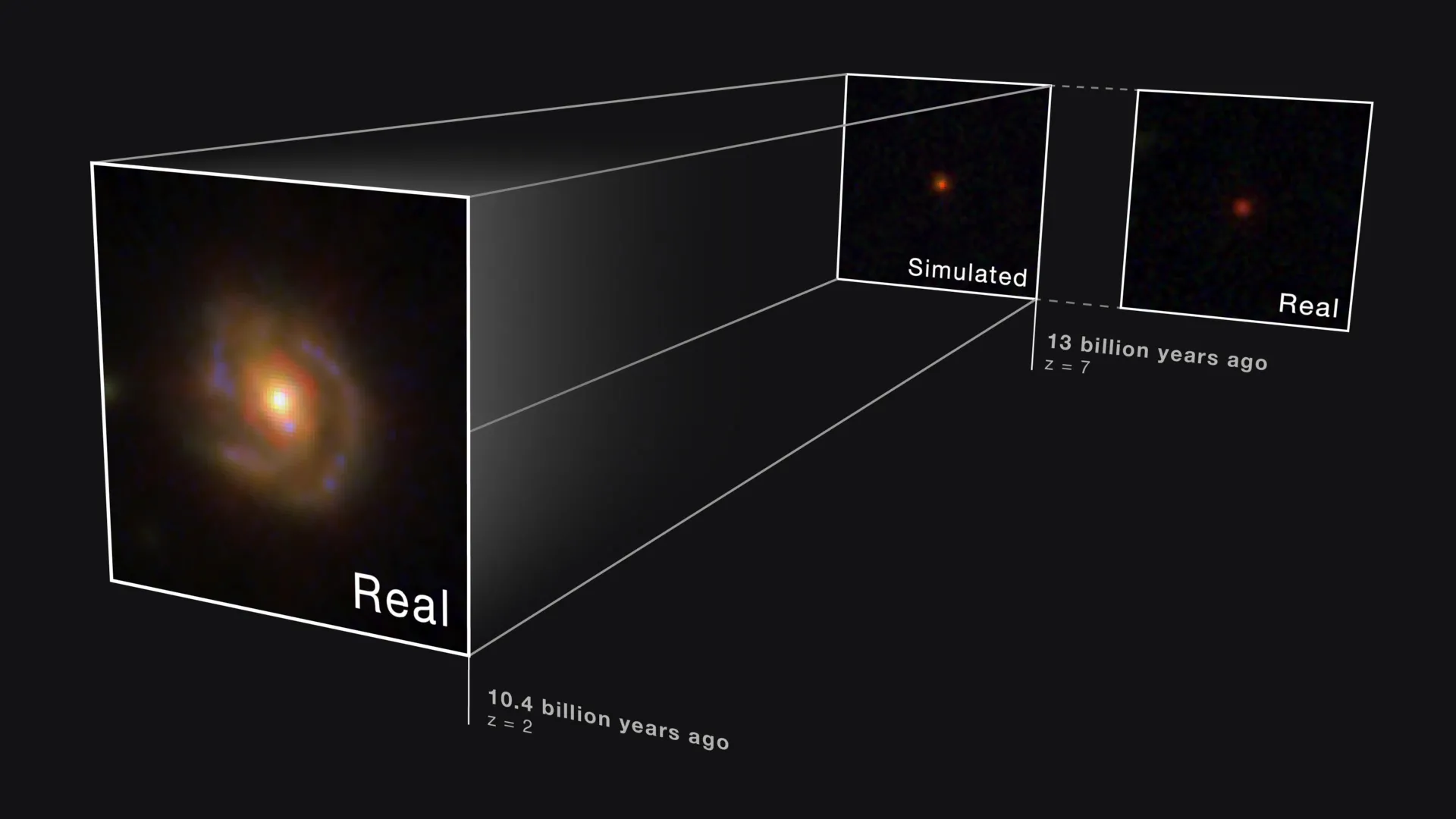
A study of the spiral galaxy WISEA J123635.56+621424.2 (nicknamed “Saguaro”) shows a bright red nucleus that matches the appearance of the mysterious little red dots seen at high redshift, implying those dots may be whole galaxies whose outer parts are too faint to detect.
If little red dots are actually compact galaxy cores, models of early-universe galaxy formation must account for a hidden host component, changing how astronomers infer mass and star-formation rates from infrared data. The result also highlights the need for telescopes with sufficient resolution and sensitivity to capture faint surrounding structures, influencing future instrument design and data-processing pipelines.
Written by elseif from the cluster below · every claim links back to a sourceThe three things worth knowing
The Saguaro galaxy at redshift 2 displays a compact, bright red center that looks like a little red dot.
Simulating the Saguaro at greater distances makes its spiral arms disappear, leaving only the red core, mirroring observations of distant little red dots.
The study suggests observational bias hides the host galaxies of little red dots, meaning they may not be a separate population.
THE CLUSTER