AI Signal 478
Local LLM inference performance diverges from reference implementations due to hardware and software variations
 ↗
↗
Local deployments of large language models often underperform compared to reference implementations due to differences in hardware, software stacks, and sampling configurations
Engineers running LLMs locally may observe degraded performance or unexpected behavior that isn’t inherent to the model itself. Understanding the sources of divergence helps diagnose issues and set realistic expectations for local inference. Without accounting for these factors, benchmarks and user experience may misrepresent a model’s true capabilities.
Written by elseif from the cluster below · every claim links back to a sourceThe three things worth knowing
Hardware differences, including GPU instruction sets, introduce variability in token generation even with identical model weights
Sampler settings and benchmark methodologies significantly impact perceived model performance and must match reference implementations
KL Divergence measurements require full disclosure of methodology to be meaningful, as small changes in logits can alter output quality
THE READ
What the cluster adds up to.
Local implementations of large language models rarely match the performance of reference implementations due to differences in hardware and software stacks. Reference implementations typically run on optimized, homogeneous hardware with carefully tuned inference engines, while local deployments often involve mixed GPU generations, different instruction sets, and varied software configurations. These differences manifest as subtle but cumulative changes in token generation, leading to outputs that may feel less coherent or capable than expected. The divergence isn’t a flaw in the model itself but a consequence of the local environment’s inability to replicate the reference conditions precisely.
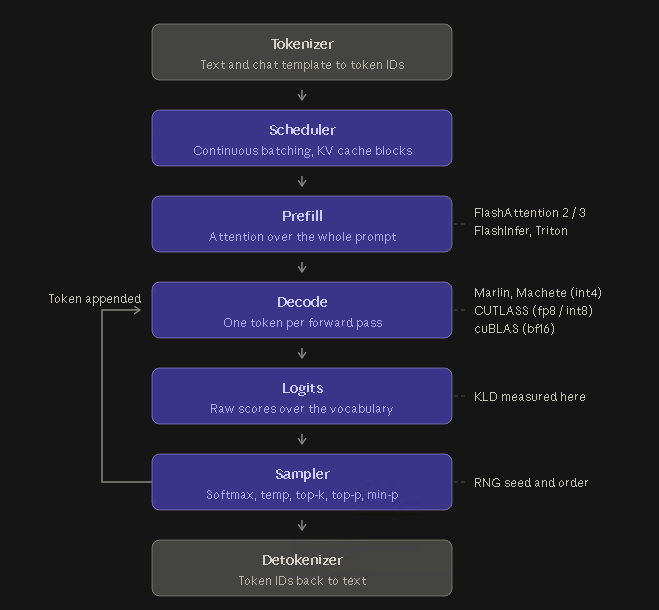
Sampler settings and benchmarking practices play a critical role in the perceived performance of local LLMs. Model cards often specify exact sampler configurations, such as temperature and top-p values, which must be adhered to for consistent results. Deviating from these settings, such as setting temperature too low, can cause issues like repetitive or stalled outputs. Similarly, benchmarks must be representative of real-world use cases, including long-context tool-calling and domain-specific evaluations. Zero-shot tests or limited prompt sets fail to capture the nuances of agentic tasks, leading to misleading conclusions about a model’s capabilities in local deployments.
KL Divergence (KLD) is a metric used to quantify how far the output probability distribution of a local implementation deviates from a reference baseline. While lower KLD values suggest closer alignment with the reference, they do not inherently indicate better performance. The metric is directional and sensitive to the choice of baseline, evaluation text, and context length. Claims of impossibly low KLD on quantized models are often meaningless without full disclosure of the methodology, including calibration data, sampled positions, and aggregation methods. Engineers must treat KLD as one tool among many, not a definitive measure of model quality.
The software stack used for local inference introduces additional sources of divergence. Inference engines like vLLM include multiple configurable components, each of which can alter the model’s behavior. For example, differences in how logits are normalized, how tokens are sampled, or how detokenization is handled can compound into noticeable changes in output quality. These variations are often invisible to the end user but contribute to the feeling that a local LLM is "dumber" than its reference counterpart. Understanding these layers is essential for diagnosing performance issues and optimizing local deployments.
The practical takeaway for engineers is that local LLM performance is highly dependent on the specific hardware and software environment. While reference implementations provide a benchmark, local deployments will almost always diverge due to uncontrollable variables. The goal isn’t to eliminate divergence entirely but to minimize it through careful configuration and benchmarking. This includes using the correct sampler settings, running representative benchmarks, and validating outputs against known baselines. Without these steps, local LLMs may underperform expectations, not because the model is flawed, but because the implementation is mismatched to the task.
Written by elseif from the cluster below · checked for specifics the sources never containedTHE CLUSTER