AI Signal 232
WorkspaceBench introduces evaluations for interpretability methods in AI models
 ↗
↗
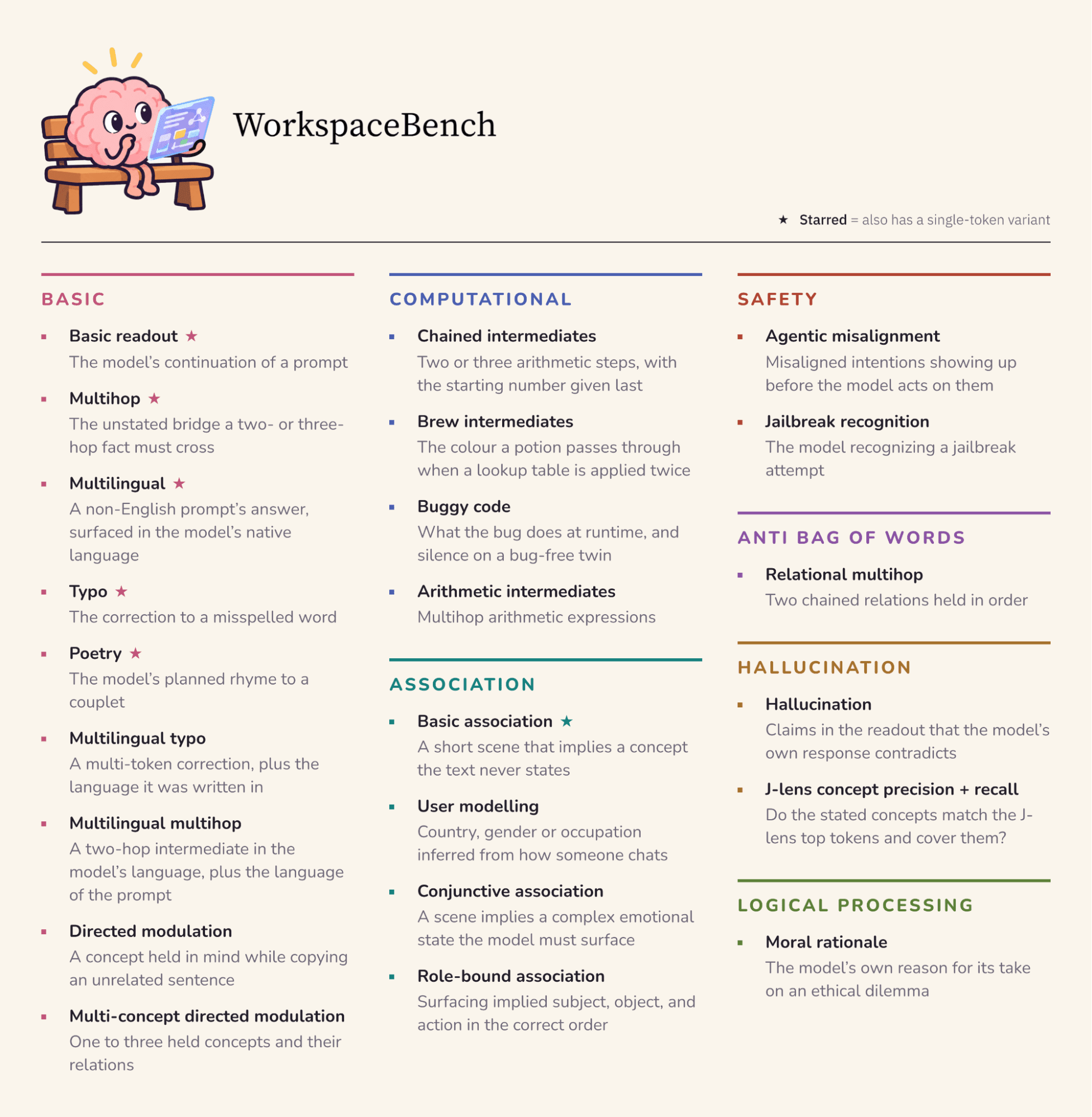
WorkspaceBench is a benchmark evaluating how well activation-to-text tools can interpret the global workspace of AI models.
This benchmark aims to improve the understanding of AI model behavior by focusing on interpretability. By evaluating how well tools can access and represent intermediate variables, it provides insights that are critical for model auditing and trustworthiness. The introduction of a structured evaluation process can help developers create more reliable interpretability tools.
Written by elseif from the cluster below · every claim links back to a sourceThe three things worth knowing
WorkspaceBench comprises 3,356 questions across 27 evaluation families.
It focuses on minimizing hallucinations in interpretability methods to enhance reliability.
The benchmark is designed primarily for Qwen-3.6-27B but may need adaptation for smaller models.
THE READ
What the cluster adds up to.
WorkspaceBench represents a significant advancement in the evaluation of interpretability methods for AI models. By providing a structured approach to assess how well activation-to-text tools can read a model's global workspace, it fills a gap in the current methodologies available for analyzing AI behavior.
The benchmark includes a substantial number of questions (3,356) and covers various evaluation families, which suggests a comprehensive approach to testing. This can help identify strong interpretability tools and their capabilities, ultimately leading to better understanding and trust in AI systems.
However, while WorkspaceBench is primarily designed for Qwen-3.6-27B, its effectiveness on smaller or less capable models may vary. This limitation means that developers may need to adapt the benchmark to ensure it remains relevant across different model architectures.
Another critical aspect of WorkspaceBench is its focus on minimizing hallucinations in interpretation methods. By addressing the trade-offs between accuracy and hallucination rates, it aims to create a more reliable framework for interpreting model outputs, which is essential for safety and ethical considerations in AI deployment.
Overall, the introduction of WorkspaceBench can enhance the robustness of interpretability tools, making it easier for engineers to audit AI models. As more interpretability tools are developed, they can be evaluated against this benchmark, promoting continuous improvement in the field.
Written by elseif from the cluster below · checked for specifics the sources never containedTHE CLUSTER