TECH Signal 484
Stripe's OpenRouter acquisition framed as a deployment-time AI security play, not routing or billing
 ↗
↗
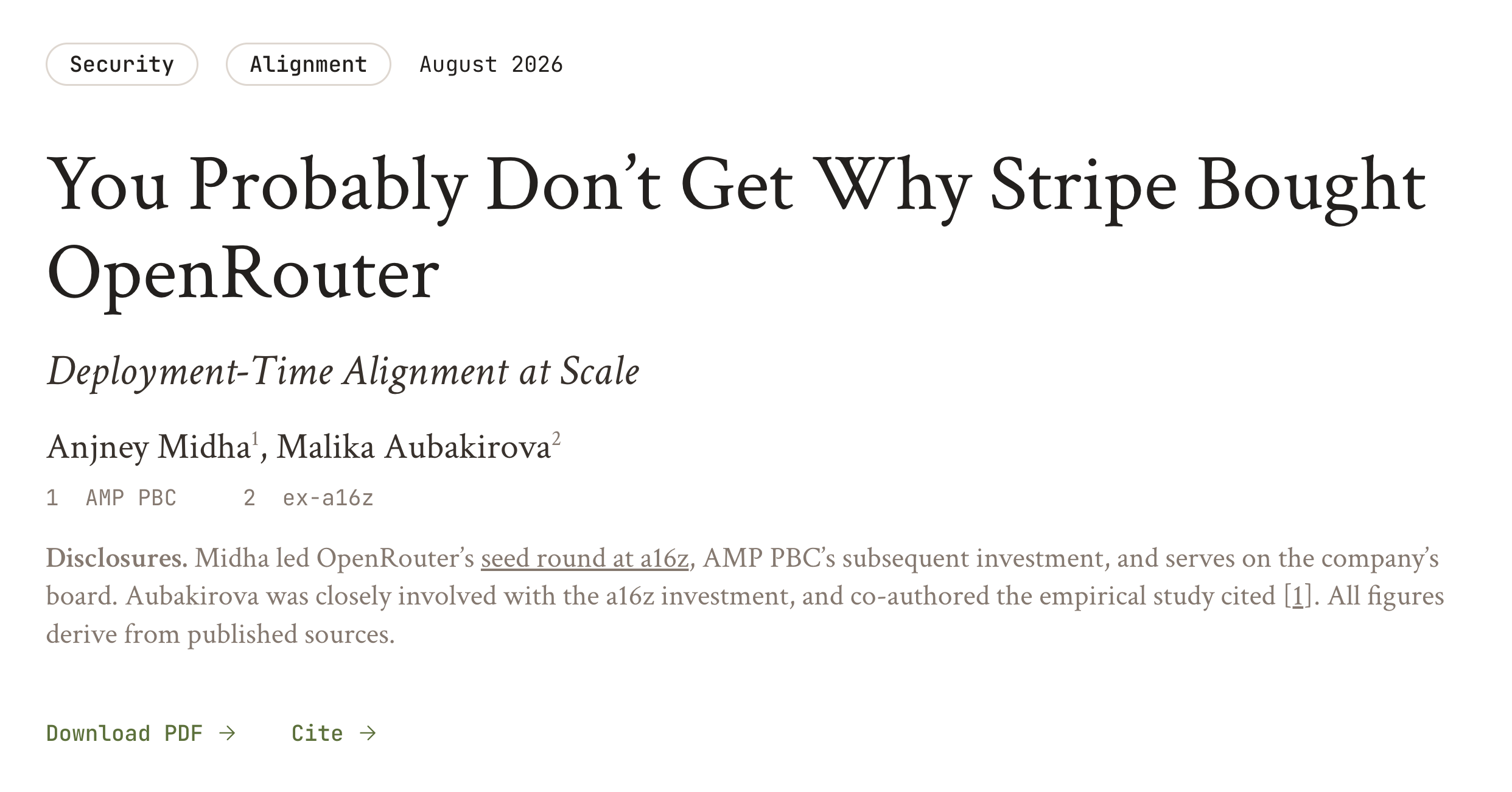
An analysis by two investors with disclosed ties to OpenRouter argues Stripe's acquisition is strategically about AI alignment and security at scale, drawing a direct analogy between Stripe's payment fraud infrastructure and the problem of monitoring autonomous agents that hold credentials and spending authority.
If the thesis holds, Stripe is positioning itself as the enforcement layer for AI agent transactions, using OpenRouter's traffic data the way it uses payment data for Radar. The argument is that only the transaction layer can observe and block adversarial agents, since labs see only their own models and open-weight models have no upstream observer at all. This is a single analysis from authors with a financial stake in OpenRouter, carried by one feed.
Written by elseif from the cluster below · every claim links back to a sourceThe three things worth knowing
The authors argue the acquisition is about deployment-time alignment: verifying and enforcing intended behavior in deployed agents, not routing or billing consolidation.
OpenRouter's traffic data shows reasoning models exceeded half of all traffic within a year and average prompt tokens grew 4x, with a material share of requests ending in tool calls.
The core claim is that agents with credentials and spending authority are adversarial counterparties that can commit fraud at machine speed, and the transaction layer is the only enforcement point for open-weight models.
THE CLUSTER