TECH Signal 496
Study finds economic connectedness predicts upward mobility more than hard work or luck
 ↗
↗
Research using 21 billion Facebook friendships shows who you know, not effort or chance, drives earnings and job mobility.
Engineers often focus on skill-building and effort, but this data suggests networking, especially weak ties, may have a larger impact on career outcomes. The findings challenge assumptions about meritocracy in tech hiring and advancement.
Written by elseif from the cluster below · every claim links back to a sourceThe three things worth knowing
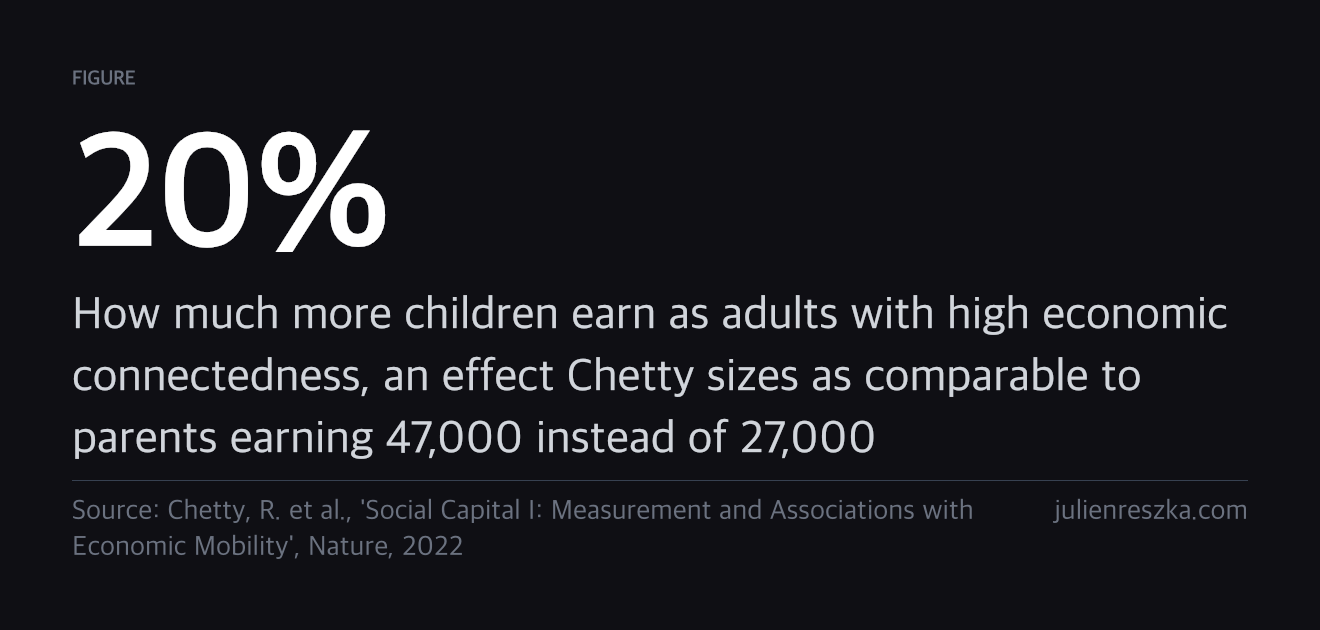
Children with high economic connectedness earn 20% more as adults, an effect comparable to parents earning $47K vs. $27K annually.
Weak ties (acquaintances) drive job mobility more than close contacts, confirmed by a 2022 LinkedIn experiment on 20 million users.
Networking advice often targets cohesion or volunteering, but these show no measurable link to upward mobility in the study.
THE READ
What the cluster adds up to.
A study led by economist Raj Chetty analyzed 21 billion Facebook friendships to quantify 'economic connectedness', the share of a person’s friends who earn more than they do. The data revealed that children growing up with high connectedness earn 20% more as adults, a gap comparable to the effect of parents earning $47,000 instead of $27,000. This effect outpaced other predictors like school quality or poverty rates, making it the strongest known factor for upward mobility. The findings suggest that who you know, not just what you know or how hard you work, shapes long-term career outcomes.
The study also dismantles common networking advice. High rates of volunteering or tight-knit community ties showed no meaningful link to economic mobility. Instead, weak ties, people you know casually but not well, emerged as the critical factor. A 2022 LinkedIn experiment on 20 million users confirmed this: algorithmic suggestions for weak ties increased job mobility more than close connections. For engineers, this implies that deliberate, low-effort networking (e.g., engaging with acquaintances at conferences or online) may yield better career returns than traditional relationship-building.
The data challenges the narrative that hard work alone determines success. While effort and luck play roles, they are less controllable than social networks. For example, fewer than 2% of low-income individuals’ friends are in the top 10% of earners, while 34% of high earners’ friends are also high earners. This disparity suggests that systemic barriers, not just individual effort, limit access to opportunity. Engineers may need to rethink how they allocate time, prioritizing strategic networking over grinding on skills or projects.
The study’s implications extend to hiring and team-building. If weak ties drive job mobility, companies might reconsider referral programs that favor close-knit networks, which can reinforce homogeneity. For individual engineers, the takeaway is clear: the next career opportunity is more likely to come from someone you barely know than from a mentor or a long workday. The cost of adopting this approach is low, an afternoon of targeted outreach, but the potential payoff is substantial.
Written by elseif from the cluster below · checked for specifics the sources never containedTHE CLUSTER