TECH Signal 285
Discarded SpaceX Falcon 9 stage creates 60-foot lunar crater after uncontrolled impact
 ↗
↗
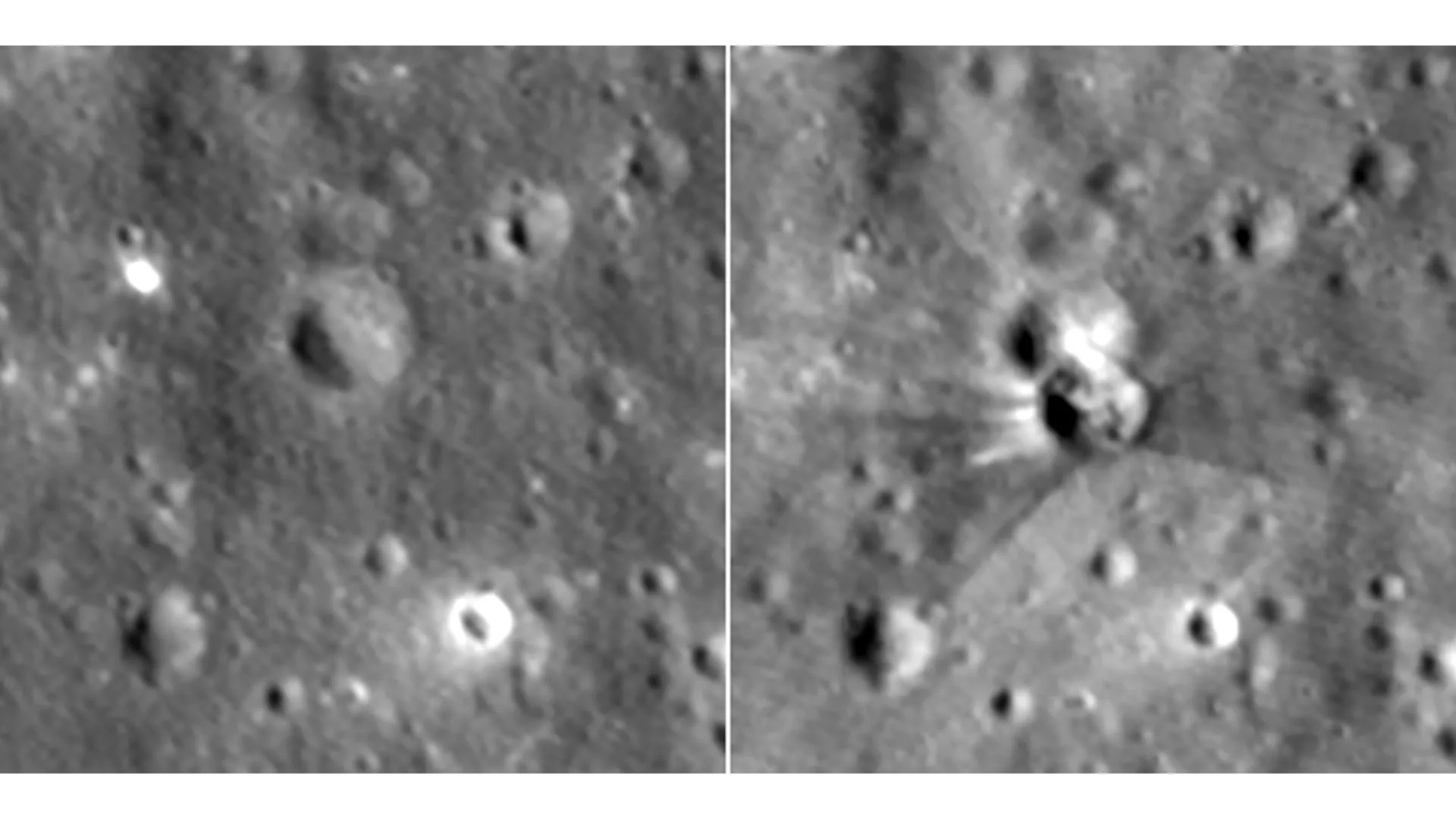
A spent SpaceX Falcon 9 upper stage crashed into the Moon, forming a 60-foot-wide crater visible in NASA’s Lunar Reconnaissance Orbiter images.
The event demonstrates the risks of uncontrolled space debris in cislunar space. It also provides a rare opportunity to study freshly exposed lunar material, which could inform future lunar missions and impact modeling.
Written by elseif from the cluster below · every claim links back to a sourceThe three things worth knowing
NASA’s Lunar Reconnaissance Orbiter captured images of a 60-foot crater formed by the impact of a discarded SpaceX Falcon 9 stage.
The collision exposed fresh lunar material, offering insights into the Moon’s subsurface composition.
International collaboration helped refine impact predictions and locate the crater with high precision.
THE READ
What the cluster adds up to.
A discarded SpaceX Falcon 9 upper stage, launched in January 2025 as part of the Firefly Blue Ghost 1 mission, struck the Moon on August 5. The impact created a crater approximately 60 feet wide and less than 10 feet deep, as measured by NASA’s Lunar Reconnaissance Orbiter (LRO). The event highlights the growing challenge of tracking and managing space debris, particularly in cislunar orbits where monitoring infrastructure is still developing. For engineers, this underscores the need for better end-of-life disposal strategies for rocket stages and satellites to avoid unintended collisions with celestial bodies or operational spacecraft.
The LRO’s imaging of the crater required precise timing and maneuvering, as the spacecraft orbits the Moon at roughly 1 mile per second. Engineers had to tilt the orbiter and wait for the Moon’s rotation to align the impact site within the camera’s field of view. The Narrow Angle Camera, capable of resolving features as small as 3 feet, captured the crater under varying lighting conditions to reveal details like the rim’s structure and debris streaks. This level of detail is valuable for planetary scientists studying impact dynamics, but it also serves as a case study for mission planners designing future lunar observations or debris avoidance protocols.
The impact exposed fresh lunar material, with bright and dark streaks of debris extending outward from the crater. The darker streaks consist of weathered surface material altered by solar wind and cosmic rays, while the brighter streaks reveal subsurface material excavated from depths of up to 1.5 feet. For engineers and researchers, this provides a natural experiment to study the Moon’s composition without the need for drilling. However, the uncontrolled nature of the impact also raises questions about the potential for similar events to interfere with planned lunar missions or surface operations.
Locating the crater involved international collaboration, including amateur astronomers, NASA’s Center for Near Earth Object Studies, and South Korea’s Danuri mission. The process tested impact prediction models, with NASA’s calculations proving accurate to within 0.6 miles. The Danuri orbiter’s high-resolution camera confirmed the location before passing the coordinates to NASA for further imaging. This cooperation demonstrates the importance of shared data and cross-agency coordination in space situational awareness. For engineers, it also highlights the need for standardized tracking and reporting systems to mitigate risks from uncontrolled objects in cislunar space.
Written by elseif from the cluster below · checked for specifics the sources never containedTHE CLUSTER