WEB Signal 142
Interactive web project draws a random human life from an estimated 100 billion people who have ever lived
 ↗
↗
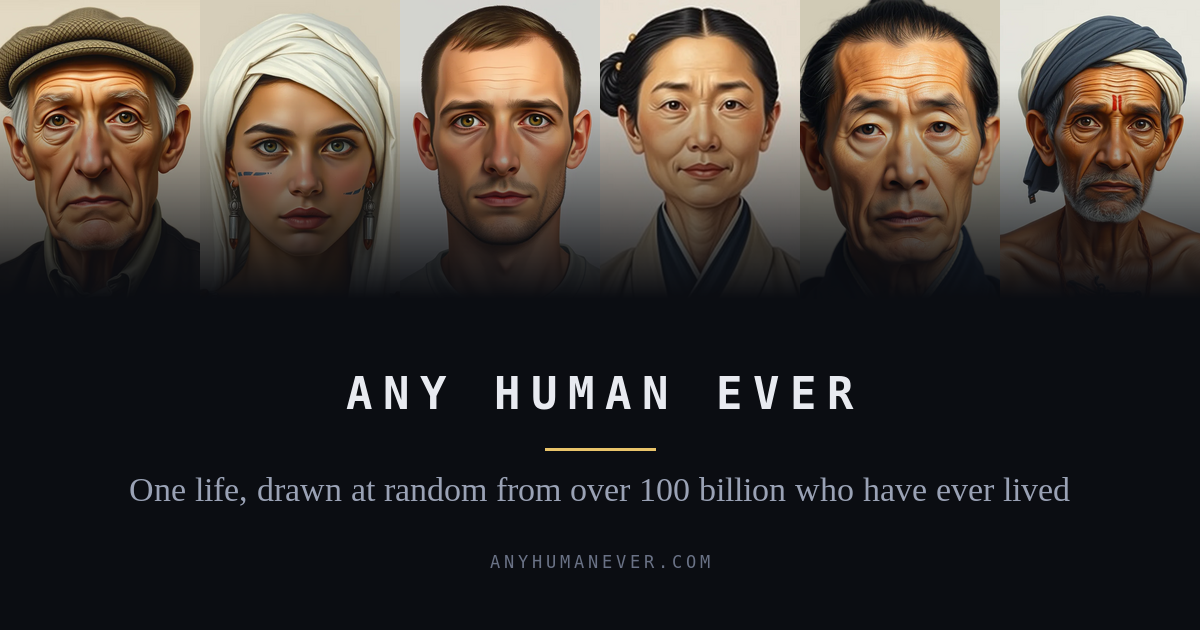
A web-based project called "Any Human Ever" lets users randomly select one life from all humans who have ever lived, generating a birth year, location, and story from real data.
The project uses population data to probabilistically reconstruct a plausible life, with birth years weighted toward the present due to exponential population growth. It is a single-feed story with no engineering detail on implementation, data sources, or methodology beyond what the interface exposes.
Written by elseif from the cluster below · every claim links back to a sourceThe three things worth knowing
The project estimates over 100 billion people have ever lived and draws one life at random from that population.
Birth year selection is weighted toward recent times because population grew exponentially, making a random birth more likely to fall near the present.
The interface steps through year, location, and life sequentially, each drawn from real data, with sources listed.
THE READ
What the cluster adds up to.
"Any Human Ever" is an interactive web project that selects a random human life from the estimated 100 billion-plus people who have ever lived. The interface walks the user through three stages: a birth year, a geographic location, and a life story, each drawn from real data. The project lists full sources for each generated story as well as all project sources, though the specific datasets are not named in the available material.
The birth-year selection is not uniform. The project notes that almost everyone who ever lived was born recently because population grew exponentially, so a random birth is far more likely to fall near the present. The interface offers both log and linear scale views of the year distribution, letting the user see why recent births dominate the sample space. This is the most substantive design decision visible in the material: the random draw is shaped by demographic reality rather than a flat prior across history.
Location selection uses a visual map where brighter clusters indicate higher historical population. The user draws a location, can redraw it, and then proceeds to a generated life story for that time and place. The material does not describe how stories are constructed, whether they are templated, procedurally generated, or drawn from specific historical records, so no claim can be made about the narrative engine.
This story appeared on a single feed (Hacker News) with no accompanying technical discussion in the provided material. There is no information about the tech stack, data pipeline, hosting, or performance characteristics. The project appears to be a browser-based experience, but nothing in the material confirms implementation details beyond the interactive draw-redraw-select interface.
For an engineer, the interesting aspects are the probabilistic modeling of birth-year selection and the use of population-density data to weight location draws. However, the material is too thin to assess data quality, sourcing rigor, or scalability. The project's value as an engineering artifact cannot be judged from what is available; it is primarily presented as an experiential web tool rather than a technical one.
Written by elseif from the cluster below · checked for specifics the sources never containedTHE CLUSTER