SECURITY Signal 389
Google open-sources an AI model it says can help with earlier hurricane warnings
 ↗
↗
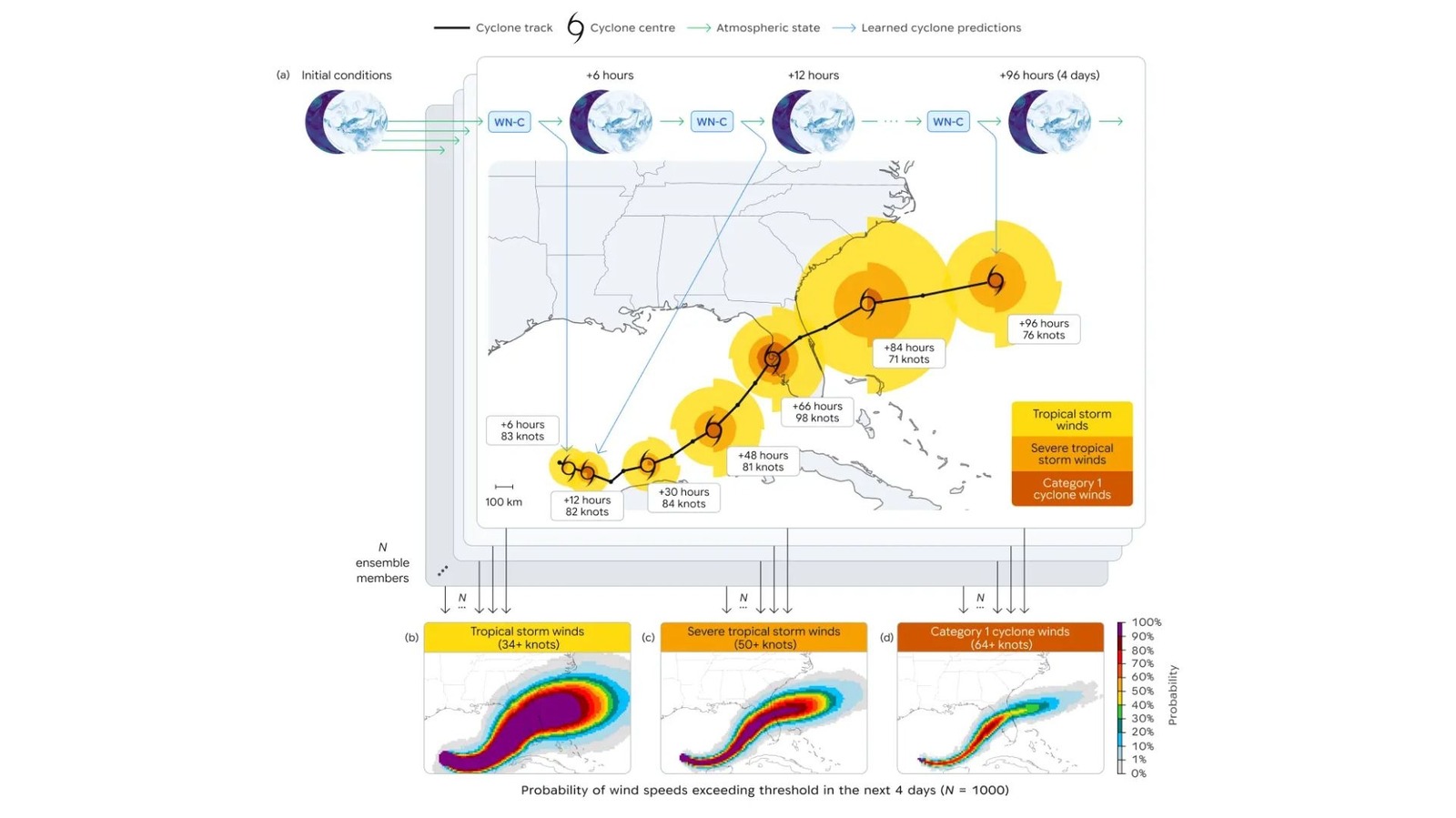
Google has released the WeatherNext AI model and its weights as open-source software for generating 15-day hurricane track and intensity forecasts.
The model can produce a full two-week forecast in under a minute on specialized hardware, giving forecasters a fast way to explore risk scenarios. Open-sourcing the code and weights lets other agencies and researchers integrate the model into their own pipelines without building it from scratch. Engineers will need to provision compatible accelerators and manage the data ingestion required to keep the model up to date.
Written by elseif from the cluster below · every claim links back to a sourceThe three things worth knowing
WeatherNext predicts both cyclone path and strength in a single 15-day run.
The model runs in under a minute on a tensor processing unit, enabling rapid scenario analysis.
All source code and trained weights are publicly available on GitHub.
THE READ
What the cluster adds up to.
Google’s DeepMind and research teams have made the WeatherNext model, along with its trained parameters, publicly accessible. The release includes the full training pipeline and inference code, allowing any organization to reproduce the 15-day forecasts that were previously demonstrated by the authors. By publishing both code and weights, the barrier to entry for advanced hurricane forecasting is lowered for weather agencies and academic groups. Engineers who adopt WeatherNext will need to allocate tensor-processing hardware or an equivalent accelerator to meet the sub-minute inference time reported. The model expects a large historical atmospheric dataset as input, so pipelines must be built to feed current observations and the 20-terabyte archive used during training. Integration will also involve handling the model’s output format, which provides probability distributions for track and intensity, rather than a single deterministic forecast. From a security perspective, the open-source nature introduces both opportunities and risks. While transparency enables independent verification of the model’s behavior, it also means that malicious actors could attempt to tamper with the c
Written by elseif from the cluster below · checked for specifics the sources never containedTHE CLUSTER