PERFORMANCE Signal 422
Cerebras Nexus rack triples performance and CS-6 wafer adds stacked DRAM for AI inference
 ↗
↗
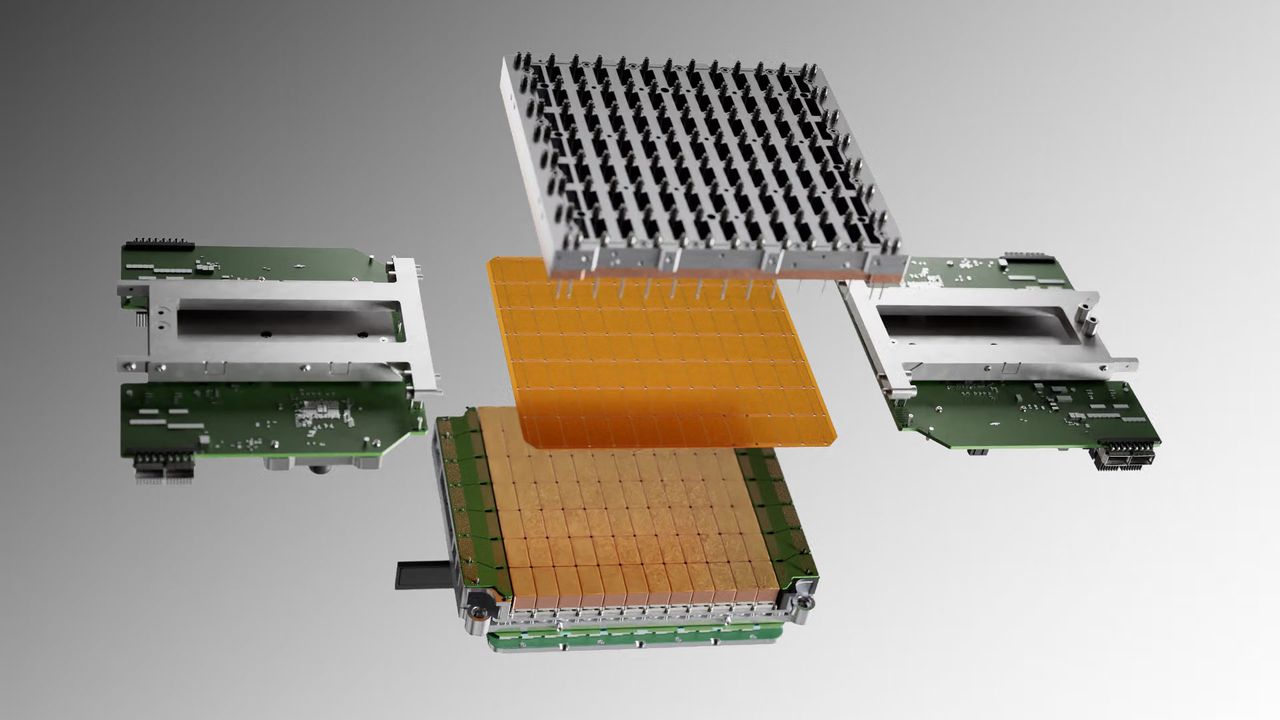
Cerebras unveiled its Nexus rack design for the CS-4 system and a roadmap for the CS-6 wafer-scale engine with stacked DRAM to address memory constraints in AI inference workloads.
Wafer-scale accelerators face unique scaling challenges due to fixed silicon area. Cerebras’ approach of stacking DRAM and modular rack design could redefine performance and upgradeability for high-throughput AI inference. Operators must weigh the trade-offs of specialized hardware against GPU-based alternatives.
Written by elseif from the cluster below · every claim links back to a sourceThe three things worth knowing
Nexus rack architecture triples rack-scale performance for Cerebras CS-4 systems by integrating three WS-3T wafer-scale engines in modular, swappable backpacks.
CS-6 wafer-scale engine will incorporate stacked DRAM to expand memory capacity without sacrificing logic area, targeting future AI inference demands.
Modular design allows independent upgrades of compute wafers and I/O modules, reducing cable complexity and improving redundancy in power delivery.
THE READ
What the cluster adds up to.
Cerebras’ Nexus rack design for the CS-4 system consolidates three WS-3T wafer-scale engines into self-contained backpack modules. This eliminates the need for thousands of external cables, replacing them with on-die interconnects and direct copper busbar power delivery. The vertical mounting of wafers removes traditional PCB substrates, reducing power loss and simplifying cooling. For operators, this means lower failure rates and easier maintenance, but the proprietary form factor locks them into Cerebras’ ecosystem for future upgrades.
The CS-6 wafer-scale engine introduces stacked DRAM as a solution to the memory constraints inherent in wafer-scale designs. Since the 300mm wafer area is fully utilized by logic and SRAM, adding more memory requires sacrificing compute or memory resources. Stacking DRAM on top of the wafer preserves logic area while increasing memory capacity, a critical advantage for AI inference workloads with large KV caches. However, 3D stacking introduces thermal and yield challenges that could limit scalability or increase costs.
Cerebras’ modular approach allows independent upgrades of compute wafers and I/O modules, a departure from monolithic GPU-based systems. The Nexus rack’s disaggregated I/O modules support RoCE v2 RDMA for interoperability, while power delivery units offer configurable redundancy. This flexibility reduces downtime for upgrades but may complicate integration with existing data center infrastructure. Operators must assess whether the performance gains justify the operational overhead of managing a non-standard architecture.
The performance claims, tripling rack-scale performance, highlight Cerebras’ focus on low-latency, high-throughput AI inference. This positions the company as a niche alternative to GPU-based systems, particularly for workloads like large language model serving. However, the lack of broader industry adoption means limited tooling and ecosystem support. Engineers evaluating Cerebras must consider whether the performance benefits outweigh the risks of vendor lock-in and potential supply chain constraints.
Written by elseif from the cluster below · checked for specifics the sources never containedTHE CLUSTER