PERFORMANCE Signal 425
JioHotstar Explains the Distributed Engineering Behind Personalized Ad Requests at Streaming Scale
 ↗
↗
JioHotstar published a technical overview of its distributed system that selects and serves personalized video ads in real time during streaming playback.
The note shows how a large-scale streaming service meets sub-100 ms latency while handling spikes of traffic, which is a common challenge for any real-time ad or recommendation engine. It also illustrates the combination of tiered decision logic, pacing algorithms, and robust service orchestration needed to keep video playback uninterrupted.
Written by elseif from the cluster below · every claim links back to a sourceThe three things worth knowing
A multi-stage ad decision pipeline uses waterfall tiering and pacing algorithms such as PID and SHALE to narrow thousands of candidates to a few ads within a strict latency budget.
Distributed services for inventory, metadata, tracking, and analytics are coordinated with caching and retry mechanisms to sustain reliability during high-concurrency events.
The architecture builds on OpenRTB standards but adds internal personalization and content-aware logic, requiring close collaboration between advertising, platform, and reliability teams.
THE READ
What elseif makes of it.
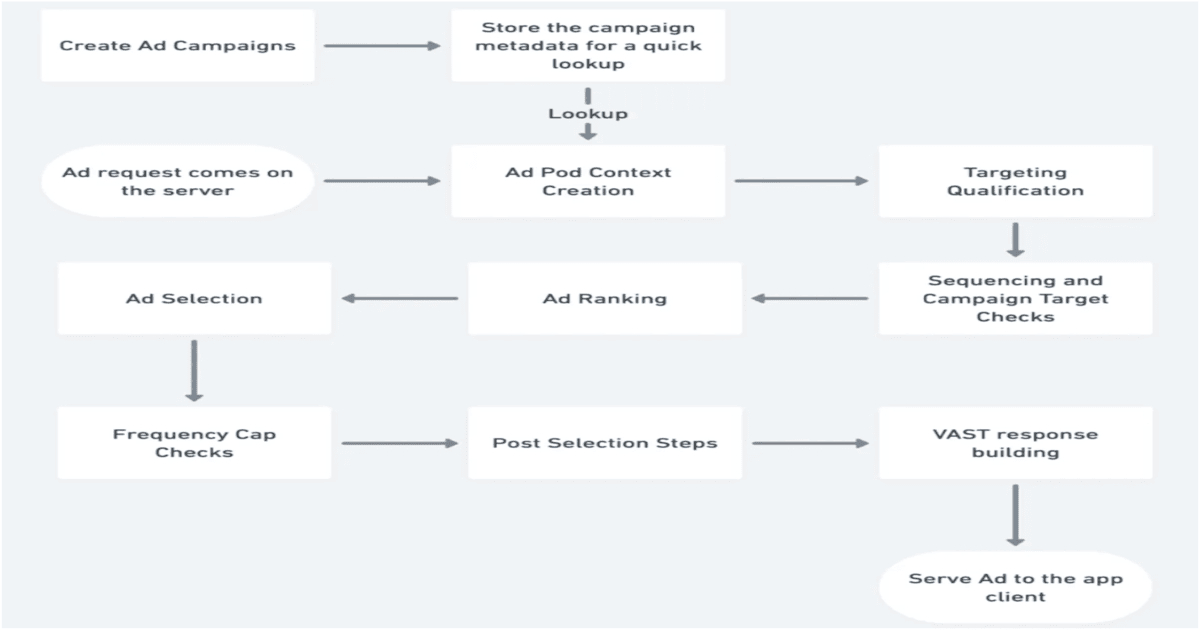
When a viewer reaches an ad break, the platform gathers content, user, device, and inventory data and forwards it through a chain of backend components. Each component contributes a piece of the decision, and the entire process must finish within roughly one hundred milliseconds to avoid disrupting playback. This latency target drives the need for tightly coupled, low-overhead communication between services.
The decision engine does not rely on a single lookup; instead it applies a waterfall tiering model that evaluates candidates in successive layers, combined with pacing controls like PID and SHALE. These controls balance campaign delivery goals, inventory limits, and advertiser constraints while selecting only a handful of ads for a typical thirty-second pod. The approach reduces the computational load per request while preserving targeting fidelity.
To keep the pipeline fast and reliable, the system employs extensive caching of static metadata and inventory snapshots, and it implements retry and fallback paths for transient failures. If an individual service degrades, the architecture can still return a valid ad response, preventing playback stalls. This fault-tolerant design is essential during traffic spikes such as live sports events.
While the platform adheres to the OpenRTB protocol for external bidding interactions, it layers additional internal services that inject content-aware targeting and business-specific decision rules. These extensions mean that a straightforward OpenRTB integration is insufficient for streaming contexts; engineers must design custom personalization layers that operate within the same latency envelope.
Adopting a similar stack would require building or extending multiple distributed services, implementing caching strategies, and integrating pacing algorithms tuned to campaign goals. Teams must also invest in observability and cross-functional processes to monitor health across the request path and to troubleshoot failures without affecting the viewer experience. The design may not translate directly to environments with looser latency constraints or different ad formats, where the overhead of tiered decisioning could outweigh its benefits.
Written by elseif from the cluster below · checked for specifics the sources never containedTHE CLUSTER