TECH Signal 255
MIT researchers engineer bacteria to act as transistors and build living circuit boards
 ↗
↗
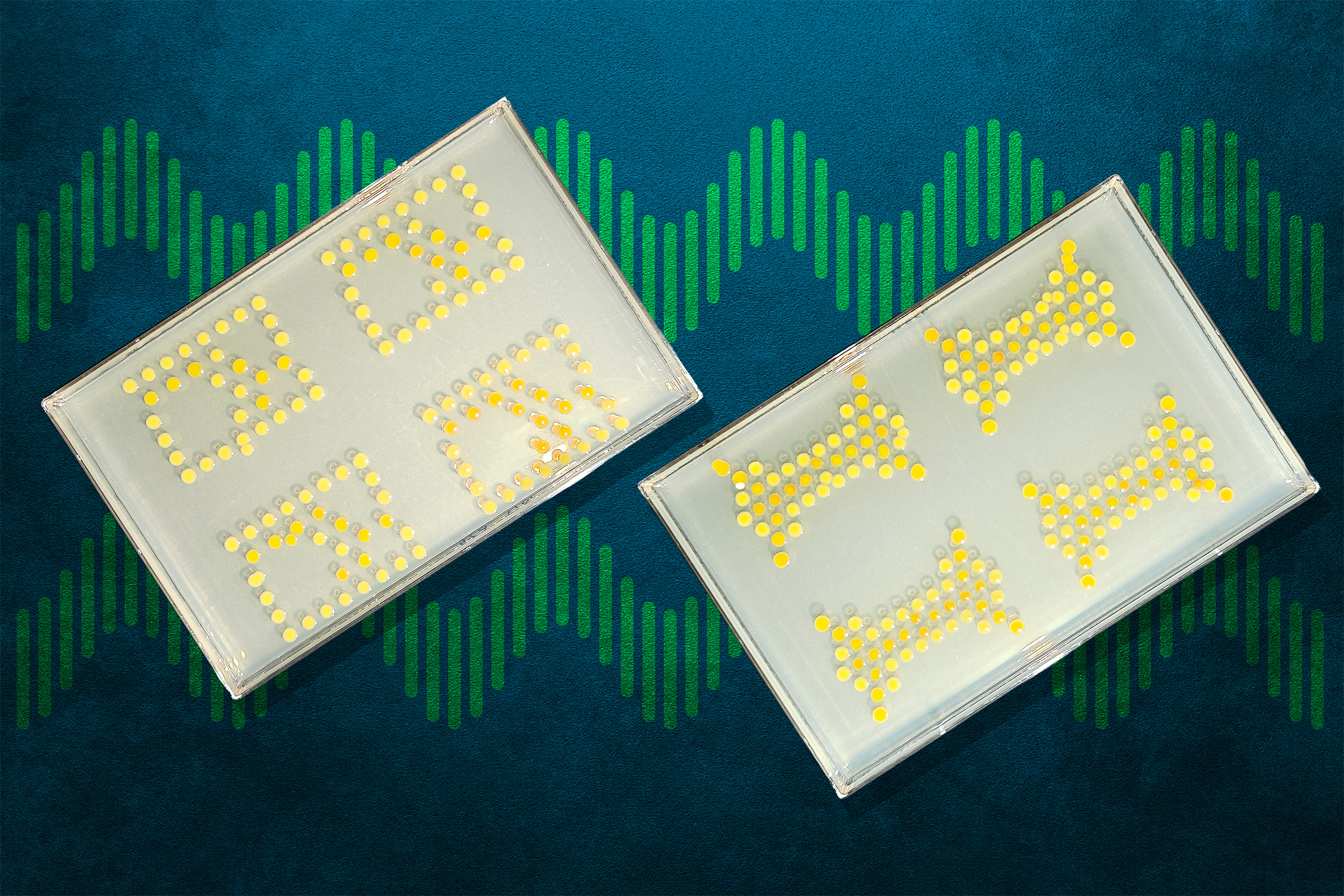
MIT researchers engineered five strains of Pantoea agglomerans bacteria to function as transistors and relays, allowing them to construct living circuit boards capable of performing logic operations.
Distributing circuit components across multiple bacterial cells avoids the complexity limits and cellular burden of engineering a single cell to perform an entire task. This approach provides modular building blocks for designing biological circuits that could eventually be printed onto plant surfaces to sense environmental conditions.
Written by elseif from the cluster below · every claim links back to a sourceThe three things worth knowing
MIT researchers created two types of bacterial transistors and three relay strains using Pantoea agglomerans.
The transistors use small molecules like OC-6 and OC-12 to control signal flow and produce an output molecule called OHC-14.
By wiring these strains together, the team built circuits that can perform calculations such as adding two or three inputs.
THE READ
What the cluster adds up to.
Traditional synthetic biology circuits place all logic components inside a single cell, which limits complexity due to a finite number of available transcription factors and the burden on protein production machinery. MIT researchers changed this by engineering individual bacterial cells to function as transistors, distributing the circuit across multiple cells. They designed two types of transistors and three relay strains using the bacterium Pantoea agglomerans. This provides a set of five modular strains that can be wired together to form living circuit boards.
The biological transistors operate by controlling the flow of small molecules instead of electrical current. The transistors are switched on or off by a molecule called OC-6 and detect the presence of OC-12 to produce an output molecule known as OHC-14. Three relay strains then translate the OHC-14 signal into an output that can be fed into downstream transistors. Using this approach, the team constructed circuits capable of adding two or three inputs or routing a signal to a specific location.
Adopting this architecture requires maintaining live bacterial cultures and supplying specific molecular inputs, restricting operations to environments where these cells can survive. The current work demonstrates initial computer architecture components, though the researchers state any operation can be built with these five strains. The system stops functioning if the growth medium or environmental conditions fail to support the Pantoea agglomerans bacteria.
The researchers aim to apply these living circuits to agricultural settings by printing them onto plant leaves or roots. In this deployment, the circuits could compute sensory data to detect and respond to environmental conditions such as drought or pest attacks. This represents a shift from isolated cellular logic to macroscopic biological computing surfaces.
Written by elseif from the cluster below · checked for specifics the sources never containedTHE CLUSTER