PERFORMANCE Signal 408
Benchmarking on modern systems reveals unpredictable performance variations despite deterministic workloads
 ↗
↗
A lecture on benchmarking highlights how complex modern systems introduce hidden variables that distort performance measurements even in seemingly deterministic workloads.
Engineers rely on benchmarks to optimize and validate performance, but modern systems introduce noise that can mislead conclusions. Ignoring these pitfalls risks basing decisions on flawed data, leading to suboptimal or incorrect optimizations. Understanding these limitations is critical for designing reliable benchmarks.
Written by elseif from the cluster below · every claim links back to a sourceThe three things worth knowing
Performance benchmarks on modern systems often show unexpected variations due to hidden factors like CPU core types, thermal throttling, or JIT compilation races.
Even deterministic workloads can produce inconsistent results across runs without changes to code or configuration.
Mitigating benchmark noise requires deliberate controls like thread pinning, fixed CPU frequencies, or statistical aggregation of multiple runs.
THE READ
What the cluster adds up to.
Modern computer systems introduce layers of complexity that complicate benchmarking. A seemingly deterministic workload, such as a Java-based payroll PDF generator, can exhibit performance variations across runs due to factors outside the benchmark’s control. These include differences in physical memory allocation, CPU core types (e.g., performance vs. efficiency cores), or thermal throttling. Such variability undermines the assumption that repeated runs of the same code will produce identical results, forcing engineers to treat performance as a distribution rather than a fixed value.
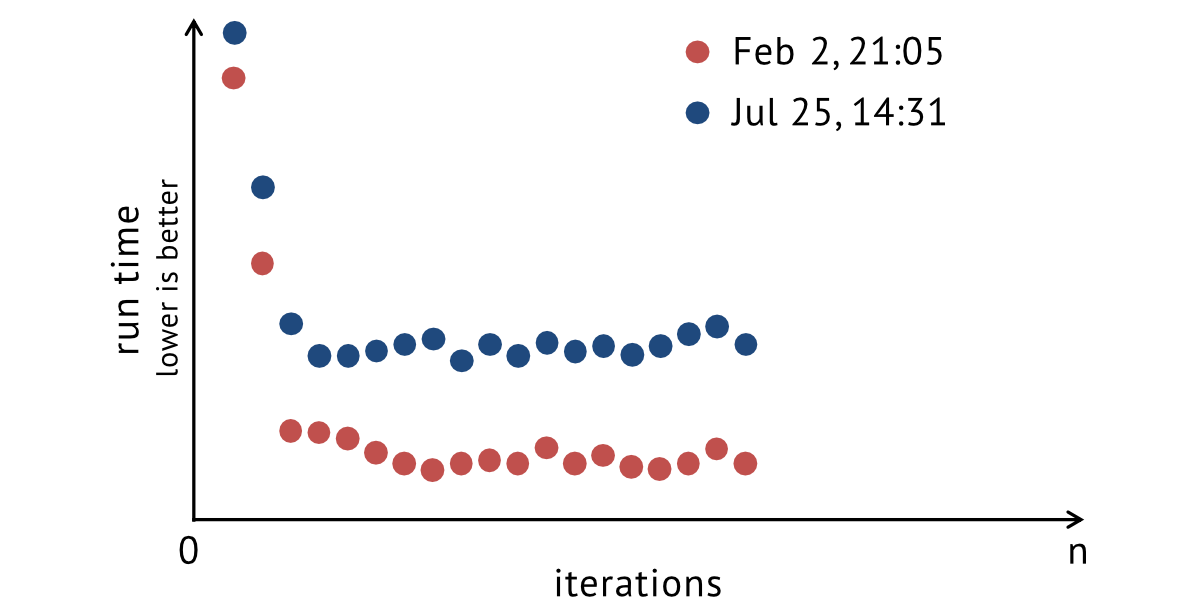
The role of just-in-time (JIT) compilation adds another layer of unpredictability. In the example, a Java benchmark showed performance improvements across iterations as the JIT compiler optimized the code. However, subsequent runs produced faster or slower results due to slight differences in profiling data collected by background compilation threads. This race condition means that even minor timing variations can lead to divergent optimization decisions, making it difficult to isolate the true performance characteristics of the workload.
Addressing these pitfalls requires tradeoffs in benchmark design. Engineers can mitigate noise by collecting data from many runs to characterize the performance distribution, but this approach may not always be practical. Alternatively, they can enforce strict controls, such as pinning threads to specific cores, disabling address space layout randomization, or fixing CPU frequencies. However, these measures may limit the benchmark’s realism or introduce new biases. The choice of methodology depends on whether the goal is to model real-world behavior or to isolate specific performance factors.
The lecture’s fictitious benchmark illustrates how easily performance artifacts can be misinterpreted. Without identifying the root cause of a slowdown or speedup, engineers risk drawing incorrect conclusions about their code or system. For example, attributing a performance drop to a code change when it was actually caused by thermal throttling could lead to wasted optimization efforts. This underscores the need for rigorous hypothesis testing and verification in benchmarking, rather than relying on initial assumptions or guesswork.
Written by elseif from the cluster below · checked for specifics the sources never containedTHE CLUSTER