PERFORMANCE Signal 447
Higher screen time from ages 1 to 8 linked to lower academic performance at age 9
 ↗
↗
Engineers designing children's educational apps should consider that increased screen exposure in early childhood correlates with poorer later academic outcomes.
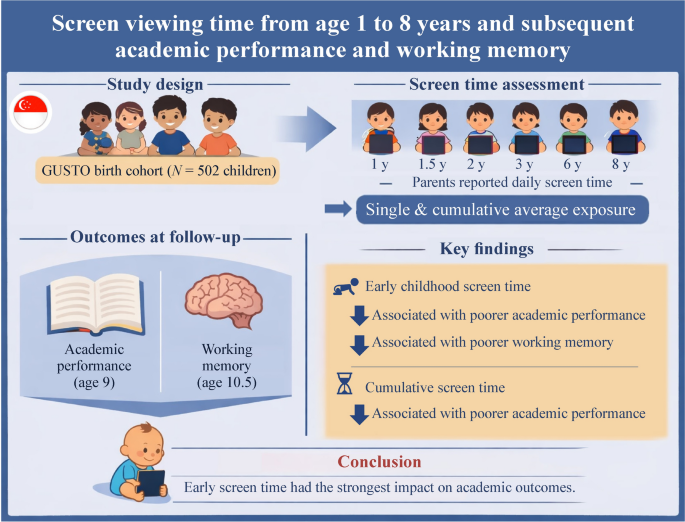
The study found that higher screen time at ages 1, 1.5, and 6 years predicts lower academic performance at age 9, and higher screen time at ages 1 and 6 predicts poorer working memory at age 10.5. For engineers building apps or devices used by young children, this indicates that features encouraging prolonged viewing may negatively affect later learning outcomes.
Written by elseif from the cluster below · every claim links back to a sourceThe three things worth knowing
Higher screen viewing time at ages 1, 1.5, and 6 years was associated with poorer academic performance at age 9 after adjusting for confounders.
Greater screen time at ages 1 and 6 years predicted lower working memory performance at age 10.5.
Cumulative average screen time across childhood was linked to lower academic performance but not to working memory.
THE READ
What the cluster adds up to.
The study tracked screen viewing reported by parents for children at ages 1, 1.5, 2, 3, 6, and 8 years in a Singapore birth cohort. At ages 9 and 10.5, psychologists measured academic performance and working memory using standardized tests. In unadjusted models, more screen time from age 1 to 8 years correlated with lower scores on both outcomes. After adjusting for confounding factors, the association remained significant for academic performance but was attenuated.
After adjustment, higher screen time at age 1 year showed the strongest link to poorer academic performance at age 9 (β =, 1.47). Similar, though weaker, associations were found at ages 1.5 years (β =, 0.95) and 6 years (β =, 0.88). No other ages retained a statistically significant relationship with academic performance in the adjusted model. These results suggest early infancy and mid-childhood are sensitive periods for screen exposure effects on learning.
For working memory at age 10.5 years, only screen time at ages 1 year (β =, 1.12) and 6 years (β =, 1.01) remained significant after adjustment. The cumulative average screen time across childhood was associated with lower academic performance but did not reach significance for working memory. Thus, while overall viewing time predicts academic outcomes, it does not appear to affect working memory in this sample. The effect sizes for working memory were smaller than those for academic performance.
Engineers creating apps or devices aimed at young children may need to embed usage-tracking or default limits to mitigate the identified risks, which adds development and maintenance overhead. The benefit of such limits is uncertain for working memory, as the study found no cumulative effect on that outcome. Moreover, the observed associations weakened after statistical adjustment, indicating that other family or environmental factors may explain part of the link. Consequently, any screen-time reduction strategy should be evaluated alongside broader contextual interventions to ensure it actually improves academic trajectories.
Written by elseif from the cluster below · checked for specifics the sources never containedTHE CLUSTER