SECURITY Signal 500
Show HN: Vibez – Open-Source Rust Based Digital Audio Workstation (DAW)
 ↗
↗
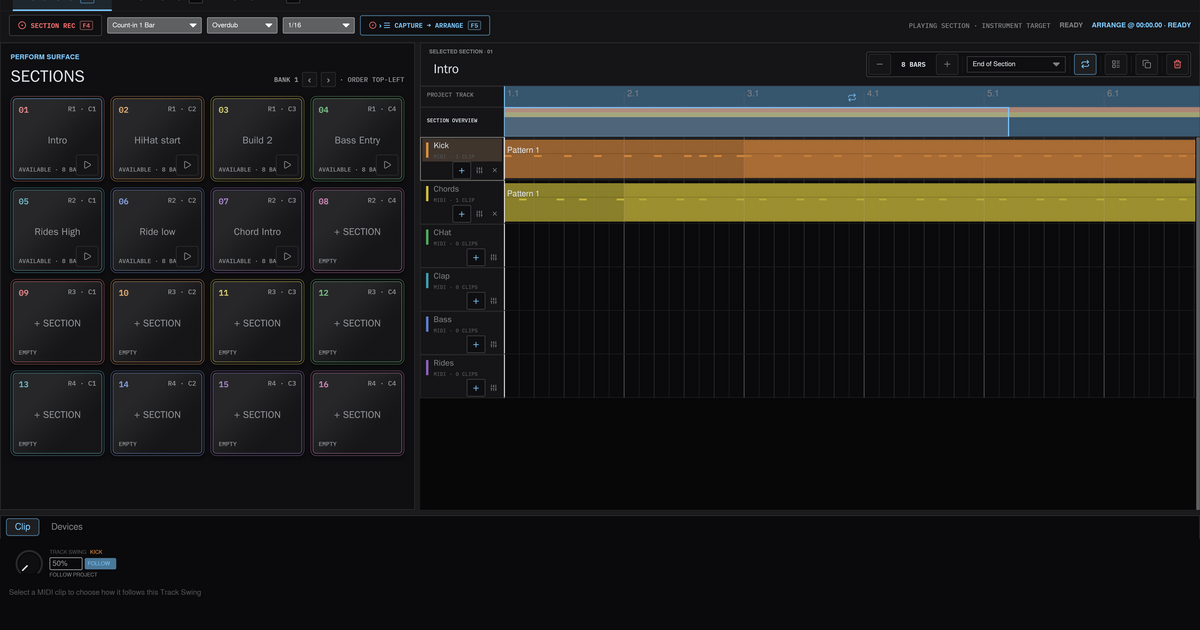
Vibez is an open-source digital audio workstation written in Rust that offers a three-workspace workflow for performing, arranging, and mixing audio.
For engineers building audio software, a Rust-based DAW demonstrates how memory-safe systems programming can be applied to low-latency, real-time audio processing. The project’s cross-platform releases and open source license invite contributions that could improve plugin compatibility and tooling. However, because the announcement appears in only one feed, engineers should treat the claims as preliminary until further community feedback or independent reviews surface.
Written by elseif from the cluster below · every claim links back to a sourceThe three things worth knowing
The DAW separates work into Perform (pad-grid playback), Arrange (linear timeline editing), and Mix (console-style channel processing).
It captures live performances as editable clips without retaining references to the original sections, allowing later arrangement changes to not affect recorded takes.
Keyboard shortcuts are platform-aware, using Ctrl on Linux/Windows and Cmd on macOS, and the pad grid is rebindable for custom workflows.
THE READ
What the cluster adds up to.
Vibez introduces a Rust implementation of a full-featured DAW, which is notable because audio processing traditionally relies on C/C++ for deterministic timing and low overhead. Engineers evaluating the project can see how Rust’s ownership model and zero-cost abstractions are applied to real-time audio threads, potentially reducing bugs such as buffer overruns or use-after-free errors. The source being hosted on GitHub invites inspection of the audio engine, threading model, and plugin host implementation.
The three-workspace design mirrors common hardware-based workflows (performance pads, linear arranger, analog-style mixer) but translates them into a single application. This could reduce the learning curve for engineers who need to prototype audio effects or instrument plugins, as they can test changes directly within the DAW’s Arrange and Mix views without external hosting. The capture feature, which writes performances as ordinary clips, means that automation and MIDI data become first-class editable objects, simplifying downstream processing.
Adoption costs include learning the specific keybindings and workflow concepts (Sections, Capture, anti-click ramp) that differ from mainstream DAWs. Engineers must also consider the maturity of the plugin host: Vibez supports VST3 and CLAP plugins with native interfaces, but the stability and performance of those bridges depend on the underlying Rust bindings, which may still be evolving. Cross-platform support (Linux, macOS, Windows) is claimed, yet engineers should verify real-time audio performance on each target OS, especially regarding driver latency and scheduler guarantees.
Because the only source of information is a single Hacker News post, there is no independent corroboration of claims such as latency measurements, CPU usage, or bug rates. Engineers should treat the project as an experimental prototype until community testing, benchmark reports, or third-party reviews appear. The lack of multiple feeds also means that any potential security or licensing concerns have not been widely examined, so due diligence is required before integrating Vibez into a production audio pipeline.
In summary, Vibez offers a concrete example of how Rust can be used to build a complex, real-time audio application, providing a useful reference for engineers interested in safe systems programming for audio. Its modular workspace approach may streamline internal tooling for plugin development, but the early-stage nature of the project warrants cautious evaluation, particularly regarding performance guarantees and long-term maintenance.
Written by elseif from the cluster below · checked for specifics the sources never containedTHE CLUSTER