PERFORMANCE Signal 545 2 feeds carried it
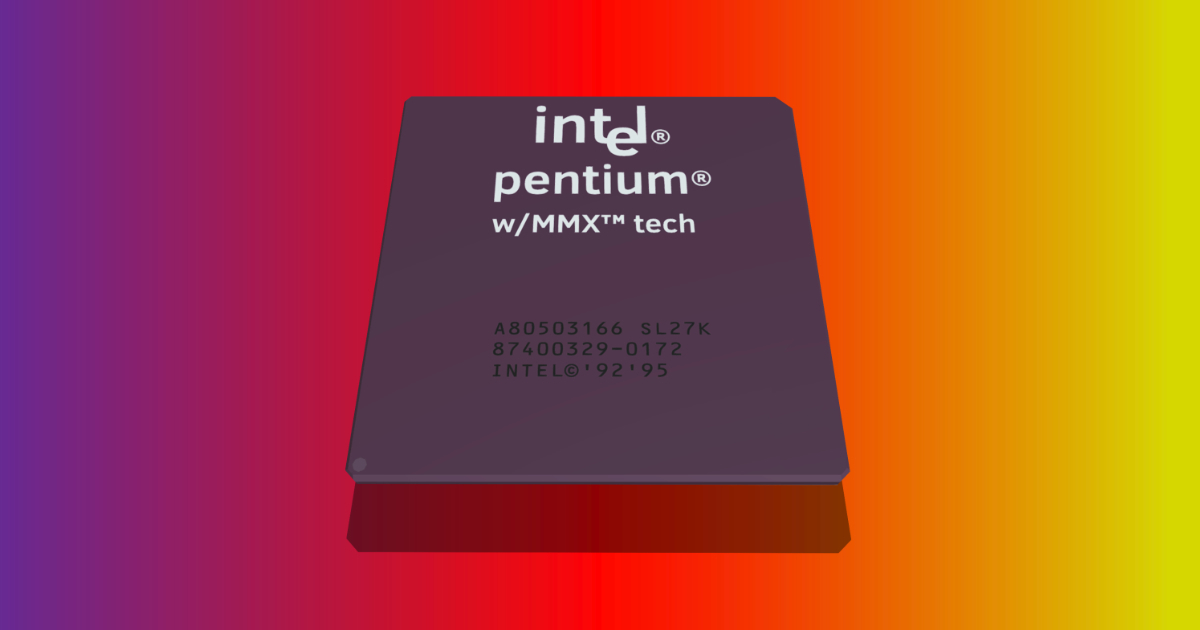
Intel Pentium MMX introduced SIMD to mainstream x86 PCs in 1997 with 57 new instructions
 ↗
↗
Intel’s Pentium MMX added 57 SIMD instructions to x86 in 1997, enabling parallel integer operations on 64-bit registers for multimedia workloads.
MMX marked the first widespread adoption of SIMD on consumer hardware, shaping modern CPU design. Engineers today rely on its successors (SSE, AVX) for performance-critical code, but MMX’s constraints reveal trade-offs in early SIMD implementations.
Written by elseif from the cluster below · every claim links back to a sourceThe three things worth knowing
MMX provided 57 new x86 instructions for parallel integer operations on 64-bit packed data.
The technology repurposed floating-point registers, requiring mode switches that limited flexibility.
While not the first SIMD architecture, MMX popularized the concept for desktop PCs, influencing later extensions.
THE READ
What the cluster adds up to.
Intel’s Pentium MMX introduced SIMD to mainstream x86 processors in 1997 through 57 new instructions. These instructions allowed parallel operations on 64-bit registers, enabling simultaneous processing of multiple integer values. The design targeted multimedia workloads like image processing, audio mixing, and video playback, where repetitive arithmetic on small data types (e.g., 8-bit pixels) was common. By packing eight 8-bit integers into a single register, MMX could execute a single instruction across all values, reducing instruction count and improving throughput. This was a departure from scalar x86 code, which processed one value at a time.
The implementation had significant limitations. MMX repurposed the first 64 bits of the x87 floating-point registers, requiring a mode switch to toggle between MMX and floating-point operations. This shared register file created a bottleneck: code mixing MMX and floating-point instructions incurred overhead from frequent mode changes. Additionally, MMX only supported integer operations, leaving floating-point parallelism to later extensions like SSE. The 64-bit register width also constrained performance gains compared to modern 256-bit or 512-bit SIMD registers. These trade-offs reflected the era’s hardware constraints and the need for backward compatibility with existing x86 software.
MMX’s legacy lies in its role as a catalyst for SIMD adoption on consumer hardware. While earlier systems like the ILLIAC IV or Cray-1 supercomputers used similar parallel processing techniques, they were niche or specialized. MMX brought SIMD to millions of PCs, forcing developers to grapple with vectorization for the first time. The instruction set’s quirks, such as the register sharing and integer-only support, highlight the challenges of retrofitting parallelism into a scalar architecture. Later extensions (SSE, AVX) addressed these limitations, but MMX’s design choices still echo in modern SIMD programming, where register widths and instruction sets remain critical performance factors.
Written by elseif from the cluster below · checked for specifics the sources never containedTHE CLUSTER