PERFORMANCE Signal 353
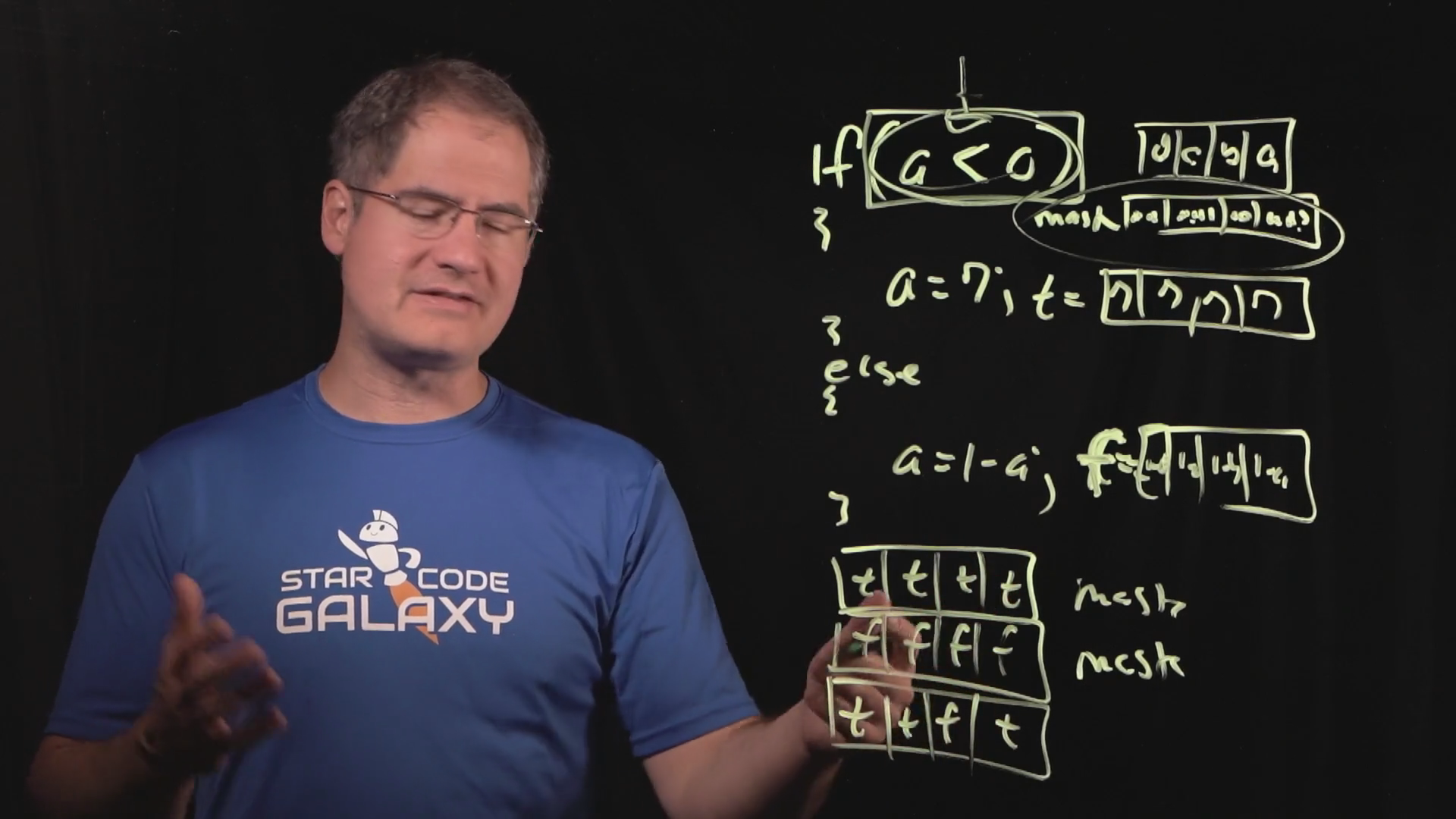
SIMD masking technique merges divergent if-else results in parallel execution
 ↗
↗
A performance-aware programming method uses SIMD masking to combine outcomes from both branches of a conditional without branching penalties
Conditional logic in SIMD pipelines typically forces serial execution of branches, hurting throughput. This approach avoids divergence by computing both paths and merging results, which matters for engineers optimizing data-parallel workloads. The trade-off is increased computation for reduced pipeline stalls
Written by elseif from the cluster below · every claim links back to a sourceThe three things worth knowing
SIMD masking computes both if and else branches in parallel and merges results using bitwise operations
The technique eliminates branch misprediction penalties but increases total instruction count
Applicability depends on branch frequency and the cost of redundant computation versus pipeline stalls
THE READ
What the cluster adds up to.
SIMD masking addresses a fundamental limitation in data-parallel execution: conditional divergence. Traditional SIMD implementations must either serialize branch paths or use predication that still incurs pipeline bubbles. This method instead executes both sides of an if-else unconditionally, then combines the results using a mask derived from the original condition. The mask acts as a bitwise selector, preserving only the correct results for each data lane.
The performance trade-off is immediate: every conditional now executes both branches, doubling the computational work for that section. However, the benefit comes from eliminating branch misprediction penalties and avoiding pipeline flushes. For workloads with frequent but predictable branches, the redundant computation may be cheaper than the latency of mispredictions. The break-even point depends on the branch's predictability and the SIMD width of the target architecture.
Implementation requires careful handling of side effects. Since both branches execute, any memory writes or state changes must be masked or deferred until after the merge. This constraint limits the technique to pure computations or those with commutative operations. Additionally, the mask generation itself adds overhead, which may negate gains on architectures with poor bitwise operation throughput. Engineers must profile both the original branching code and the masked version to determine which performs better for their specific workload.
The technique's effectiveness also varies with data patterns. For branches that are highly data-dependent or exhibit poor locality, the redundant computation may dominate runtime. Conversely, for branches that are mostly uniform across SIMD lanes, masking can approach the performance of unconditional code. The method is most valuable in domains like image processing or scientific computing, where data-parallel operations frequently encounter conditionals but can tolerate redundant computation.
Written by elseif from the cluster below · checked for specifics the sources never containedTHE CLUSTER