WEB Signal 176
Browser Use updates to allow models to choose observations and actions via CDP
 ↗
↗
Comments
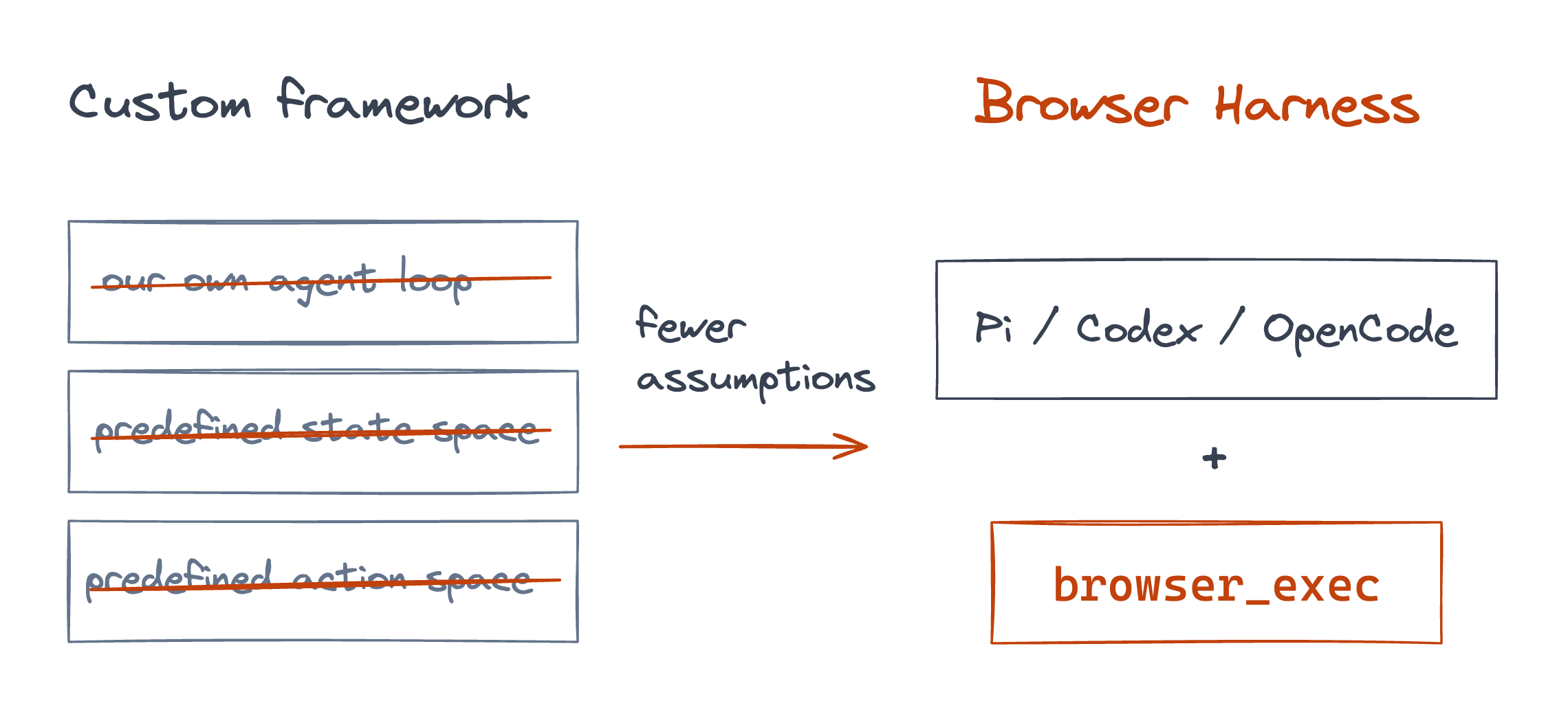
The update to Browser Use enhances the capability of models to interact with web pages by allowing them to determine their own observations and actions. This shift reduces the reliance on predefined states, which can miss critical elements on a page. It also simplifies the browser automation process, potentially improving efficiency and accuracy in web interactions.
Written by elseif from the cluster below · every claim links back to a sourceThe three things worth knowing
Models can now write their own observations instead of relying on predefined states.
Direct access to the Chrome DevTools Protocol (CDP) allows for more flexible and comprehensive page interactions.
The update aims to address limitations of prior frameworks by letting models make decisions based on real-time page states.
THE READ
What the cluster adds up to.
The update to Browser Use marks a significant shift in how models interact with web pages, moving from a fixed set of actions and observations to a more dynamic approach. By allowing models to write their own observations, this change enhances their ability to adapt to different page structures and elements more effectively than before.
The cost of adopting this new method involves implementing the necessary infrastructure to enable direct access to CDP. Teams will need to ensure that their models are capable of leveraging this flexibility, which could require additional training and testing to optimize performance. However, the potential for improved automation efficiency could justify these initial investments.
This approach stops working in scenarios where the CDP cannot provide necessary data, or if the model fails to interpret the page structure correctly. While this method removes some limitations, it also introduces new dependencies on the model's understanding of DOM structures and the ability to generate effective queries.
The decision to use CDP over alternatives like Playwright is notable, as it allows for deeper access to browser functionalities without the constraints imposed by higher-level APIs. This choice emphasizes the importance of direct control when building automation tools that need to interact with complex web elements, such as closed shadow roots.
Overall, the bitter lesson learned is the importance of flexibility in agent design. This new direction encourages ongoing evaluation of how agents interact with browsers, suggesting that as models evolve, so too should the frameworks and interfaces that support them.
Written by elseif from the cluster below · checked for specifics the sources never containedTHE CLUSTER