TECH Signal 282
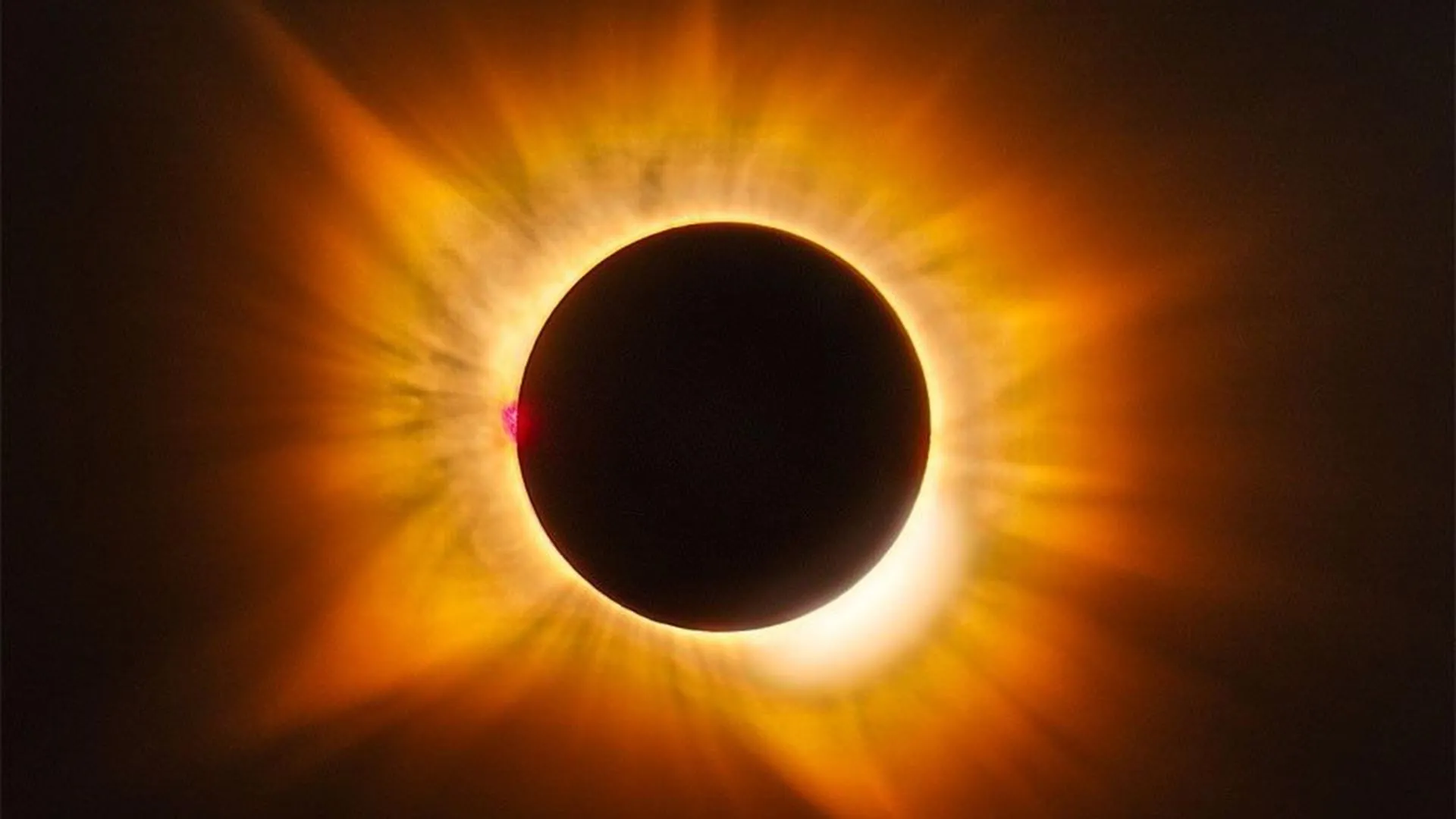
Spain’s total solar eclipse corona appeared golden due to sunset and wildfire smoke filtering
 ↗
↗
A total solar eclipse in Spain displayed a golden corona instead of the usual white, caused by atmospheric scattering and wildfire smoke during sunset.
This event highlights how environmental conditions can alter observational data for engineers working on solar imaging or atmospheric modeling. Understanding these effects is critical for calibrating instruments and interpreting eclipse observations accurately.
Written by elseif from the cluster below · every claim links back to a sourceThe three things worth knowing
The eclipse’s golden hue resulted from sunlight passing through more atmosphere at sunset, scattering blue light.
Wildfire smoke intensified the effect by further filtering blue wavelengths, enhancing the golden tones.
A bright pink solar prominence remained visible, contrasting with the golden corona due to hydrogen emission
THE READ
What the cluster adds up to.
The total solar eclipse in Spain deviated from the typical visual experience due to two key environmental factors. First, the eclipse occurred near sunset, forcing sunlight to traverse a longer path through Earth’s atmosphere. This increased scattering of shorter (blue) wavelengths, leaving predominantly warmer tones. Second, smoke from nearby wildfires acted as an additional filter, removing even more blue light and amplifying the golden appearance of the corona. For engineers, this underscores how atmospheric conditions can distort observational data, particularly in fields like solar imaging or remote sensing.
The golden corona was not uniform; a bright pink solar prominence remained visible along the Sun’s edge. This prominence, composed of hydrogen plasma, emitted light at wavelengths less affected by atmospheric scattering. The contrast between the golden corona and the pink prominence demonstrates how different light sources interact with environmental filters. Engineers designing optical systems or analyzing eclipse data must account for such variations to avoid misinterpreting results or calibrating instruments incorrectly.
High dynamic range (HDR) imaging was used to capture the eclipse’s details, preserving both bright and faint features in a single frame. While HDR is a powerful tool for visualizing extreme contrasts, it also introduces potential artifacts if not properly calibrated. The reliance on HDR in this case highlights the importance of post-processing techniques in observational astronomy. Engineers working with similar data must ensure their methods accurately represent the physical phenomena, rather than introducing distortions from processing.
The event serves as a reminder that environmental factors, such as air quality, altitude, and time of day, can significantly alter the appearance of celestial events. For engineers involved in solar research or atmospheric studies, this eclipse provides a real-world example of how transient conditions can impact data collection. It also emphasizes the need for contextual awareness when analyzing observations, as external variables may introduce unexpected biases or anomalies.
Written by elseif from the cluster below · checked for specifics the sources never containedTHE CLUSTER