TECH Signal 498
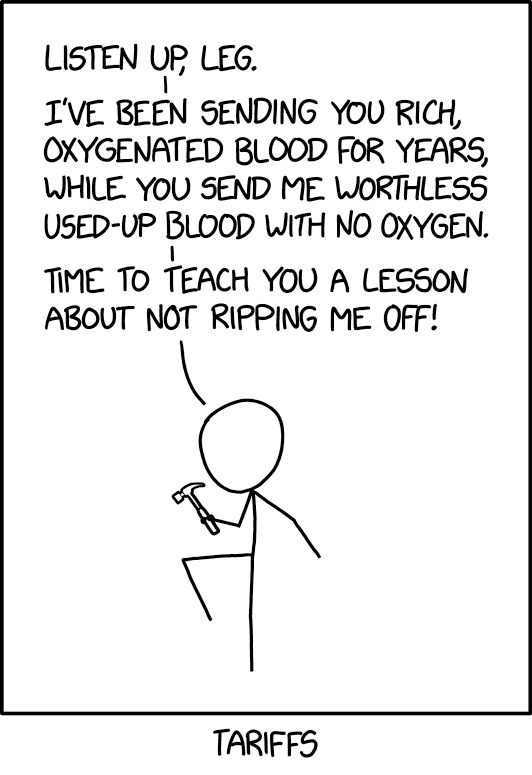
xkcd webcomic illustrates trade and tariff mechanics through simplified economic model
 ↗
↗
xkcd comic 3290 uses a visual analogy to explain how trade and tariffs affect resource distribution and efficiency
The comic provides engineers with an accessible mental model for trade policy impacts. While oversimplified, it highlights how tariffs can create inefficiencies in resource allocation. This visualization may help technical teams communicate economic concepts to non-specialist stakeholders.
Written by elseif from the cluster below · every claim links back to a sourceThe three things worth knowing
Comic uses physical resource flows to represent trade between entities
Tariffs are depicted as artificial barriers that disrupt optimal distribution
Model demonstrates how protectionist policies can create local surpluses and shortages
THE READ
What the cluster adds up to.
The xkcd comic presents trade and tariffs through a mechanical analogy where resources flow between entities like water through pipes. This visualization strips away financial abstractions to show how trade creates efficient distribution when unimpeded. The model demonstrates how each entity naturally produces what it's best at, creating a balanced system where all participants benefit from specialization.
When tariffs are introduced in the comic, they appear as physical barriers that restrict these flows. The visualization shows how these barriers create artificial scarcity in some areas while causing surpluses in others. This mirrors real-world economic effects where protectionist policies can lead to inefficient resource allocation, though the comic's model necessarily simplifies complex market dynamics that engineers would recognize from systems design.
The comic's strength lies in its ability to communicate economic principles without jargon. For engineers accustomed to thinking in terms of systems and flows, this representation may provide intuitive understanding of trade mechanics. However, the model omits important real-world factors like currency fluctuations, labor mobility, and political considerations that would affect actual policy outcomes.
While not a rigorous economic analysis, the comic serves as a useful conversation starter about trade policy. Technical teams might use this visualization to explain trade concepts to colleagues in non-economic roles. The model's limitations also create opportunities to discuss where simple analogies break down when applied to complex global trade systems.
Written by elseif from the cluster below · checked for specifics the sources never containedTHE CLUSTER